Dr Shivam Kotecha details a case combining aligner orthodontics and injection-moulded composite veneers to rehabilitate worn anterior teeth.
A 41-year-old female patient presented with concerns about the alignment, colour and overall appearance of her upper anterior teeth. Over time she had noticed increasing wear and felt her smile no longer reflected how she wanted to look.
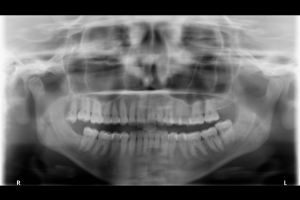
The patient had previously undergone orthodontic treatment during her teenage years and her UL8 and LR8 had been extracted. The orthodontics had initially improved alignment, minor relapse and progressive tooth wear meant the anterior teeth had gradually lost their symmetry and aesthetic harmony.
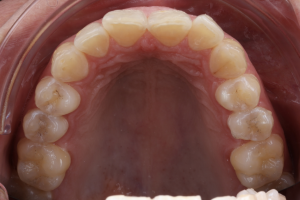
Close Examination
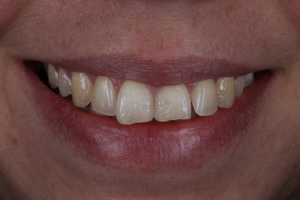
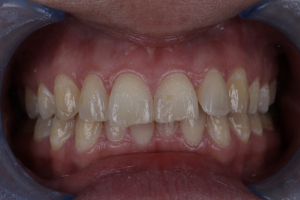
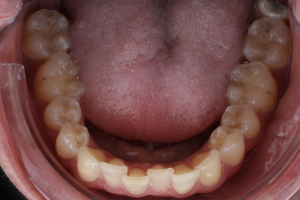
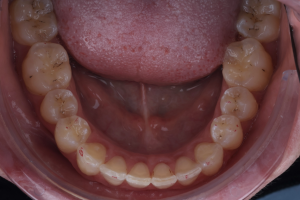
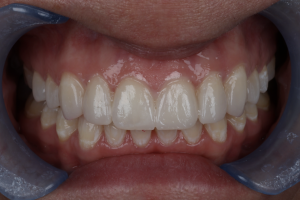
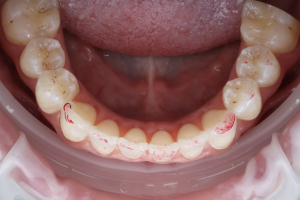
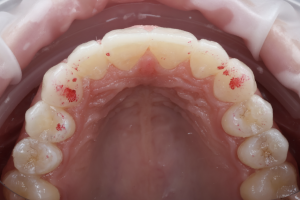
A clinical examination revealed a Class I incisor relationship, however the anterior dentition showed signs of wear, including incisal chipping, a reduced overjet and mild to moderate anterior crowding with contact displacement. The right molar relationship was Class I, while the left was a half-unit Class III.
Medically, the patient was fit and well, a non-smoker and did not consume alcohol. Within the dentition, there was clear evidence of multifactorial tooth surface loss. The upper anterior teeth demonstrated labial erosive wear alongside localised anterior attrition. Caries was present on the UR8 and LL8 which were both unopposed.
Periodontal health was reassuringly good, with a maximum Basic Periodontal Examination score of 1. The patient reported brushing twice daily with an electric toothbrush and flossing several times per week, providing a stable foundation for treatment.
The treatment objectives were centred around addressing the following:
- Caries affecting the UR8 and LL8
- Anterior crowding and reduced overjet
- Worn and chipped incisal edges
- Labial erosive wear and compromised surface texture of the upper anterior teeth
- Tooth shade concerns
- Uneven gingival zeniths
Viewed as a whole, the case called for more than a purely restorative solution. Improving alignment first would create a more favourable foundation for the restorative phase, allowing a more predictable and conservative outcome.
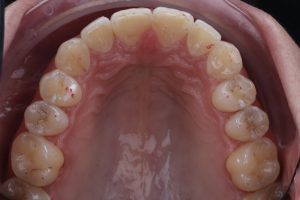
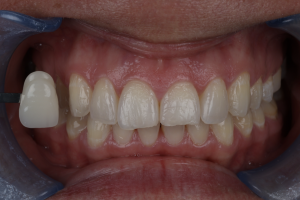
Treatment Planning
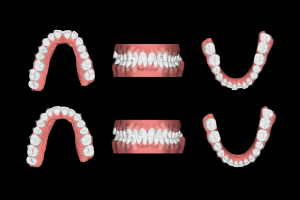
Several treatment options were discussed with the patient. For the orthodontic stage, both fixed appliances and clear aligner therapy were considered. However, like many adult patients, she was keen for a more discreet option that would fit comfortably around day-to-day life. Clear aligner therapy was therefore selected.
Tooth whitening was planned prior to restoration to establish a brighter baseline shade and allow the restorative materials to be matched more predictably.
For the restorative phase, both composite and ceramic options were considered. While ceramic restorations can provide excellent aesthetics and durability, they involve a higher biological and financial cost. Given the additive nature of the corrections required and the patient’s age, direct composite restorations were considered the most appropriate approach at this stage.
Maintenance expectations for this modality were discussed from the outset, highlighting that periodic polishing, minor repairs and occasional whitening may be required to maintain aesthetics over time.
Orthodontic Stage
The UR8 was considered for restoration but, given its non-functional position, buccal placement and poor cleansability, was ultimately extracted. The LL8 caries was managed with a composite restoration.
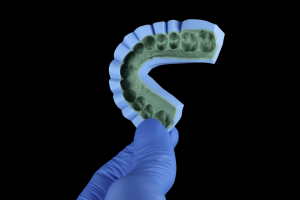
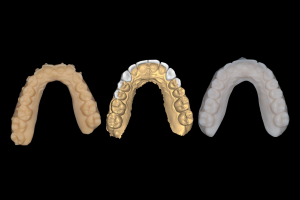
Alignment was carried out using 32Co aligners fabricated from Zendura FLX with a straight finish line. The initial series consisted of 13 aligners, changed every 14 days. A refinement stage followed with eight additional aligners changed every 10 days, bringing the total to 21 aligners.
One of the advantages of using 32Co is their DUO planning service, which allows clinicians to plan cases alongside a specialist orthodontist. In this case, treatment planning was carried out collaboratively with Dr Samir Farmahan, helping to ensure the movements were clearly defined and progressed predictably.
The orthodontic phase itself progressed smoothly, with excellent patient compliance throughout.
Whitening
Once alignment had been achieved, attention turned to establishing the final tooth shade prior to restoration.
The patient completed a course of Boutique Whitening, beginning with 10% carbamide peroxide worn overnight for two weeks, followed by 16% carbamide peroxide for a further two weeks. The patient was highly compliant throughout and a stable B1 shade was achieved, providing an ideal foundation for the restorative phase.
Restorative Planning
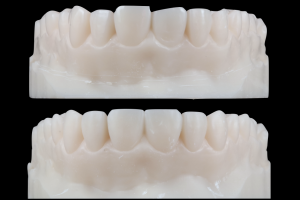
Digital scans of the patient’s dentition were sent to Majestic Smile, where the restorative planning and diagnostic wax-up were carried out by Lino Adolf.
The initial plan focused on restoring UR5-UL4. However, following mock-up evaluation this was extended to include UL5. The additional tooth was incorporated not to increase labial volume, but to improve surface texture and achieve better aesthetic integration across the smile.
A mock-up was fabricated using DMG Luxatemp bis-acryl in shade B1, allowing assessment of incisal length, smile arc, gingival zenith harmony, phonetics and overall aesthetic integration, while also giving the patient an opportunity to visualise the proposed outcome.
Injection Moulding Workflow
Following approval of the mock-up, the definitive restorations were carried out using an injection moulding composite technique, following protocols popularised through the Dentinal Tubules GUI Fellas series by Dr Kostas Karagiannopoulos and Dr Zohaib Ali.
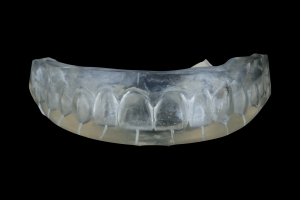
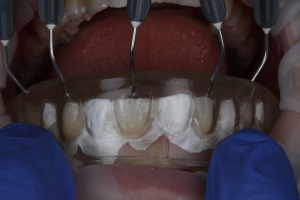
The UR5-UL5 were restored using Gænial Universal Injectable composite (shade B1). GC Exaclear stents were fabricated from the diagnostic wax-up by the laboratory, with venting holes created chairside to allow controlled composite flow during injection.
Surface preparation was intentionally minimal, limited to 27µm aluminium oxide air abrasion. An Optragate (Ivoclar) was used to retract the soft tissues and provide a clear working field, while PTFE tape was used to isolate alternating teeth.
An adhesive protocol of 37% phosphoric acid etching, Clearfil Universal Bond Quick 2 and GC Gænial Universal Injectable (shade B1) was followed. The composite was injected through the stents and light cured, with a final cure carried out under glycerine gel to eliminate the oxygen-inhibited layer.
Margins were refined using No.12 scalpel blades and finishing and polishing were completed using 3M Sof-Lex discs followed by EVE Diacomp Twist polishers to achieve a natural surface lustre.
Final Outcome
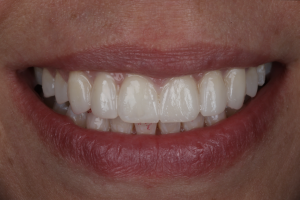
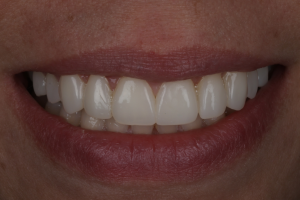
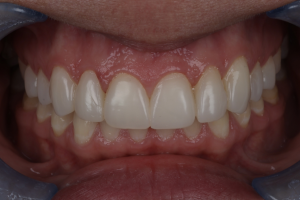
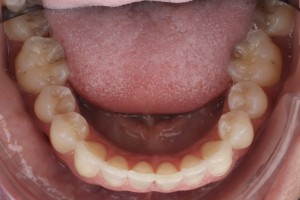
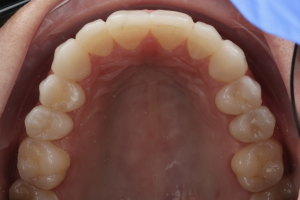
Following completion of treatment, the patient was provided with removable retainers to maintain the orthodontic outcome. Functionally, the improved tooth position and balanced anterior contacts resulted in a stable, mutually protected occlusion. From an aesthetic perspective, the worn incisal edges were restored, surface texture improved and the smile harmonised with the newly established B1 shade.
The patient was advised that the composite restorations will require periodic maintenance over time. With appropriate care, the expected lifespan is typically around five to seven years, although they may function for longer with regular review. Maintenance may include polishing, repeat whitening and minor composite repairs where required.
Clinical Reflections
Overall, the treatment progressed smoothly, with excellent patient engagement and compliance throughout both the orthodontic and restorative stages.
This case was particularly rewarding from a professional perspective, as it represented both my first orthodontic case and my first experience using the injection moulding composite technique. The support provided through the 32Co DUO planning service, working alongside specialist orthodontist Dr Samir Farmahan, was invaluable in ensuring the orthodontic phase was carefully planned and progressed predictably.
The case highlights the benefits of combining orthodontic alignment with additive restorative dentistry when managing patients presenting with anterior wear and aesthetic concerns. By first optimising tooth position and gingival architecture, the restorative stage could be delivered in a controlled and minimally invasive manner.
The final outcome restored the worn incisal edges, improved smile aesthetics and established a stable, mutually protected occlusion, providing a functional and aesthetic result that can be maintained and refined over time.

For further information and enquiries about the British Academy of Cosmetic Dentistry visit www.bacd.com
 Bio: Dr Shivam Kotecha is Scientific Director for the BACD. Graduating in 2022, Dr Kotecha practices as a general dentist across two private clinics in Berkshire and is also the co-founder of a specialised dental photography course, PIXEL.