The ever-growing impact of and contributions to climate change is something well understood in various areas of the current landscape. The healthcare sector, in particular, is responsible for approximately 5% of global CO2 emissions,[i] with one area less frequently, but increasingly being discussed: dentistry.
Now an unavoidable conversation in dentistry, sustainability is something that practices are rethinking and managing – from packaging and energy use to clinical waste. Similarly, patients expect the products they are recommended by their dental professionals to reflect these core environmental values. Despite this, one of the most routine areas of daily oral care – the tools we use to clean interdentally and along the gingiva – often escapes scrutiny. The environmental footprint of these small yet frequently replaced items adds up passively, and it is certainly worth examining more closely.

Daily demise
For example, a patient who uses a disposable interdental brush every day, or even every few days, gets through hundreds of plastic items over the course of a single year. When this is multiplied across an entire patient base, and then across a working lifetime, the cumulative amount of waste becomes disturbingly substantial.
Most of these products are manufactured from mixed materials that are difficult or impossible to recycle through ordinary household systems, so the majority end up in landfill. For something that is used for less than a minute before being thrown away, the persistence of such waste is alarming.
Of course, none of this is an argument against interdental cleaning. The removal of plaque between dentition is well understood, and patients should never be discouraged from maintaining a thorough, consistent routine. Plaque left between the teeth is a significant contributing factor to both caries and periodontal disease, and the spaces a toothbrush cannot reach are where problems commonly arise.
The question persists therefore not in whether patients should clean interdentally, but rather, in how to maintain the clinical necessity whilst committing to waste reduction. The answer remains with the kind of tools recommended: those designed to last, rather than those designed to be discarded.
Reusable and reliable
Reusability is the single most effective solution in this predicament. A well-made interdental brush that can be rinsed, dried, and used repeatedly over a period of weeks considerably reduces the number of individual items a patient consumes. The daily routine stays exactly the same with the standard of cleaning remaining unchanged, and yet the waste generated is a fraction of what a disposable approach produces. For patients who want to do the right thing without compromising their oral health, this is the obvious place to initiate change.
It also supports a more economical situation for patients over time. This presents a strong incentive, as anything that lowers the ongoing cost of a healthy habit makes that habit far easier to sustain. Sustainability and affordability, in this instance, pull in the same direction rather than against each other.
Quality over quantity
There is a quality element to this as well. A reusable tool only delivers on its promise of genuinely reusability if it is built to perform reliably over its lifespan. A brush whose bristles split or whose wire bends after a couple of uses defeats the purpose, forcing earlier replacement and undermining both the environmental and the economic reasoning.
Essentially, durability is not a luxury feature but rather, the very thing that makes reusability meaningful. When recommending products to patients, it is certainly worth advising them towards ranges that have been engineered for the purpose of longevity, because a cheap brush replaced constantly is neither the greener nor the cheaper option in the long run. The most sustainable product is invariably the one that is used well and replaced only when it genuinely needs to be.
Recommendations without compromise
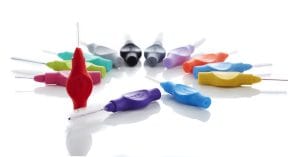
This is where the TANDEX FLEXI range offers. FLEXI interdental brushes are built to be reused, with a durable wire core and bristles that hold their shape across multiple uses. Clear colour-coded sizing helps clinician and patient match the brush to the interdental space, improving both cleaning and comfort, and the quality of construction means each brush can be used countless times rather than being disposed of after a single use. For patients who want to take it a step further, the WOODI brush offers the same excellent clean with a an entirely environmentally friendly design!
A small change with a lasting impact
Sustainability in oral care does not demand dramatic change. It is rather the small, intentional choices that are repeated daily. In particular, the tools that patients use are at the very heart of this intent. For dental professionals, recommending reusable options that clean effectively and last well, allows patients to protect their oral health and reduce their waste at the same time. It is a simple shift, but one that adds up, and the means to make it are already within easy reach, with the right guidance.

TANDEX is giving dental professionals the opportunity to win a FREE FLEXI Educator Kit by answering just a few questions! Enter the quiz by scanning the code or following this link https://form1.tandex.de/
For more information on Tandex’s range of products, visit https://tandex.dk/
Our products are also available from DHB Oral Healthcare https://dhb.co.uk/
Author: Jacob Watwood on behalf of Tandex – Rodericks Dental Partners Associate dentist at Fieldside Dental Practice

[i] Sijm-Eeken, M., Jaspers, M., & Peute, L. (2023). Identifying Environmental Impact Factors for Sustainable Healthcare: A Scoping Review. International Journal of Environmental Research and Public Health, 20(18), 6747. https://doi.org/10.3390/ijerph20186747