

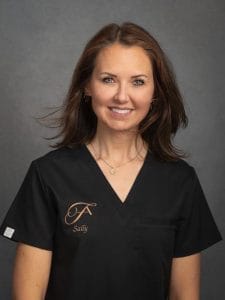
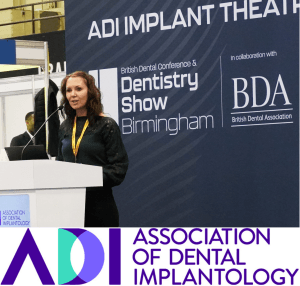
 Sally Rayment, restorative dentist, speaking at the ADI Implant Theatre at the British Dental Conference & Dentistry Show 2026 in Birmingham, described one specific treatment for implant fractures as “an absolute game changer” that “100% works on every single case,” it may have sounded too good to be true. But, for those in the know, the data she brought to the room was anything but surprising.
Sally Rayment presented a ten-year clinical audit of Ankylos dental implant abutment fractures from her practice: a body of evidence that tells a clear and troubling story. Abutment fractures are a growing problem, the patient profile is fairly consistent (male patients account for 62% of cases; the first molar is involved in 84%),[i] and the underlying driver, in the vast majority of cases, is parafunction. The clenching and grinding that loads the dentition far beyond what it was designed to bear is doing the same to dental implants, and the rates are increasing.
“A lot of dental problems were left to become worse during the pandemic,” Sally Rayment noted. “This is not a problem that is going to go away.”
Parafunction: a compounding risk
What Sally Rayment describes is one something most dental professionals will recognise. Parafunction – the involuntary habitual loading of the dentition outside of normal function – is implicated not only in dental implant abutment fractures but across a wider pattern of damage: tooth wear, attrition, cracked teeth, and restorative failure. It is a risk factor that is frequently noted and inconsistently managed.
Part of the problem is that parafunction isn’t static: patients who do not present with bruxism at the point of dental implant placement may develop it subsequently – through stress, sleep changes, medication, or other factors.[ii] “We need to get better at asking patients how they’re doing,” Sally Rayment said. A patient’s parafunctional status at one appointment is not necessarily their status at the next, and the consequences of missing the transition can be significant.
Meanwhile, the patients who most need intervention are frequently the ones least able to access it. “A lot of patients who need this help simply can’t get it,” Sally Rayment observed, and this is a reality that she believes the profession should confront more directly.
The limitations of conventional management
The standard approaches to managing parafunction are well established: occlusal splints, conservative measures, patient education, and behavioural advice. The Michigan splint, in particular, remains a widely used and clinically supported option. But Sally Rayment pointed out its major weakness: splint therapy depends on the patient wearing it, and motivation famously fluctuates. Truthfully, the patient who needs it most may find it the most intrusive.
This is a familiar frustration for clinicians who have watched restorations and dental implant components, as well as natural teeth, fail in patients who were provided with a splint but did not use it. The barrier here tends to be human.
Masseteric Botox: a game-changer?
Botulinum toxin injected into the masseter and, where indicated, the temporalis, addresses parafunction from a different direction entirely. Rather than asking a patient to modify their behaviour, it modifies their physiology directly. At eight to twelve weeks post-injection, bite force it reduced by approximately 40%. The clenching and grinding continues as a pattern, but the force it generates is substantially reduced.
Critically, this does not rely on patient compliance. The injection is given, and the treatment is essentially complete.
Sally Rayment described the treatment’s effects on her own time as a dental professional. “For myself, this is the most rewarding part of dentistry,” she said, reflecting on what it means to offer a treatment that works reliably and also sits at the intersection between two disciplines. One of her patients contributed with a quote that summarised Rayment’s own thoughts quite simply: “I presumed it’d be really painful, but it wasn’t. I lost the tension in my face … it was just heaven.”
Are there still barriers?
 The clinical case for masseteric Botox in the management of parafunction is, it seems, fairly well made. The barriers lie elsewhere in this case. Patient awareness is low – many simply do not know the treatment exists, or may associate Botox exclusively with cosmetic use. Clinician awareness and confidence in offering it remains variable, and stigma persists particularly among older male patients – precisely the demographic most at risk of dental implant abutment fractures – for whom the association is often a real deterrent.
This patient conversation, Sally Rayment made clear, requires patience and care. But it is still a conversation worth having. Clinicians who understand both the mechanics of parafunction and the options for managing it are best placed to lead it.
The ADI Implant Theatre at the British Dental Conference & Dentistry Show 2026 was a new initiative from the Association of Dental Implantology, bringing together some of the UK’s leading voices in dental implant dentistry for practical, evidence-based education across both days of the show. The ADI’s wider education programme, including its Fellowship Pathway and annual congress, supports dental professionals at every stage of their dental implant journey.
The case for masseteric Botox in dental implant practice is an argument gaining more traction, and seemingly deservedly so. As a response to a growing issue, in any case, it appears to have the support of both the data and of the patients.

[i] Rayment S, Packer M, Millar BJ. Clinical audit of Ankylos implant abutment fractures for a ten-year period in practice. Br Dent J. 2025;238(11):869-878. doi:10.1038/s41415-024-8009-0
[ii] Mdpi.com. Published 2026. Accessed May 29, 2026. https://www.mdpi.com/2673-9992/45/1/2