Effective decontamination is the foundation of every safe and successful dental practice. High standards must be maintained by all members of the team in order to prevent pathogenic transmission and protect both colleagues and patients from potential harm. Despite being a staple component of every professional’s knowledge and skill set, several myths surrounding infection control remain. It is important to be aware of any misinformation that might circulate and to ensure that you and your team are applying only evidence-based protocols that are HTM 01-05 compliant across your practice.[i]
Myth #1
Hot water is more effective at killing bacteria than cold
This is only true when attempting to kill the majority of pathogens within water itself – boiling has been shown to reduce microbial load by approximately 86%–99%.[ii] The process is often used in rural communities to render water safe for drinking. In UK dental practices, however, there is no need to boil the water. When it comes to hand hygiene, skin can’t cope with water temperatures anywhere near boiling, so this is once again made redundant. As such, rinsing the hands with cold water is just as effective as rinsing with warm water for reducing key pathogens like E.coli.[iii] This is true for all temperatures between 15 and 38 ºC, assuming that an appropriate soap is used in the right way.[iv]
Myth #2
Gloves are safer than regular hand washing
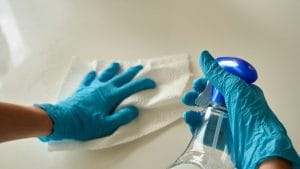
This claim is false because gloves are never a replacement for hand hygiene.[v] They remain vital to minimise the risk of professional exposure to blood and bodily fluids, but they do not protect patients from pathogenic transmission alone.
Perforation is also a risk, though use of an indicator glove has been associated with a two- to six-fold increase in detection of the same.[vi] There are even calls by some researchers to reassess the guidelines for glove wearing in medical settings due to their high environmental impact and the availability of alternative hand hygiene solutions in the modern world.[vii]
Myth #3
Duration of active hand washing has no impact on effectiveness
This myth is not so clear-cut – though if taken to the extreme it is absolutely incorrect. The NHS recommends washing hands for at least 20 seconds.[viii] This provides enough time to adequately cover every surface of the hands in soap and avoids rushing or compromising the process.
However, further study is needed to determine the most effective duration with greater accuracy. For example, there is a lack of research assessing the impact of washing for 20-30 seconds, though the evidence does suggest sufficient bacterial reduction for anything between 20 and 30+ seconds.[ix] A systematic review commissioned by the GDC was also inconclusive on the relative effectiveness for 10, 20, and more seconds of hand washing.[x] Once again, it highlights the need to allocate enough time to fully cover the hands with soap, rub, and rinse. Less than 20 seconds is likely to compromise results.
Myth #4
Disinfection, sanitising and cleaning are all the same thing
This myth is not so common in today’s highly educated dental community, but it never hurts to refresh understanding. Cleaning is the removal of physical dirt or impurities, sanitising reduces the pathogenic load, and disinfection kills the vast majority of germs on a surface.[xi] Decontamination of dental instruments takes all this one step further with sterilisation, which destroys all pathogens and endospores, and renders the item safe for reuse.
Myth #5
All disinfection and cleaning products are created equal
This is not true at all. A vast range of decontamination solutions are available to dental professionals today, but these vary significantly in effectiveness, reliability, value, ease of use, and application. For maximum results, practices should find a supplier they trust to elevate their infection control standards and ensure the safety of everyone on the premises.
Dentisan offers a highly-respected portfolio of solutions that supports exceptional hand hygiene, surface decontamination, dental unit water line disinfection, and so much more. All products are tried and tested to deliver results and ensure compliance with HTM 01-05.i They are also designed to be easy-to-use and cost-efficient, giving your practice complete confidence in your infection control workflows.
Maintaining best practices
Infection control protocols are constantly evolving in line with our collective understanding about pathogens and their transmission. However, the foundations of decontamination will likely remain the same and it is vital that all members of the team appreciate the role they play. To avoid following the myths and implementing incorrect workflows, professionals should seek training, advice, and products from trusted providers.

For more information about Dentisan, please visit https://dentisan.co.uk/
For geneal enquiries, email info.dentisan@getinge.com
Book your in-practice CPD by emailing your request to the expert in your area:
For the Midlands, North Wales & North of England, contact Jenny: jenny.nixon@getinge.com
For the South of England, Wales & Channel Islands, contact Anne: anne.harris@getinge.com
For Scotland, Ireland & Northern Ireland, contact Holly: holly.dickinson@getinge.com
Author: Jenny Nixon

[i] Department of Health (2013). Decontamination Health Technical Memorandum 01-05: Decontamination in Primary Care Dental Practices 2 0 1 3 E D I T I O N. [online] Available at: https://www.england.nhs.uk/wp-content/uploads/2021/05/HTM_01-05_2013.pdf.
[ii] Rosa G, Miller L, Clasen T. Microbiological effectiveness of disinfecting water by boiling in rural Guatemala. Am J Trop Med Hyg. 2010 Mar;82(3):473-7. doi: 10.4269/ajtmh.2010.09-0320. PMID: 20207876; PMCID: PMC2829912.
[iii] Kordasiewicz-Stingler R, Reiter M, Kampf G, Gebel J, Ilschner C, Suchomel M. Equivalent reduction of Escherichia coli by rinsing hands with cold and warm water. GMS Hyg Infect Control. 2024 Dec 16;19:Doc72. doi: 10.3205/dgkh000527. PMID: 39810802; PMCID: PMC11730179.
[iv] Indications and techniques for hand hygiene. Literature review. NHS National Services Scotland. ARHAI Scotland. Version 2.0. January 2023. https://www.nipcm.hps.scot.nhs.uk/web-resources-container/literature-review-indications-and-technique-for-hand-hygiene/ [Accessed May 2026]
[v] Gloves do not replace hand hygiene – reminder from WHO. Health topics. May 2025. https://www.who.int/news/item/05-05-2025-gloves-do-not-replace-hand-hygiene—reminder-from-who [Accessed May 2026]
[vi] Wharton KR, Sawyer RG, Enz A, Bah-Rösman J, Brindle CT. Hands Deserve Better: A Systematic Review of Surgical Glove Indicator Systems and Identification of Glove Perforation. Journal of Clinical Medicine. 2025; 14(22):7977. https://doi.org/10.3390/jcm14227977
[vii] Vilar-Compte D, Garciadiego-Fossas P, Ibanes-Gutiérrez C. Gloving in medicine: a boon for infection prevention or a hindrance? Antimicrob Steward Healthc Epidemiol. 2025 Oct 29;5(1):e288. doi: 10.1017/ash.2025.10145. PMID: 41180300; PMCID: PMC12571685.
[viii] How to wash your hands. NHS. Healthy living. https://www.nhs.uk/live-well/best-way-to-wash-your-hands/ [Accessed May 2026]
[ix] Hilton SP, An NH, O’Brien LA, Snyder JS, Rogers HK, Cumming O, et al. Efficacy and effectiveness of hand hygiene-related practices used in community settings for removal of organisms from hands: a systematic review. BMJ Global Health. 2025;10:e018925. https://doi.org/10.1136/bmjgh-2025-018925
[x] Guidelines on hand hygiene in community settings [Internet]. Geneva: World Health Organization; 2025. 3, Effective hand hygiene. Available from: https://www.ncbi.nlm.nih.gov/books/NBK619535/
[xi] The difference between cleaning, sanitizing & disinfecting. Centres for Disease Control and Prevention. https://www.cdc.gov/hygiene/pdf/331782-a_cleaning_sanitizing_disinfecting_508.pdf [Accessed May 2026]