Dental professionals are increasingly supporting individuals who experience difficulties with manual dexterity – something that is often underestimated as a significant challenge for many. In the UK alone, approximately 7% of working-age adults, 6% of school-aged children, and 50% of those over the age of 70 suffer with severe dexterity issues.[i] While these patients may not necessarily lack the motivation, appropriate oral care routines can be significantly compromised.

For clinicians, it is vital that a combination of both education and adapted tool recommendations are offered to support these patients. This preventive approach encourages better long-term oral health for patients, supporting practices by relying less on invasive treatments and more on everyday maintenance.
Understanding limited dexterity
Compromised dexterity, also known as reduced fine motor coordination, refers to the limited ability to perform delicate hand manipulations: affecting fine motor skills, coordination, and grip strength.[ii] Good dexterity requires muscle control, steadiness, and discrete muscle movements such as pointing or hand closure/opening.i
Impairments of dexterity can be the result of various circumstances, from congenital conditions to a neuromuscular disorder, and can be associated with a range of other diagnoses, including:[iii]
- Arthritis
- Multiple sclerosis
- Cerebral palsy
- Parkinson’s disease
- Osteoporosis
- Cubital and carpal tunnel syndrome, and more
Each of these can significantly affect a patient’s ability to carry out precise, controlled actions – essential for a comprehensive oral health care routine. Holding a toothbrush steady for two minutes, whilst altering angles and applying the correct and consistent amount of pressure is not as straightforward for these patients. Additionally, manipulating tools like floss or interdental brushes is something that many without dexterity limitations might take for granted. However, experiencing difficulty and frustration is the reality for so many people, meaning it is important for oral health professionals to assist.
Another thing to note is that these challenges are not always visible immediately and patients may not necessarily declare their need for support. Dental professionals therefore have a duty to assist where they can, even before they have been asked. Evidence suggests that the average clinician is not trained to appropriately and sufficiently support this population of patients, reinforcing the need for foundational education on the topic.[iv]
Patients with limited dexterity don’t always ask for help for several reasons, spanning from people not acknowledging a perceived lack of control or the required help not being available – often discouraging people from seeking support at all.[v]
Standard routines
Tooth brushing can become ineffective when dexterity issues get in the way of angulation or access – particularly in the posterior region. Even with regular brushing, if the technique isn’t effective, plaque can accumulate quickly, leading to further complications.
For this reason, regular dental routines cannot be generalised. Conventional oral hygiene advice is often based on full manual control. Standardised instructions around certain aspects like technique or cleaning duration for example, are commonly built around the conventional patient, who doesn’t suffer with dexterity challenges. But for patients who don’t possess the same abilities, the oral health expectations can be difficult to attain.
Interdental cleaning presents an even more significant challenge due to the precision and deftness required. In fact, many patients with limited dexterity may avoid this step altogether, leading to further issues. Studies on these patients show that they have more missing teeth and fewer restored teeth than people of the same age without limited dexterity.[vi]
Tailored support
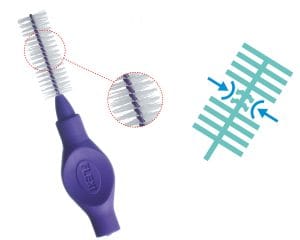 By adapting routines and advice to individuals with limited dexterity, the same level of oral hygiene can be achieved as those without these difficulties. Interdental areas are incredibly susceptible to plaque accumulation, which is why interdental tools are critical.
One such product ideal for those with restricted dexterity is the FLEXI interdental brushes from TANDEX. The unique non-slip rubber handle ensures a good firm grip, with a flexible – and extendable by attaching the cap – handle that offers facilitated access to the hardest-to-reach spots. This ergonomic handling is reinforced through the large assortment of 11 sizes, and 4 variants in the FLEXI UltraSoft range, meaning that every patient can experience comprehensive oral hygiene, tailored to them.
TANDEX is also running an exciting competition offering dental professionals the opportunity to win a free Educator Kit – allowing patients to learn first-hand from those who know best!
Supporting long-term oral health
Reduced dexterity presents a clear challenge in maintaining effective oral hygiene, but with the right advice and tool recommendations, nobody needs to suffer the consequences. The generic routines that have been established can be adapted and altered to find solutions fit for each individual.

For more information on Tandex’s range of products,
visit https://tandex.dk/
Our products are also available from DHB Oral Healthcare https://dhb.co.uk/
Find out more the exciting TANDEX competition that offers the chance of winning a FREE Educator Kit!

Enter the quiz by following this link https://form1.tandex.de/
Author – Dr Jacob Watwood

[i] Dexterity and Fine Motor Skills: What causes dexterity issues? (2024) Ability Central. Available at: https://abilitycentral.org/article/dexterity-and-fine-motor-skills-what-causes-dexterity-issues (Accessed: 22 April 2026).
[ii] Martin JA, Ramsay J, Hughes C, Peters DM, Edwards MG. Age and grip strength predict hand dexterity in adults. PLoS One. 2015 Feb 17;10(2):e0117598. doi: 10.1371/journal.pone.0117598. PMID: 25689161; PMCID: PMC4331509.
[iii] Jansen AE, Rosenfeldt AB, Lopez-Lennon C, Fernandez H, Zimmerman E, Imrey PB, Dibble LE, Alberts JL. Characterizing Hand Function in Parkinson’s Disease Patients with a Self-Administered Electronic Manual Dexterity Test. Mov Disord Clin Pract. 2025 Mar;12(3):333-339. doi: 10.1002/mdc3.14286. Epub 2024 Nov 27. PMID: 39604309; PMCID: PMC11952952.
[iv] Indiran, M. A., Subramanian, A. K., Prabakar, J., Kumar, R. P., Sakthi, D. S., & Leelavathi, L. (2020). Concerns with oral health care services for adults with cognitive and intellectual disabilities. Bioinformation, 16(12), 974.
[v] Hat, A. (2022) 7 reasons why I don’t ask for help, AndyHat Disability. Available at: https://disability.andyhat.co.uk/articles/7-reasons-why-i-dont-ask-for-help/#:~:text=Many%20independent%20disabled%20people%20get,for%20help%20pushing%20my%20wheelchair. (Accessed: 22 April 2026).
[vi] Orsós M, Moldvai J, Simon F, Putz M, Merész G, Németh O. Oral Health Status of Physically Disabled Inpatients – Results from a Hungarian Single-Centre Cross-Sectional Study. Oral Health Prev Dent. 2021 Dec 18;19:699-706. doi: 10.3290/j.ohpd.b2448609. PMID: 34918504; PMCID: PMC11640792.