


While no longer a new concept in dentistry, the idea of starting with the end in mind remains hugely relevant for all dental professionals. It requires the clinician to establish the ideal clinical outcome from the outset and then work backwards to determine the steps needed to achieve this result. Not only can this make treatment more predictable, but it also improves patient communication and treatment acceptance – because they have a better understanding of what to expect post-procedure. Prosthetically-driven treatment planning is popular in implant dentistry, but a similar approach can be applied on most multidisciplinary cases. To optimise outcomes while ensuring a seamless patient experience, it is crucial to utilise the right diagnostic equipment.
Working backwards works
The literature supports a ‘start with the end in mind’ philosophy. In implant dentistry, prosthetically-driven planning can facilitate harmony between the implant-supported restoration and the natural dentition, ensuring the placement and aesthetic of the solution blends seamlessly. These are important factors that influence patient satisfaction with the results delivered.[i] The accuracy and reliability with which implant treatment can be planned when prioritising the final prosthetic position and design makes them a reality in every day care. As such, prosthetically-driven implant treatment – especially when combined with guided implant surgery protocols – affords similar implant survival and success rates to conventional techniques.[ii] It is also proven to be an effective approach to complex oral rehabilitation involving zygomatic implants.[iii]
Implantology isn’t the only field where this concept can be applied. Prior to any type of treatment, it is important to explore the desired outcomes before procedures commence. The growing popularity of smile simulations further demonstrates the importance of communicating the potential end result with patients in all situations. The research reports a high level of patient satisfaction among those who have access to accurate smile design visuals prior to treatment.[iv] Software assisted by artificial intelligence (AI) makes this process relatively quick and efficient for clinicians, with many incorporating facial feature data to help optimise aesthetics.[v] This could be advantageous ahead of restorative, orthodontic, or cosmetic dental treatment.
Reliable data collection
Once the end result is visualised, it’s necessary to establish the most predictable way of achieving it. This necessitates a comprehensive clinical assessment, which will allow professionals to identify the most appropriate solution. Part of this process is mitigating potential complications and managing patient expectations in order to encourage their engagement during treatment and their satisfaction post-completion.
To ensure the accuracy of the assessment, it is vital to have access to high-quality equipment that supports reliable data collection. Insights gained are also required for the fabrication of surgical guides or implementation of dynamic navigation, further emphasising the importance of their accuracy and precision. Achieving this requires investment by the practice in digital solutions, including everything from intraoral cameras and scanners to more comprehensive 2D and 3D imaging units.
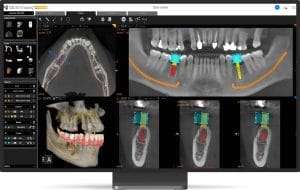
Among the many technologies available, the CBCT scanner has become integral to many treatment pathways. It will come as no surprise that dental implants are a leading indication for CBCT imaging, as are bone pathology and impacted teeth.[vi] Supporting a thorough clinical assessment and diagnosis, it affords high-resolution, 3D images of the anatomy, including visualisation of all vital structures around the proposed surgical site.
Modern systems combine this functionality with low dose technology to minimise radiation exposure and optimise patient safety. The multi-award-winning CS 9600 CBCT from Carestream Dental, for example, offers an innovative low-dose setting that delivers 3D images with up to 86% less exposure than 2D panoramic images without any compromise in quality or reliability. The 5-in-1 scanner features 14 fields of view, AI-powered patient positioning, and supports open workflows to meet the needs of every dental practice. The AI-powered CS 3D Imaging Premium software streamlines the entire treatment workflow, elevating each step from assessment and diagnosis to treatment planning and execution.
Starting with the end in mind
In a dental landscape that promotes clinical accuracy, efficiency, and predictability, it’s crucial that dental professionals can consistently deliver the standard of care patients seek. Whether contemplating a single implant or a full-arch rehabilitation, a crown, or an orthodontic procedure, knowing the desired end result is a useful reference point both prior to and throughout the treatment workflow. It also improves patient understanding and helps to manage their expectations. Reliable digital technology, including high-quality imaging equipment, is vital for the assessment, diagnostic, and planning processes. Brining it all together makes prosthetically-driven treatment not only possible, but simple for exceptional outcomes every time.

For more information on Carestream Dental visit www.carestreamdental.co.uk
For the latest news and updates, follow us on Facebook and Instagram @carestreamdental.uk
Author: Nimisha Nariapara
[i] Nulty A. A literature review on prosthetically designed guided implant placement and the factors influencing dental implant success. Br Dent J. 2024 Feb;236(3):169-180. doi: 10.1038/s41415-024-7050-3. Epub 2024 Feb 9. PMID: 38332076; PMCID: PMC10853061.
[ii] Sakkas A, Westendorf S, Thiele OC, Schramm A, Wilde F, Pietzka S. Prosthetically guided oral implant surgery. A retrospective cohort study evaluating the 5-year surgical outcome. GMS Interdiscip Plast Reconstr Surg DGPW. 2023 Aug 18;12:Doc06. doi: 10.3205/iprs000176. PMID: 37693294; PMCID: PMC10486885.
[iii] Wang, F., Fan, S., Huang, W., Shen, Y., Li, C., & Wu, Y. (2022). Dynamic navigation for prosthetically driven zygomatic implant placement in extensive maxillary defects: Results of a prospective case series. Clinical Implant Dentistry and Related Research, 24(4), 435-443.
[iv] Babaei M, Kazemian M, Barekatain M. A comparative analysis of patient satisfaction with various methods of digital smile design and simulation. Dent Res J (Isfahan). 2025 Mar 19;22:10. doi: 10.4103/drj.drj_254_24. PMID: 40191790; PMCID: PMC11970902.
[v] Saini RS, Kaur K, Gurumurthy V, Binduhayyim RIH, Kaushik A, Kuruniyan MS, Alarcón-Sánchez MA, Heboyan A. Impact of artificial intelligence-based digital smile design on patient and clinician satisfaction and facial esthetic outcomes: A systematic review and meta-analysis. Digit Health. 2025 Oct 16;11:20552076251388392. doi: 10.1177/20552076251388392. PMID: 41122427; PMCID: PMC12536214.
[vi] Altan Şallı, G., Öksüz, M.F., Köse, T.E. et al. USG and CBCT indications in pediatric to adult dental patients: a university hospital study. BMC Oral Health 25, 1010 (2025). https://doi.org/10.1186/s12903-025-06407-2