Hypochlorous acid emerged in the pandemic years as a reliable solution for fighting enveloped viruses like COVID-19. More recently, the acid has side-stepped into the dermatology industry, with social media trends encouraging the use of it to treat skin conditions like acne.[i]
The range of applications that hypochlorous acid has do come with certain drawbacks, however. For dental practices, its use in infection control should be treated with a degree of caution: it’s effectiveness is dependent on diligent management. So how suitable is it?
From cell beginnings
Considering its role in eliminating coronaviruses, it may surprise that hypochlorous acid is naturally created in the body. Neutrophils, the most common type of white blood cell, attack invading pathogens and produce the acid in response to injury and infection.[ii] At sites of inflammation it binds with the cell membrane and disrupts cellular activity to eliminate bacteria.[iii] It’s pH range is 3-6 for aqueous solutions, with 3.5-5 considered a stable form that maximises antimicrobial activities and minimises undesirable side products.ii
One of the advantages of hypochlorous acid is that it is easy to make in laboratories. In 8 minutes, the combination and electrolysis of water, non-iodised salt and vinegar can create the acid at a higher, safer pH of 5-6.5 that is ready to use for disinfection against a broad range of microorganisms.iii For healthcare providers, hypochlorous acid that meets regulatory requirements can be used for wound care, hand hygiene, surface application and, of note to dental professionals, to target biofilm.
Role in the water lines
Dental unit water lines (DUWLs) are the arteries of the dental practice, and as such the water quality must be regularly checked and maintained. Untreated DUWLs coated in biofilm allow microorganisms to disperse through the water network, eventually posing a risk to the patient and dental team through the aerosolisation of the water.[iv]
Biofilm formation occurs when microorganisms attach to the inner surface of the waterlines. Despite being a complex process, it can easily occur if infection control is inconsistent.iv Flushing the lines that deliver waterreduces the microbial count, but the biofilm can still adhere to the inner wall and contaminate the water, hence the need for a chemical solution that eliminates harmful bacteria and prevents biofilm formation.iv
Drawbacks
The consistent use of hypochlorous acid faces several challenges. Chiefly, exposure to sunlight or UV radiation reduces the chlorine concentration after 4 days, destabilising the solution and making it less effective. The acid also has a short shelf life, with air contact causing the pH to rise towards neutral levels.iii Because of this, hypochlorous acid must be stored in a cool dark place, placing a limitation on its use.
Another drawback is that any errors in measurements causes delays in time and product waste (especially when considering that the antimicrobial activity of the solution is dependent on the optimal pH).[v] Some formulations may require a thorough rinse out of the waterlines before the end of each working day – this can be a further inconvenience and runs the risk of being overlooked.
A reliable solution
For cleaning DUWLs, the long-term application of a chemical solution means it must have a low corrosivity and a minimal impact on the equipment – a more acidic pH will corrode DUWLs and the dental equipment, such as plastic tubing, O-rings and any adhesives inside the dental unit. Such damage will impact efficiency and lead to costly repairs. Dental practices therefore need a disinfectant and maintenance solution that must be non-toxic when it enters a patient’s mouth, and does not interfere with any bonding or restorative work. It must also be noncorrosive, effective in various forms, and relatively inexpensive. For a stamp of quality assurance, water quality outcomes should be verified by the dental practice too.
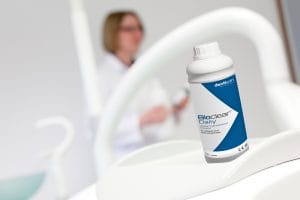
The Dentisan product range is filled with reliable infection control solutions. For managing DUWLs, BioClear Daily supports water maintenance by reducing the planktonic bacteria count. The excellent material compatibility and ease of use means a seamless integration into the daily workflow, with prepared solutions lasting up to 10 days when stored in suitable plastic containers. Continuous use of BioClear Daily ultimately ensures compliance with HTM 01-05, keeping the dental team and patients safe.
The widespread use of hypochlorous acid has many benefits in healthcare. However, the need for correct infection control protocols can limit its effectiveness for treating DUWLs due to several drawbacks. Dental practices must therefore find the very best solutions for daily use, guaranteeing ease of use and optimal outcomes.

For more information about Dentisan, please visit https://dentisan.co.uk/
Book your in-practice CPD by emailing your request to the expert in your area:
For the Midlands, North Wales & North of England, contact Jenny: jenny.nixon@getinge.com
For the South of England, Wales & Channel Islands, contact Anne: anne.harris@getinge.com
For Scotland, Ireland & Northern Ireland, contact Holly: holly.dickinson@getinge.com
Author: Jenny Nixon – Business Development Dentisan

[i] Sweeney, E. (2026). Why Are People Obsessed With Hypochlorous Acid? [online] TIME. Available at: https://time.com/7358447/what-is-hypochlorous-acid/.
[ii] Wang, L., M Bassiri, Najafi, R., Najafi, K., Yang, J., B Khosrovi, Hwong, W., Barati, E., Belisle, B., C Celeri and Robson, M. (2007). Hypochlorous Acid as a Potential Wound Care Agent: Part I. Stabilized Hypochlorous Acid: A Component of the Inorganic Armamentarium of Innate Immunity. Journal of Burns and Wounds, [online] 6, p.e5. Available at: https://pmc.ncbi.nlm.nih.gov/articles/PMC1853323/.
[iii] Block, M.S. and Rowan, B.G. (2020). Hypochlorous Acid: A Review. Journal of Oral and Maxillofacial Surgery, [online] 78(9). doi:https://doi.org/10.1016/j.joms.2020.06.029.
[iv] Shajahan, I., Kandaswamy, D., Srikanth, P., Narayana, Ll. and Selvarajan, R. (2016). Dental unit waterlines disinfection using hypochlorous acid-based disinfectant. Journal of Conservative Dentistry, 19(4), p.347. doi:https://doi.org/10.4103/0972-0707.186441.
[v] Haralović, V., Mokos, M., Špoljar, S., Dolački, L., Šitum, M. and Lugović-Mihić, L. (2025). Hypochlorous Acid: Clinical Insights and Experience in Dermatology, Surgery, Dentistry, Ophthalmology, Rhinology, and Other Specialties. Biomedicines, [online] 13(12), p.2921. doi:https://doi.org/10.3390/biomedicines13122921.