

Nearly one in four practitioners administering cosmetic injectables in the UK are dentists.[i] 40–50% of private dental practices now offer facial aesthetic treatments.[ii] The reasons seem clear: declining NHS income, established patient relationships, existing facial anatomy expertise, and a market predicted to reach over £11 billion this year.[iii]

For practices making this transition, the clinical opportunities are substantial. However, expanding into facial aesthetics fundamentally changes your waste management needs, particularly when it comes to the disposal of sharps. Understanding these changes and implementing compliant workflows from the outset will help prevent any accidental regulatory breaches during a time of change.
Why are dental practices moving into facial aesthetics?
The move into facial aesthetics is a natural extension of a dental practice, as dentists have pre-existing, in-depth knowledge of facial anatomy and physiology, as well as experience in clinical workflows and patient care, with decontamination protocols already in place.
Financial pressures are also likely a factor. Mixed NHS-private practices face UDA constraints, and fully private practices may seek reliable, additional income streams. Aesthetic treatments offer high-margin procedures with repeat business, as patients require regular top-ups every 3–6 months,[iv] creating predictable income.
Infrastructure is a big part of it: the physical clinical space, CQC registration, and many workflows and protocols already exist. Training courses can enable practitioners to build aesthetic services part-time while continuing to provide high-quality dental care.
Transforming the waste profile
Dental sharps waste is straightforward once the appropriate workflows are established. Local anaesthetic cartridges, suture needles, disposable scalpels and blades can be managed routinely, with different coloured waste containers on hand to manage different hazards.
Aesthetic treatments, as could be expected, create an entirely different waste profile. Every dermal filler, collagen stimulator or skin booster syringe contains pharmaceutical residue. These sharps are contaminated with medicinal products and must therefore be segregated into yellow-lidded containers destined for incineration. Whilst botulinum toxin (Botox®, etc.) needles complicate things further, as these are known to be cytotoxic and must be segregated into a purple-lidded sharps container.
The volume of waste generated changes dramatically. A single aesthetic appointment may involve 20–40 injection points for botulinum toxin, or multiple syringes for dermal fillers.[v] Compare this to occasional local anaesthetic injections during dental procedures.
Additionally, aesthetic procedures generate new waste streams: empty pharmaceutical vials, preparation syringes, and potentially cytotoxic waste if handling specialised treatments. Each requires appropriate segregation according to Health Technical Memorandum 07-01 (HTM 07-01) guidelines.[vi]
Understanding the colour code
HTM 07-01 establishes the UK colour-coding system for the segregation of healthcare waste. For practices offering aesthetic treatments, understanding these distinctions prevents costly compliance failures and keeps clinicians, visitors and waste handlers safe. Commonly produced waste should be segregated as follows:
Yellow-lidded: All sharps containing, or contaminated with, medicinal products and chemicals, including dermal filler syringes, and any pharmaceutical injections. An infection risk may also be present. Yellow-stream waste requires incineration or alternative treatment at an authorised facility.
Orange-lidded: These containers remain appropriate for sharps waste without chemical or pharmaceutical contamination. Phlebotomy needles for blood tests, non-medicinal sharps, and some dental procedure waste. Orange stream waste can undergo alternative treatment, with incineration as a secondary option.
Purple-lidded: This stream applies exclusively to cytotoxic or cytostatic medicine contamination. While uncommon in standard dental aesthetics, when botulinum toxin (Botox®, etc.) is used, this becomes a must-have addition.
The colour code for clinical waste must be followed in both dental and aesthetic care. Every item entering an incorrect container creates waste stream contamination, potentially resulting in rejected collections, regulatory investigation, and re-classification costs.
Setting up your new sharps waste system
Deliberate waste management planning is key to successfully integrating aesthetics into the practice.
Separate treatment spaces and point-of-use containers: Position colour-coded sharps containers in treatment rooms at arm’s reach of the point of use. Separate spaces for treatments and their subsequent colour codes reduce cross contamination risks and remind staff of their different waste requirements.
Staff training: Every team member must understand the colour-coding system and pharmaceutical waste requirements. Ensure individuals are up to date with regular training.
Documentation protocols: Hazardous waste requires consignment notes tracking waste from the producer through collection to disposal. Maintain records for the mandatory three-year period.
Storage and audits: Segregate waste types safely in a secure storage space. Implement monthly checks ensuring containers are used correctly and documentation remains current, alongside regular audits depending on the volume of clinical waste produced, especially when the work completed in the practice changes significantly.
Professional sharps waste management solutions
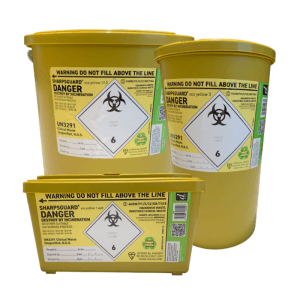 Practices expanding into facial aesthetics must find specialist waste management support that understands the specific requirements of clinical sharps disposal. Initial Medical provides comprehensive sharps waste solutions designed for healthcare settings, including UN-approved Eco Sharps Bins in multiple sizes and colours suitable for aesthetic treatment rooms, regular collection services with complete hazardous waste documentation support, and expert guidance on compliance for practices adding aesthetics to their services. Their containers are manufactured with at least 40% recycled plastic, providing sustainable disposal.
Facial aesthetics could be a fantastic opportunity for dental practices to grow. However, clinical expansion must be matched by an evolution in waste management. With good systems in place, dental practices can confidently offer aesthetic treatments while protecting patients, staff, and practice reputation.
To find out more, get in touch at 0808 304 7411 or visit the website today www.initial.co.uk/medical
About Initial Medical
Initial Medical set the standard in healthcare and infectious waste management in the UK, providing a reliable, effective and fully compliant service built around customer needs and delivered by our highly trained local teams. We are ISO 9001:2015 accredited, with technology fully integrated into our operations, providing full traceability of service delivery, electronic waste documentation and the best customer experience possible. We also offer innovative healthcare waste management services and infection control products to help break the chain of transmission and prevent cross contamination.
Initial Medical are a company with a ‘World Class’ Health and Safety record, and ISO 45001:2018 accreditation. We are also accredited to ISO 14001:2015 environmental standards and pride ourselves on our sustainable approach with a focus on delivering eco-friendly products and operational solutions.
Author: Rebecca Waters – Rentokil Initial

Media enquiries:
For more information, please contact:
01227 265700
[i] Seaborne A. Can your dentist carry out facial aesthetics? Bupa.co.uk. Published September 2025. Accessed February 27, 2026. https://www.bupa.co.uk/newsroom/ourviews/dentist-facial-aesthetics
[ii] Tebbutt, J. Injecting with confidence: exploring UK dentistry facial aesthetic practice. Br Dent J 238, 715 (2025). https://doi.org/10.1038/s41415-025-8762-8
[iii] Facial Injectables Market Size, Share, Growth | Report [2028]. www.fortunebusinessinsights.com. https://www.fortunebusinessinsights.com/industry-reports/facial-injectables-market-100603
[iv] Hall E. How Often Should You Top Up Botox? | YouCan Clinic. YouCan Clinic. Published December 3, 2024. Accessed February 27, 2026. https://www.youcanclinic.com/how-often-should-you-top-up-botox/
[v] Paradis B. Utah Facial Plastics. Published October 27, 2025. Accessed February 27, 2026. https://www.utahfacialplastics.com/blog/average-number-of-tox-units-and-syringes-in-botox-treatments/
[vi] https://www.england.nhs.uk/publication/management-and-disposal-of-healthcare-waste-htm-07-01/