


For many dentists, owning a practice has long represented professional freedom. It offers the ability to shape patient care, build a team around shared values, and guide the direction of the business.

For some, that independence remains deeply rewarding.
However, the environment in which practices operate has evolved considerably. Administrative, regulatory, and financial pressures have increased, and the responsibilities associated with running a practice have become more complex. As a result, a growing number of principals are finding it harder to ignore the true cost of going it alone.
The hidden price of staying solo
Running a practice has never been simple, but in recent years, complexity has intensified.
Regulatory requirements from the Care Quality Commission (CQC), NHS contractual obligations, and evolving compliance frameworks – from infection control to data protection and clinical governance – now demand significant time and resource. In many independent practices, much of this responsibility ultimately sits with the principal.
Administrative workload is now widely recognised as a leading contributor to dentist burnout and dissatisfaction. Time spent on compliance, HR, and business management is time not spent with patients – or on the parts of dentistry that drew many practitioners to the profession in the first place.
Buying power and the economies of scale
Independent practices also face structural challenges when it comes to procurement.
Larger groups are often able to negotiate more favourable terms on materials, equipment, and laboratory fees. By contrast, a solo principal typically has far less negotiating leverage. Over time, these differences compound.
The same dynamic applies to associate recruitment. Candidates increasingly look beyond salary, considering the wider proposition: CPD support, clinical mentoring, access to modern equipment, and clear professional development pathways.
Competing in these areas can be difficult when margins are already under pressure.
Isolation and the limits of going it alone
There is also a less visible – but equally important – cost.
Solo practice ownership can be professionally isolating. Decisions around clinical governance, complex cases, or business strategy are often made without the benefit of peer input.
Access to best-practice sharing, clinical networks, and operational expertise – resources that larger organisations typically embed into their infrastructure – is often limited for independent principals.
Over time, this isolation can affect both clinical confidence and business resilience. Challenges that might be quickly addressed within a broader network can take longer to resolve when faced alone.
Weighing the options
For principals experiencing these pressures, the choice is often framed as binary: remain independent, or sell and step away.
In reality, the range of options is evolving.
A full sale to a traditional corporate group may provide capital and operational relief, but it can also involve relinquishing a degree of clinical autonomy and adapting to a different cultural and operational model. For principals who value independence, that trade-off can feel significant.
Shared ownership models offer a third path.
Rather than treating ownership as an all-or-nothing decision, they are designed to combine the benefits of scale and support with the ability to retain meaningful influence over how a practice operates day to day.
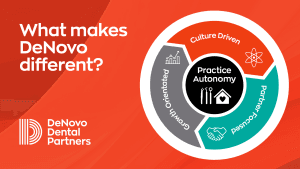
A different kind of partnership
DeNovo Dental Partners has developed its model with this balance in mind.
Principals who join DeNovo can realise the full value of their practice upfront – through a combination of cash and equity – while continuing to lead their practice with autonomy over clinical and operational decisions.
As significant shareholders in the wider group, Partners also benefit from ongoing wealth creation linked to both practice and group growth, ensuring their financial interest continues beyond completion.
Day to day, Partners gain access to central support services and a network of peers where knowledge, experience, and best practices are actively shared.
There is no single right answer for every practice owner.
The decision about whether – and how – to seek external support will always depend on individual circumstances, career stage, and what you want from the next chapter of your professional life.
But understanding the full range of options available – including models that enable principals to retain autonomy while gaining support – is an important first step towards making a confident, well-informed decision.
 Media Contact:
DeNovo Dental Partners
Kristen Pope
Chief Integration, Partnership & Communications Officer
Kristen.Pope@DeNovo.Partners
https://www.denovo.partners/

Author: Caron Best, Chief Operating Officer DeNovo Dental Partners