Despite the rapid adoption of digital scanning across many dental disciplines, conventional impression materials remain a routine part of clinical practice. Firstly, digital scanning is still challenging when managing removable prosthodontics cases due to variable tissue displacement, with a considerable barrier for entry. On the other hand, conventional impression materials are cost-effective, versatile, and well-understood – but their reliability is not without conditions.
The accuracy of a conventional impression depends not only on technique, but also on careful management of material throughout the workflow, from preparation to delivery. Temperature is one of the most significant variables in that process, and one of the most frequently underestimated.
Hot and cold: temperature and material behaviour
Conventional impression materials are thermoplastic, which means they soften and set in response to changes in temperature. This property is fundamental to how they work, but it also makes them sensitive to conditions that fall outside a specific range. The working temperature is very precisely defined for thermoplastic materials. Too low and the material will not achieve the right level of flow to capture detail; too high and it risks causing soft tissue injury to the patient, or producing a material too fluid to be controlled properly.[i]
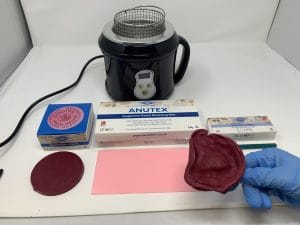
The working temperature for an impression compound typically sits in the range of 50–55°C, but clinicians should refer to the instructions paired with their chosen material. Achieving and maintaining this consistently during preparation is essential for predictable outcomes. Uneven heating – where the surface of the material reaches the correct temperature but the centre remains colder – can compromise the quality of the impression even before it is placed.
Temperature and preparation
The water bath is an established method for reaching the correct working temperature. It provides consistent, controllable, even heating that cannot be reliably replicated through alternatives such as open flame or hot water from a tap, both of which introduce variabilities and therefore greater risk of overheating.[ii] A water bath with digital temperature control removes the guesswork, allowing clinicians to prepare material at a known, stable temperature and maintain that temperature throughout the appointment. This is particularly valuable when multiple impressions are required, or when delays occur between preparation and seating.
Equally important is the immediate environment – ambient temperature, temperature of the impression tray, and contact with cold instruments or surfaces can have more of an effect than anticipated.[iii] Pre-warming trays and ensuring the material is used promptly after removal from the water bath minimises heat loss and preserves the window of optimal working consistency.
Chairside considerations
Beyond temperature, the physical properties of conventional impression materials introduce additional variables that require clinical attention. High-viscosity materials offer excellent detail capture, particularly for recording fine grooves and other details, but require confident placement to avoid distorted final pieces.
Timing is critical. Impression compounds begin to set as they cool in contact with oral tissues. Clinicians should be familiar with the working time of the specific material in use, and should minimise delays between preparation and seating. Patient cooperation, moisture control, and tray stability during the setting phase all influence the final result.iii
Temperature and transport
Once a successful impression has been taken, the challenge does not end at the chairside. The period between impression removal and pouring in the laboratory introduces a second set of environmental risks that are often overlooked in clinical practice.
Packaging impressions appropriately for transit – using insulated containers where necessary, avoiding prolonged exposure to direct sunlight, and ensuring prompt collection and delivery – should be part of standard clinical protocol rather than an afterthought.
Choosing the right products
Consistent results begin with materials and equipment designed to support accurate workflows. Kemdent supply a Dental Water Bath which was designed, developed, and tested by UK dental clinicians and features digital temperature control with a fitted lid to maintain stable working conditions throughout preparation. Fully autoclavable and with a wipe-clean outer casing, it is built for clinical environments where infection control is a priority. Kemdent’s KemKat Impression Compound – with a recommended working temperature of 50–55°C – offers high viscosity for exceptional capture of sulcal depth. It also has a convenient form that allows for it to be broken down into only the amount needed for partials or additions, reducing waste.
Temperature management in conventional impressions is not necessarily complex, but it does require deliberate attention at every stage of the workflow. When the conditions can be controlled, the materials prepared correctly, and the handover to the lab is managed with care, the conventional impression remains a highly reliable tool for clinicians.

For more information about the leading solutions available from Kemdent, please visit www.kemdent.co.uk or call 01793 770 256
Author: Alistair Mayoh Marketing Director Kemdent

[i] Al-Ansari A. Which final impression technique and material is best for complete and removable partial dentures?. Evid Based Dent. 2019;20(3):70-71. doi:10.1038/s41432-019-0039-0
[ii] PHC Corporation. Water Bath Science: Ensuring Precision in Your Lab Work | solution | PHCbi. PHC Holdings Corporation. Published 2025. https://www.phchd.com/apac/biomedical/service-downloads/evolving-science-for-the-future/laboratory-water-bath-science
[iii] Gupta R, Brizuela M. Dental Impression Materials. [Updated 2023 Mar 19]. In: StatPearls [Internet]. Treasure Island (FL): StatPearls Publishing; 2026 Jan-. Available from: https://www.ncbi.nlm.nih.gov/books/NBK574496/