

For many patients, the final day in the chair may feel like the final day of their long implant journey. Plenty of challenges are now in the rear-view mirror, but plenty still remain ahead. Namely, oral hygiene and restorative upkeep. It is, of course, vital to protect the investment of dental implants, but is post-implant care likely at the forefront of every patient’s mind at this stage?

Dental implants have an impressive survival rate: over 95% at 10 years,[i] yet peri-implantitis affects approximately 20% of all implant patients.[ii] This inflammatory condition, characterised by progressive bone loss around osseointegrated implants, is the primary threat to their long-term survival.
Patients can potentially spend thousands on implant treatment, and yet surgical success is really only the beginning. Long-term survival depends on effective daily oral hygiene, yet for many with fixed implant bridges and overdentures, achieving adequate cleaning using traditional methods proves remarkably difficult.
Why implants fail
Peri-implantitis mirrors periodontal disease in some ways, but typically progresses more rapidly. Inflammatory lesions around failing implants are often larger than comparable periodontal sites, while bone loss follows a circumferential pattern.[iii]
What begins as reversible peri-implant mucositis – soft tissue inflammation without bone loss – converts to destructive peri-implantitis if biofilm accumulation continues. Strong evidence identifies controllable risk factors: history of chronic periodontitis, poor plaque control, and absence of regular maintenance care.[iv]
The oral hygiene gap
When it comes to patients with single-unit implants in accessible positions, traditional string floss might suffice. However, many face more complex scenarios: multiple-unit bridges or implant-supported overdentures creating physical barriers to conventional cleaning.
Consider the patient with a fixed implant bridge. The prosthetic sits against tissue, creating an interface where biofilm accumulates. String floss cannot access the underside of fixed prosthetics, and interdental brushes cannot navigate the complex structures of implant abutments and pontics. Patients with implant-supported overdentures may find accessing the junction between implant, abutment, and tissue – where plaque threatens peri-implant health the most – close to impossible with traditional tools.
This accessibility issue can be a fairly serious one for health and implant survival, as it is bacterial biofilm in these locations that drive peri-implant disease. If patients cannot effectively remove it daily, the conditions for peri-implantitis development are present regardless of how well the treatment has gone up until this point.
When cleaning is inadequate
When biofilm removal fails, the inflammatory cascade begins. Initially, patients develop per-implant mucositis: bleeding on probing, tissue redness, swelling. At this stage, the condition remains reversible with improved hygiene.
However, continued presence of biofilm converts peri-implant mucositis to peri-implantitis. Probing depths increase, bone loss becomes evident radiographically, and inflammatory lesions extend deeper. Once established, peri-implantitis cannot be reversed through oral hygiene alone, and surgical intervention becomes necessary.[v] Clinical implications aside, patients can experience anxiety about their costly investment failing, embarrassment from visible dental issues, and the stress of potentially having to undergo treatment all over again. Managing failing implants, for practitioners, is a crucial and sometimes difficult process.
What do implant patients need?
The secret to effective peri-implant hygiene is taking the time and care to reach those areas traditional tools may find it hard to access. A soft-bristled toothbrush to avoid scratching the implant, low-abrasion toothpaste, and an antiseptic mouthwash for the management of bacteria could all contribute to the new hygiene routine, but these hard-to-reach areas demand more specialised cleaning methods.
Research demonstrates that water flossers address this accessibility challenge well. Studies comparing water flossing to string floss around implants show that they are more than twice as effective, indicating a 145% greater reduction in bleeding on probing.[vi] The mechanism is straightforward: pulses of water reach beneath prosthetics, around abutments, and into areas string floss physically cannot access. The irrigation effect removes loosely attached biofilm while creating a flushing action at the same time, which non-water flossing techniques cannot replicate.
Setting patients up for success
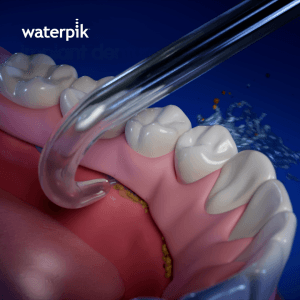 Water flossing’s advantage in accessibility can change the game for patients with implants. Arguably, when it comes to risking peri-implantitis, using a water flosser goes beyond convenient to necessary.
Establishing water flossing as part of the immediate post-treatment protocol, rather than waiting for signs of a problem, will help set patients up for long-term success. During the healing period, gentle flushing out can support tissue recovery, and as patients transition to long-term maintenance, this already established routine will continue to protect their investment.
The Waterpik™ Ultra Professional water flosser addresses the specific challenges implant patients face through a range of specialised tips designed for different restoration types. For patients with implants, crowns, and bridges, dedicated tips access stubborn biofilm in areas traditional tools cannot reach. Those with implant-supported overdentures or fixed implant bridges will benefit from specific tips designed to target areas beneath and around prosthetics, enabling patients to maintain that implant-tissue interface.
Practitioners placing or restoring implants should recognise that traditional oral hygiene recommendations may prove inadequate. Patients invest substantially in implant treatment, and expect long-term success. Providing them with tools capable of maintaining that solution is an essential part of the treatment. Evidence increasingly supports water flossing as a primary recommendation for implant patients, particularly those with fixed bridges or overdentures – protecting implant investments requires appropriately sophisticated post-surgical prosthodontic care.

For more information on WaterpikTM water flosser products visit www.waterpik.co.uk. WaterpikTM products are available from Amazon, Costco UK, Argos, Boots and Tesco online and in stores across the UK and Ireland.
 Anne Symons – Waterpik Ambassador Dental Hygienist currently working in a Specialist Periodontal/implant practice.
[i] Survival and Success. Adi.org.uk. Published 2025. https://www.adi.org.uk/resources/after_care_survival_and_success/
[ii] Diaz P, Gonzalo E, Villagra LJG, Miegimolle B, Suarez MJ. What is the prevalence of peri-implantitis? A systematic review and meta-analysis. BMC Oral Health. 2022;22(1):449. Published 2022 Oct 19. doi:10.1186/s12903-022-02493-8
[iii] Carcuac O, Berglundh T. Composition of human peri-implantitis and periodontitis lesions. J Dent Res. 2014;93(11):1083-1088. doi:10.1177/0022034514551754
[iv] Wada M, Mameno T, Otsuki M, Kani M, Tsujioka Y, Ikebe K. Prevalence and risk indicators for peri-implant diseases: A literature review. Jpn Dent Sci Rev. 2021;57:78-84. doi:10.1016/j.jdsr.2021.05.002
[v] Rokaya D, Srimaneepong V, Wisitrasameewon W, Humagain M, Thunyakitpisal P. Peri-implantitis Update: Risk Indicators, Diagnosis, and Treatment. Eur J Dent. 2020;14(4):672-682. doi:10.1055/s-0040-1715779
[vi] Magnuson B, Harsono M, Stark PC, Lyle D, Kugel G, Perry R. Comparison of the effect of two interdental cleaning devices around implants on the reduction of bleeding: a 30-day randomized clinical trial. Compend Contin Educ Dent. 2013;34 Spec No 8:2-7.