Dr Christopher Leech presents a dual arch case treated with FP1 prosthetics and immediately loaded.
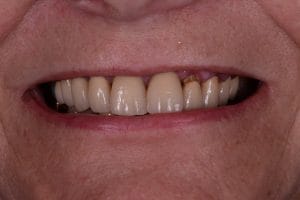
A 59-year-old female patient presented at the dental practice feeling dissatisfied with the appearance of her teeth. She had last visited the practice in 2018 and her dentition was generally compromised. The absence between appointments was due to her dental dissatisfaction and being unmotivated to do anything about her teeth, as well as suffering with depression. The patient was now finding it harder to chew and had read about dental implants as a possible solution.
A comprehensive assessment of her dentition found active periodontal disease and an overall poor level of oral hygiene. Bone loss was generally circa 20% and worse in the 16 region with furcation involvement. Ill-fitted crowns were present on the 12, 13, 14, 15, 41 and 42. The 16, 26, 34 and 35 had also been heavily restored. A discussion was had with the patient on how to improve her dentition, rather than removing the teeth for implants. As the patient was an active smoker this risk factor to dental implant success affected the decision-making.
Finding the best option
Option one was to remove all current crowns and investigate the restorability of each tooth, stabilise the periodontal disease and plan for a full mouth reconstruction. Because of the timeframe and added uncertainty, the patient did not want the current restorative work to be dismantled for a restorability assessment. The idea of leaving with the bulk of the treatment done in one day was more appealing, even though the irreversible element of this was highlighted.
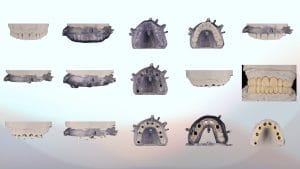
FP1/2/3 approaches were then discussed. The patient liked the idea of an FP1 to preserve the gingival tissues. This was felt to be the most minimally invasive option too. To improve understanding and consent, the patient’s husband attended and the different treatment options were again relayed verbally, in writing and with case pictures. All parties were satisfied and the patient was still happy with her choice. A CT scan was taken to allow for planning once dental implants were decided upon.
Treatment begins
Facially generated treatment plan principles were followed to optimise the aesthetic outcome. Communication with the dental technician was done virtually to trial a few options and make live adjustments together. The patient and her husband were then shown the proposed outline and it met their approval.
The initial prosthetics were made from milled PMMA on temporary cylinders and the final prostheses was a zirconia framework with ceramic restorations.
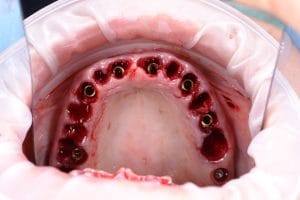
Sweden & Martina Prama implants were chosen to maximise soft tissue space and raise the working position away from the bone, and were placed fully guided. The prototype prosthetic was attached to pre-adjusted temporary cylinders and modified chairside to avoid inaccuracies and future impression taking. Teflon/gic was used to seal the screw holes and secure the prototype prosthetic.
Reviews and final placement
After one month, healing had been painless but the lower left canine region did not look quite right. The patient’s oral hygiene was sub-optimal and she had been unable to reduce her smoking. The importance of making lifestyle changes was reiterated. At the three-month mark 3 Shape and the Trios scanner were used to scan the temps, tissue contours and scan flags. The final FP1 prostheses were fabricated. The patient also felt the teeth were too small and narrow for her smile. This was amended via digital planning in Exocad.
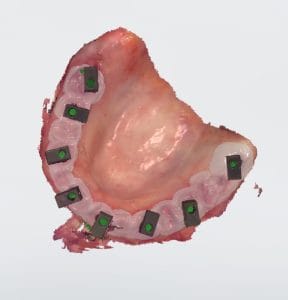
The prototypes were removed and the final restorations torqued. The patient was delighted and understood the need for ongoing professional oral hygiene alongside daily dental care.
Complications and reflections
The patient’s oral hygiene was a concern, especially being a smoker. This gave her a riskier healing profile, but she accepted this. The planned implant in the lower right premolar region was removed at surgical placement due to a lack of primary stability, but there was enough cross-arch support to instead accommodate an immediate load. The lower left lateral central incisor implant also failed to osseointegrate, likely due to poor oral hygiene and smoking. Due to originally planning for 6 implants we still have 4 well-positioned implants for a good outcome.
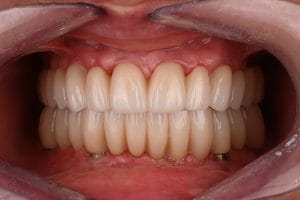
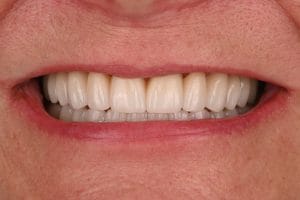
Whilst I preferred the patient’s initial prosthetics, the patient was happier with the amended look and this shows the importance of clear communication between clinician, patient and dental technician. Either way, the treatment was a huge improvement for the patient, providing a healthy, functional and aesthetic outcome.
Huge thanks to Andreas and Eddy at Vivo Dental Lab for their support with this case.

For further information and enquiries about the British Academy of Cosmetic Dentistry visit www.bacd.com
 Bio: Dr Christopher Leech is President-elect for the BACD and is based at Clear Dentistry, Bishop’s Waltham. Chris was the first UK dentist to pass the Membership for Advanced General Dental Surgery with the Royal College of Surgeons Edinburgh and also holds their implant diploma. He is an examiner for them and is also a Fellow of the Royal College and the College of Dentistry.