

It will come as no surprise to say that dental practices operate slightly differently than many other businesses. This is apparent in everyday routines, financial considerations, and the waste items produced throughout the day. When a piece of legislation is implemented in the UK that affects both businesses and homes – as the Simpler Recycling policy has done – it’s vital to interpret it through the lens of dentistry, and understand how pre-existing regulations will marry with it.
For many businesses, the new rulings on waste workflows will affect miscellaneous items such as coffee cups and waste paper. In the dental practice, a wider variety of waste items produced fall under critical clinical waste regulations. All dental teams need to be aware of their responsibilities. Many of them will also opt to work with a professional waste management service to ensure each item is managed carefully and successfully.
Understanding the latest requirements
The Simpler Recycling rules came into practice on 31 March 2025, affecting all businesses with 10 or more full-time equivalent employees. Practices that do not meet this number of team members still have until 31 March 2027 to enact the rules.[i] This directive ensures waste items are better separated at the source, improving recycling opportunities which, in turn, benefits the environment. The rules build on current waste responsibilities, and impact all businesses, charities and public sector organisations – a wide umbrella that dental practices inevitably fall under.
The changes made by the guidance require further separation of waste generated into residual (non-recyclable) waste, food waste, paper and card, and all other dry recyclable materials (including plastic, metal and glass). Any waste produced by visitors to a dental practice also needs to be separated in this way before collection by a waste service team.
Recycling contamination is an issue that must be contended with when organising this updated waste workflow. If items are incorrectly placed into an alternative waste stream, for example, food waste is placed into the dry recyclable bin, all items in the container may no longer be recyclable. Contamination also applies to items that are not clean enough, for example, plastic containers with residual food or liquid. To reduce the risk of recycling contamination, clear signage should be placed at waste sites throughout the practice. Team members should also be reminded of their responsibilities, and how they fit within current waste workflows.
Clinical contamination
Another prominent set of waste regulations for the dental practice is Health Technical Memorandum 07-01 (HTM 07-01). This guidance, which applies to all healthcare spaces and those that deal with healthcare related products, including dental laboratories, defines the correct protocol for managing a range of everyday waste items. It includes directions on the handling of clinical waste items, such as infectious, amalgam-contaminated, offensive and medicinal waste, and much more.
When an item that would otherwise fall within the Simpler Recycling guidelines becomes contaminated in a dental setting, there is a chance that its waste management falls under protocols in HTM 07-01, or similar regulations. For example, dental bibs could be considered a simple waste item that would fall into dry recycling materials. If a box of these were sufficiently damaged in storage and no longer suitable for use with patients, they could be placed into a simple dry recycling container.
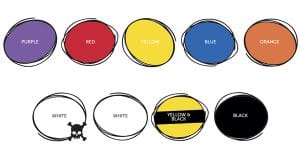
However, once used in care, a dental bib may be contaminated by aerosols produced during scaling and polishing. Now unpleasant, but not necessarily hazardous, the bib should be placed in the offensive waste stream, signified by a yellow and black (tiger stripe) container.[ii] If the patient has an infection and still requires care, and the dental bib is contaminated, the item would then be placed in the orange waste stream for known infectious items.
Clinicians should understand the context around the production of each waste item and be able to segregate appropriately with this knowledge.
Preparation makes perfect
The dental practice should be prepared to manage a wide variety of waste items. This can be facilitated with appropriately labelled containers throughout the premises, located at common points of disposal. Alongside these, choose clear posters that aid professionals with elements such as the waste colour code – this can streamline each decision, for safer disposal.
Initial Medical, a leading waste management service, provides dental professionals with support and an array of clinical solutions for everyday care. This includes a full range of simpler waste disposal options for glass, dry mixed recycling, paper and even general waste, supporting correct waste segregation throughout your practice. Alongside them, find free-to-download colour coding posters on the Initial Medical website, for clear information at a glance.
The Simpler Recycling workflows aren’t complex – and clinical waste management doesn’t have to be either. Understanding how contaminated items are segregated helps clinicians recycle safely, and this can begin with clear communication, signage and containers throughout the practice.
To find out more, get in touch at 0808 304 7411 or visit the website today www.initial.co.uk/medical
About Initial Medical
Initial Medical set the standard in healthcare and infectious waste management in the UK, providing a reliable, effective and fully compliant service built around customer needs and delivered by our highly trained local teams. We are ISO 9001:2015 accredited, with technology fully integrated into our operations, providing full traceability of service delivery, electronic waste documentation and the best customer experience possible. We also offer innovative healthcare waste management services and infection control products to help break the chain of transmission and prevent cross contamination.
Initial Medical are a company with a ‘World Class’ Health and Safety record, and ISO 45001:2018 accreditation. We are also accredited to ISO 14001:2015 environmental standards and pride ourselves on our sustainable approach with a focus on delivering eco-friendly products and operational solutions.
 Author: Rebecca Waters – Rentokil Initial
Media enquiries:
For more information, please contact:
01227 265700
[i] Department for Environment, Food and Rural Affairs, (2025). Simpler recycling: workplace recycling in England. GOV.UK (Online) Available at: https://www.gov.uk/guidance/simpler-recycling-workplace-recycling-in-england [Accessed February 2026]
[ii] NHS England, (2019). Health Technical Memorandum 07-01. (Online) Available at: https://www.england.nhs.uk/wp-content/uploads/2021/05/B2159iii-health-technical-memorandum-07-01.pdf [Accessed February 2026]