

Dr Amit Mohindra presents a restorative workflow that can be replicated to assist patients in visualising permanent outcomes with temporary solutions.
For many dental patients, personal aesthetic goals are often surrounded by the anxiety of what is achievable. Restorative dentistry traditionally involves treatment with multiple stages, only worsening these inhibitions. However, the modern dental workflow now allows for previews of outcomes within a shorter time-frame, reducing dental anxiety and creating better patient reception and compliance.[i]
Patient presentation
A male individual presented as a new patient to the practice for an implant consultation. His routine dentist had already suggested that – to achieve the aesthetic he wanted – his treatment options were limited to the extraction of all the upper teeth and full-arch implant rehabilitation.
Assessment
Oral hygiene was fair with gingivae under control and no other underlying gingival concerns. It became apparent that although some teeth had hopeless prognosis, most of them were restorable. He also had a deep bite that brought him discomfort (see figures 1-3).
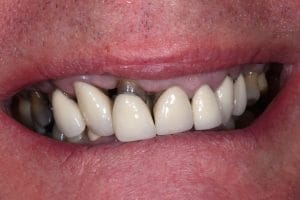
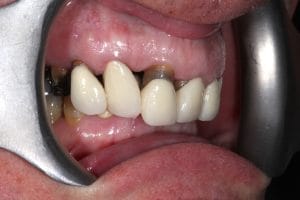
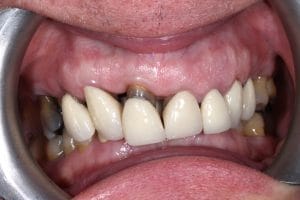
The patient had previously undergone restorative work, with existing restorations in place. He expressed that the main issues for him were aesthetic, including: receding gums, dark lines on crowns, and a missing upper right lateral incisor. Despite efforts to close the gap from the missing tooth, the result was the disproportionate widening of bordering teeth in the process.
Planning
Firstly, regular hygiene visits were planned to maintain oral health.
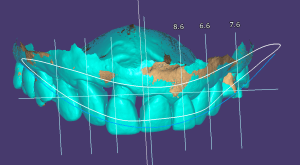
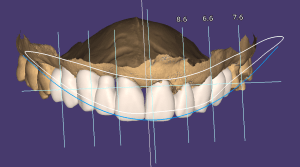
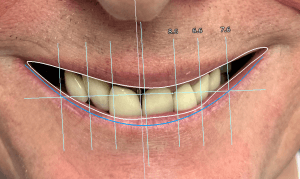
Initial scans were captured using IOS (Medit) and then transferred into Exocad for smile design (see figures 13-17). This design function allowed the exploration of treatment options, determining that the UR lateral could be replaced without closing the gap completely. This meant the incorporation of a dental bridge was necessary, which although a compromise, was still aesthetically and functionally acceptable.
After being shown his smile simulation, the patient still struggled to comprehend the proposed smile design, unable to visualise the result in his mouth. Therefore, the SprintRay Pro S 3D printer was used to create a temporary bridge that would assist in physically demonstrating the prospect more clearly and tangibly.
The use of digital workflows was convenient and advantageous: The SprintRay Pro S 3D printer reduced the fabrication process to just a single day, rather than the usual multiple week process. The streamlined workflow established more efficient communication both with the patient and internally.
The design software also afforded the opportunity to open the patient’s deep bite. This procedure was mildly traumatic, but was significantly reduced, improving comfort.
Treatment phase
A bridge was 3D printed chairside using the SprintRay Pro S and the SprintRay OnX Tough resin as a temporary solution. This was placed immediately to readily restore the function and aesthetics (see figures 4 and 5).
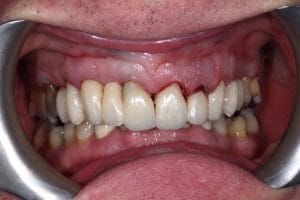
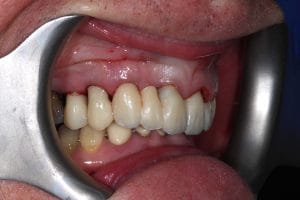
The characterisation of the temporary bridge was minimised, as the priority was to determine whether it was feasible regarding appearance, functionality, and patient acceptance. The patient’s concern was primarily to minimise costs, which is why the SprintRay 3D printer allowed him the ability to “trial” the look before making a huge investment into something he might potentially be unsatisfied with. This test period also allowed the patient to make a more informed decision on his new look by seeking the opinions of family and friends and taking more time to consider the look away from the dental chair.
Once successful, the digital scan was sent off for laboratory-made zirconia bridge.
Outcome and reflections
This treatment journey gave a “wow factor” to the patient, who was particularly pleased to have such a remarkable result in a single visit (see figures 6 and 7). The streamlined workflow and communication increased the patient’s trust in the process – allowing him to progress with the permanent solutions.
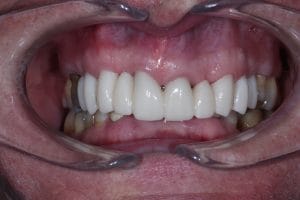
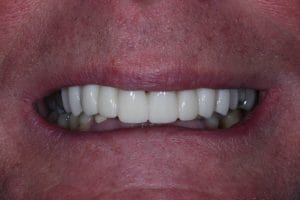
The speed of the SprintRay 3D printer allowed for full control over tweaks and duplicates to be made as necessary. This meant that every amendment could be made in a cost-effective “trial period” before permanent restorations were made – with patient involvement too. For practices, this modern workflow is a huge practice builder as patients feel you are genuinely listening and carefully assessing their situation –involving them in, but not rushing them through their decisions.
Due to the temporary smile, any inhibitions could be readily altered during this temporary stage, which together, led to a better patient journey reinforced by trust and shared control – and facilitating expectation management.
The patient was also very happy with the comfort that opening his bite brought him.
The chairside 3D printed temporaries are far superior to other options such as wax ups. They are more cleansable, make it easier to maintain gingiva heath, longer lasting with higher quality material, and offer service that supports the entire process.
Supporting evidence
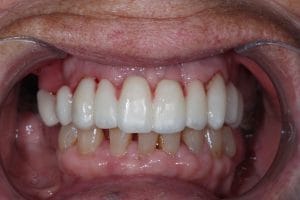
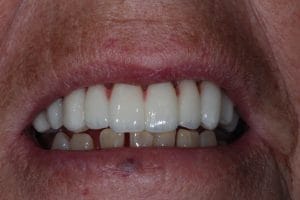
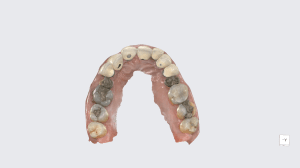
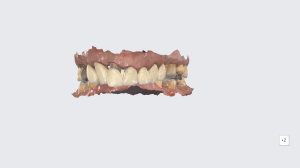
This workflow is applicable to various clinical scenarios. A new female patient presented with a misaligned bite, periodontal disease, and multiple missing teeth. She requested the removal of all her teeth, and replacement with a denture to avoid implants. An assessment indicated that she had 4 remaining salvageable teeth and the rest were of a hopeless prognosis (see figures 8 and 9).
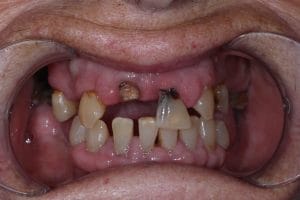
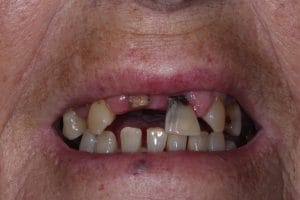
Following a similar workflow to the above patient, a temporary bridge was designed and printed with the SprintRay Pro S 3D printer (see figure 10). The patient was extremely satisfied with her new look, and left with a full set of teeth without a denture and was able to progress with a full zirconia bridge (see figures 11 and 12).
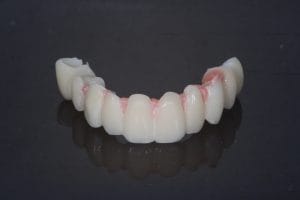
The patient journey is built on trust in their practitioner, which is enhanced with modern technology for same-day solutions. These workflows are easily repeatable and enable patients to see and feel what is achievable. These transformations deliver complete patient satisfaction, at every stage of the treatment.
For more information, please visit https://sprintray.com/en-uk/

 Author bio: Dr Amit Mohindra is a highly skilled clinician based in Oxford. His areas of expertise include dental implants, tooth replacement, and sedation procedures. He has a passion for digital innovation and aesthetic restoration, particularly digital dental implantology.
[i] Appukuttan DP. Strategies to manage patients with dental anxiety and dental phobia: literature review. Clin Cosmet Investig Dent. 2016 Mar 10;8:35-50. doi: 10.2147/CCIDE.S63626. PMID: 27022303; PMCID: PMC4790493.