

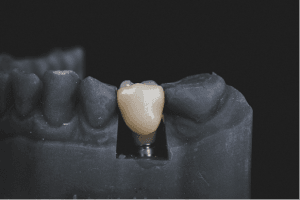
Dental implants are a desirable and reliable restorative solution for the partially or fully edentate patient in modern dentistry. However, the success and long-term stability of the implant restoration relies on the quality and quantity of supporting bone. Unavoidable crestal bone resorption often occurs following extraction and the resulting ridge dimension changes present a challenging problem for the restoring clinician. Insufficient hard and soft tissues are a leading cause of implant failure but significant advances in the area of biotechnology have changed how such deficiencies are approached.[i]
Guided bone regeneration (GBR) offers successful and predictable horizontal, and vertical bone augmentation allowing dental implants to be sufficiently supported in bone for stability and good long-term outcomes. Compared to other techniques, GBR is cited as offering the most favourable outcomes.[ii] Despite 35 years of development and progress, it is still relatively technique sensitive and complications relating to biomaterial, surgical technique and patient factors must be considered. It is a steep learning curve, but the literature consistently shows that more experienced operators have a reduced incidence of complications.[iii]
Challenges of GBR
Bony ridge defects and morphology changes present clinicians with aesthetic and restorative challenges, especially in anterior implant restoration, even with the introduction of shorter implants.[iv] GBR offers a surgical solution for bone augmentation to reestablish adequate alveolar bone dimension, utilising barrier membranes with or without particulate bone substitutes. Despite its documented superiority over other grafting techniques, it is challenging due to inherent biological sensitivity and surgical complexity as it is dependent on healing, vascularity, and space maintenance.
Traumatic extraction, longitudinal root fracture, or pre-existing periodontal disease increase the risk of alveolar ridge defects, the morphology of which increases technical difficulty in GBR. Patient factors such as compliance, pre-existing comorbidities (systemic diseases like diabetes or cancer) and behaviours such as oral hygiene and smoking cessation also have a direct impact on GBR outcomes.[v] Furthermore, flap handling and tension-free closure are significant surgical skill pre-requisites for successful GBR outcomes.
Choice of biomaterial is an important consideration since bioactivity, graft, and barrier properties affect both ease of handling and biological integration. Despite well-documented stringent protocols for GBR, there remains variability in outcomes. Such is the extent of the evidence that case selection presents innate problems for the clinician, and the literature has attempted to classify levels of difficulty in bone augmentation cases, defect morphologies, complications, and failures.[vi] [vii] [viii]
Clinical risks and patient experience
Due to these biological and technique-sensitive challenges associated with GBR, a spectrum of clinical complications may arise, resulting in consequences for both treatment outcome and patient experience. The most commonly cited surgical complication is membrane exposure. Clinically, wound dehiscence is problematic as it increases risk of contamination, leading to infection and compromised graft stability and ultimately implant loss.[ix] For patients, these complications can be as emotionally distressing as the initial tooth loss. Prolonged healing, the anticipation of further surgical interventions or in severe cases the possibility that treatment may need to be abandoned altogether can influence patient experience, expectations, and engagement with ongoing care.
Education as a key factor in successful outcomes
Much of the evidence in the literature points to operator experience as a moderator for a reduction in incidence of complications.[x] Decision-making, including case selection, choice of materials and appropriate techniques as well as planning soft tissue management meticulously all decrease risk of avoidable complications and improves predictability. However, even with good planning, complications can occur.
The importance of structured training pathways
These technical and biological complexities highlight the need for structured postgraduate training beyond isolated surgical techniques. Effective training in GBR requires an integrated understanding of defect morphology, soft tissue management, biomaterial selection and treatment planning, supported by evidence-based protocols.
The ICE Postgraduate Dental Institute and Hospital offers a course on 3D patient-specific customised grafting for the reconstruction of the resorbed alveolar ridge, led by Specialist Oral Surgeon, Professor Cemal Ucer. Covering a variety of approaches to hard and soft tissue grafts, the course also crucially offers critical appraisal of biomaterials, hands-on skills, and mentorship. Through specialist-led learning, the course supports clinicians not just in managing surgical complexity but in developing sound clinical judgement.
Expertise and training enable clinicians to plan complex bone regeneration cases, anticipate surgical challenges, and improve predictability. This way, clinicians can enhance patient comfort, reduce complications, and ensure the safest and most effective treatment outcomes for patients and practitioner reputation.

Please contact Professor Ucer at ucer@icedental.institute or Mel Hay at mel@mdic.co
01612 371842
 Author: Professor Cemal Ucer (BDS, MSc, PhD, Oral Surgeon, ITI Fellow
[i] Sulijaya, B. and Koerniadi, F.H., 2022. Guided bone regeneration prior to implant therapy in the esthetic zone: A case report. The Open Dentistry Journal, 16(1).
[ii] Buser D, Urban I, Monje A, Kunrath MF, Dahlin C. Guided bone regeneration in implant dentistry: Basic principle, progress over 35 years, and recent research activities. Periodontol 2000. 2023;93(1):9-25. doi:10.1111/prd.12539
[iii] Jepsen S, Schwarz F, Cordaro L, et al. Regeneration of alveolar ridge defects. Consensus report of group 4 of the 15th European Workshop on Periodontology on Bone Regeneration. J Clin Periodontol. 2019; 46(Suppl. 21): 277–286. https://doi.org/10.1111/jcpe.13121
[iv] Moataz, L., Afif, B., Rania, G., Lamia, O. and Nabiha, D., 2023. The Effectiveness of Guided Implant Placement and Bone Regeneration in the Aesthetic Area. Implant Therapy–A Case Report. Mathews Journal of Dentistry, 7(3), pp.1-14.
[v] Donos N, Akcali A, Padhye N, Sculean A, Calciolari E. Bone regeneration in implant dentistry: Which are the factors affecting the clinical outcome? Periodontol 2000. 2023; 93: 26-55. doi:10.1111/prd.12518
[vi] C.-H. Hsu, A. Laureti, Z. Chen, I. A. Urban, A. Pozzi, and H.-L. Wang, “ Simple-Challenging-Difficult (SCD) Difficulty Classification for Horizontal Bone Augmentation,” Journal of Esthetic and Restorative Dentistry(2026): 1–10, https://doi.org/10.1111/jerd.70116.
[vii] Checchi, V., Gasparro, R., Pistilli, R., Canullo, L. and Felice, P., 2019. Clinical classification of bone augmentation procedure failures in the atrophic anterior maxillae: esthetic consequences and treatment options. BioMed Research International, 2019(1), p.4386709.
[viii] Fontana F, Maschera E, Rocchietta I, Simion M. Clinical classification of complications in guided bone regeneration procedures by means of a nonresorbable membrane. Int J Periodontics Restorative Dent. 2011;31(3):265-273.
[ix] Kim YK, Yun PY. Risk Factors for Wound Dehiscence after Guided Bone Regeneration in Dental Implant Surgery. Maxillofac Plast Reconstr Surg. 2014;36(3):116-123. doi:10.14402/jkamprs.2014.36.3.116
[x] Alotaibi, F. F., Rocchietta, I., Buti, J., & D’Aiuto, F. (2023). Comparative evidence of different surgical techniques for the management of vertical alveolar ridge defects in terms of complications and efficacy: A systematic review and network meta-analysis. Journal of Clinical Periodontology, 50(11), 1487–1519. https://doi.org/10.1111/jcpe.13850