

Dr Simon Chard explores how AI-driven dental planning and design – with chairside 3D printing – can be utilised to replace deteriorating amalgam restorations in a single visit using minimally invasive techniques.
Amalgam restorations can develop issues which go undetected for many years, until structural failure occurs. These breakdowns do, however, offer the opportunity to explore more modern solutions – with digital dentistry affording efficiency, predictability, and durability.
Patient presentation
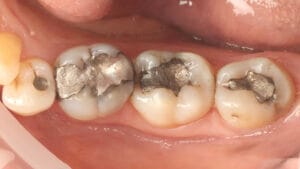
A female patient had received multiple amalgam restorations over the previous 30 years (fig 1). More teeth had broken down around the amalgam, which is a common complication of these restorations.
This initiated a wider conversation regarding the potential upgrade of her existing dental work by systematically placing more modern, tooth-coloured, indirect restorations. Her oral health was great – she was a motivated and diligent patient, who regularly attended dental hygiene appointments and was generally stable regarding caries, periodontal health, gingival disease, and decay.
Assessment
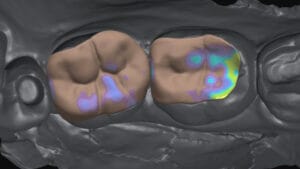
As part of the ongoing regular assessment protocol, an intraoral scan was captured for diagnostic records (fig 2). Additionally, radiographs were taken of the dentition to assess the depth of the existing restorations. There was no evident periodontal infection, but some minor, early decay was detected underneath some of the restorations – no interaction with the pulp was identified.
Following this, clinical photographs were taken and an in-depth conversation was had surrounding the status of the four teeth selected for treatment.
Treatment planning
For teeth 6 and 7, indirect restorations were selected, whilst teeth 5 and 8 – which required smaller restorations – were to be treated directly.
After identifying the early decay beneath the existing restorations, there was a clear indication for treatment, with multiple factors supporting the indirect approach. These included the size of the restorations in teeth 6 and 7, combined with the patient’s deep overbite – both increased the risk of complications like polymerisation shrinkage, postoperative sensitivity, and overall failure in a direct approach. The indirect approach, on the other hand, would deliver greater longevity while remaining significantly more conservative than a full coverage crown.
Treatment phase
All treatment was completed in a single visit – approximately three and a half hours in total. Local anaesthesia preceded the removal of the existing amalgam restorations, the cleaning away of secondary decay underneath the restorations, and the excision of any unsupported enamel where necessary to reduce the chance of further cuspal fracture.
Following the preparation of all four of the teeth, intraoral scans were taken using a Primescan scanner, which were immediately uploaded to the DS Core and imported into SprintRay’s AI design software. The AI technology created a foundational proposal for the margin placement, which I made minor tracing modifications to, optimising the proximal and occlusal contacts.
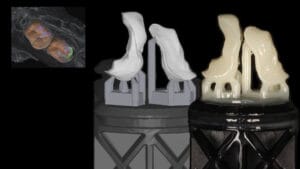
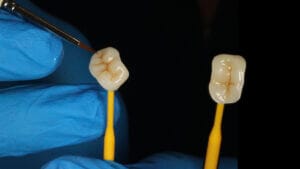
Once finalised, the designs were transferred to the SprintRay Midas system and fabricated (fig 3) using SprintRay Crown High Translucency material – both of which were printed on a single capsule in under ten minutes. Post-processing involved cleaning the restorations with IPA alcohol spray, drying them with high-power, and then using a toothbrush and an alcohol solution to ensure the complete elimination of any resin. Sprues were removed and polished to eliminate the supports with a Komet wheel on a straight handpiece at approximately 7,000 rpm.
A minor polish and characterisation were completed with a VITA Akzent glaze and the Ivoclar Empress Direct Colour staining (fig 4). The glaze was then light cured before final polymerisation was achieved in the SprintRay NanoCure unit – under light and heat – to set the material. The restorations were then sandblasted, and a thin layer of resin was applied to them with Ivoclar Adhese Universal and Variolink DC Warm Plus resin cement (fig 5).
The occlusion was checked and adjusted before completing the direct restorations on teeth 5 and 8 (fig 6), again using the Ivoclar Empress to confirm a uniform aesthetic outcome across all the teeth.
Outcome and reflections
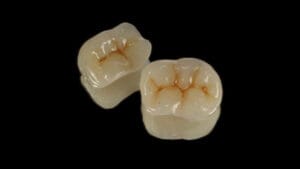
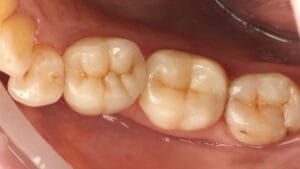
Both the patient and I were extremely satisfied with the final result – which looked aesthetically remarkable. The patient was thrilled with the lower jaw result – which was visible when talking – and to have restorations that really looked and felt like natural teeth. She now feels much more confident that these restorations structurally reinforce the teeth, as opposed to the amalgam restorations which failed to offer the anticipated durability.
Although minor refinements to anatomy on tooth 7 were constrained by the existing occlusal scheme and opposing dentition – lending less opportunity to build out more – the overall outcome was great in this case.
Clinically, the SprintRay crown material used is a heavily filled hybrid with more than 50% ceramic particle infiltration. This provided an incredible amount of strength, but with a significantly higher polymerisation of the resin, less risk of polymerisation shrinkage, less risk of fracture and more control over the three-dimensional anatomy. It’s a fantastic addition to the toolset of any restorative or aesthetic dentist’s armamentarium for indirect restorations.
Having the ability to efficiently manufacture indirect restorations chairside provides another great minimally invasive and biomimetic treatment modality that functions as an intermediary between direct and all ceramic restorations. It eliminates prolonged temporary phases, affording the function and aesthetic of a natural tooth.
Case appraisal and learning points
Ultimately, chairside 3D printing affords a remarkable upgrade to modern dental workflows. It permits the power of minimally invasive, efficient, and high-quality restorative dentistry – allowing clinicians to deliver beyond patients’ expectations.

For more information on the 3D printing solutions available from SprintRay, please visit https://sprintray.com/en-uk/
 Author bio: Dr Simon Chard BDS (Hons) BSc (Hons) is a leading UK cosmetic dentist, oral-wellness pioneer, and past President of the British Academy of Cosmetic Dentistry (BACD). He co-owns Rothley Lodge Dental in Surrey with his wife, Dr Meghan Chard, delivering modern multidisciplinary dentistry.
He is co-founder of PÄRLA, a beautifully clean oral-care brand featured on Dragons’ Den, now stocked in major UK supermarkets and pharmacies, and recognised for redefining oral care through dentist-designed, plastic free products that are better for people and planet.
Named Best Young Dentist in the UK in 2015 and Dentistry Magazine’s Person of the Year in 2023, Dr Chard is a global key opinion leader for leading dental companies, lecturing internationally on innovation and digital dentistry. His work has been featured in GQ, Sky News, and national media.
He also founded the Dental Growth Retreat, supporting dentists to build healthier, more fulfilling careers.