


Any dental professional will tell you they have goals, big or small. They may want to one day own their own practice, or become a prominent name in a niche field; some may just aim to have a steady career in the role they have already attained.
For many young professionals, implant dentistry is an area that can be of interest. It’s of little surprise, with it becoming a prominent part of modern dental care. In the UK, around 5% of adults have dental implants, and they are particularly prominent in patients aged 55 and over (8%).[i] With an increasingly aging population, there are many individuals who will be in need of such restorations in the coming years.
With this demand for treatment in mind, many professionals – at any stage of a career – may wish to pursue the path of implant dentistry. But what should the first steps look like, and how can professionals embark on their career with confidence?
Building surgical skills
Developing skills and experience around surgical care is a key foundation for future prospects. Implant dentistry is inherently invasive, and being familiar with tooth extractions, effective suturing, knot tying, tissue handling, and general instrument use is paramount. Whilst professionals may have experience from undergraduate courses, postgraduate experiences offer wider access to surgical skill development. Choosing courses that use hands-on training will help professionals gain confidence, and tutors should be able to provide feedback in the moment.
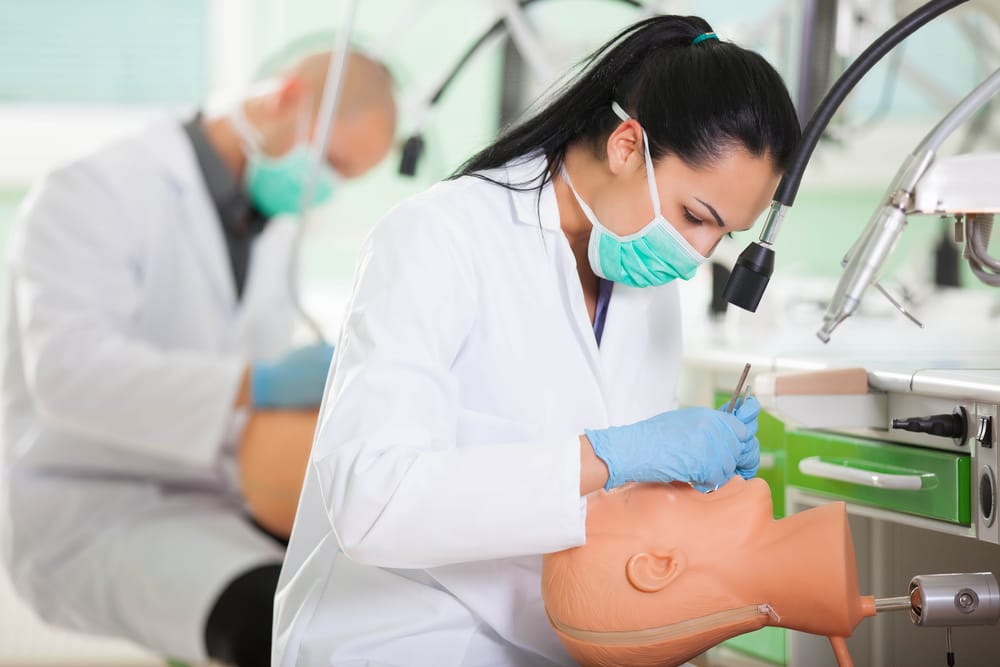
The biggest challenge for many may be broaching the gap between practice on traditional manikins and real-life oral clinical conditions; this hurdle, incorrectly managed, can affect confidence and make individuals feel under-prepared, risking an effect on the patient-practitioner dynamic.[ii] Finding courses that help clinicians make a smooth transition is key. This could be achieved by practicing on animal cadavers, shadowing mentors in real-life clinical scenarios, and leading surgeries in more straightforward cases under the guidance of an experienced professional.
With advancements in technology, we could expect to see changes to the way individuals build surgical skills. The literature has explored the use of digital virtual reality simulators, finding it can produce realistic scenarios without physical risk to patient or practitioner.ii They allow for repeated practice in a controlled setting, which can enhance procedural skills and confidence. How these solutions may be implemented into course education today and in the future is yet to be seen, but it signals an alternative method for gaining hands-on experience, which is invaluable.
Into the literature
Dental professionals will not always be able to have hands-on practice of every clinical situation before it appears in their practice; effective research fills in gaps in experience, and helps to develop knowledge and confidence. It may be that this research doesn’t lead to the ability to implement clinical action. For example, simply reading up on zygomatic implant placement will not lead to the clinical ability to complete such care. However, professionals will develop a better understanding of the cases they can complete, and potential complications that may prompt a referral to a more experienced clinician – this may create the opportunity to follow the case, and gain hands on experience through such a connection.
It’s important to understand what creates a reliable source for research. AI advancement, whilst showing promising applications in areas such as dental image detection[iii] and digital dental implant planning,[iv] is not yet entirely reliable in clinical research. Some aspects of writing may be considered hallucinations, where the information provided is false or misleading and presented as fact. This is because many AI models use a broad data set for information, and its production of content may draw from untrustworthy sources.
Instead, time taken for research to advance clinical knowledge should be dedicated to peer-reviewed papers and journals, and articles published in well-established publications. Consider finding professionals who you look up to, and delve into cases they have published, or clinical research they have completed, in particular.
Support on the courses
The best guided first steps in implant dentistry will come with the support of a comprehensive course, pairing high-quality hands-on learning with the theory that broadens clinical knowledge and confidence. Finding tutors that you can trust is key.
One to One Implant Education presents the Postgraduate Diploma in Implant Dentistry, an ideal entry into the field for professionals. Led by Dr Fazeela Khan-Osborne, a highly respected clinician and lecturer, and founder of One to One Implant Education, clinicians have the opportunity to develop practical surgical skills with hands-on lectures. Delegates will cover topics including implant planning, immediate loading, bone grafting, and long-term maintenance of restorations.
Embarking on such a journey in a career requires knowledge of the educational opportunities available. A mix of hands-on practice and in-depth research is the backbone to success, and support from experienced professionals will be key in every element.

To reserve your place or to find out more, please visit
https://121implanteducation.co.uk or call 020 7486 0000
 Author: Dr Fazeela Khan-Osborne is the founding clinician of the FACE dental implant multi-disciplinary team for the One To One Dental Clinic, London
[i] Office for Health Improvement & Disparities, (2024). Adult oral health survey 2021: self-reported health of teeth and gums. (Online) Available at: https://www.gov.uk/government/statistics/adult-oral-health-survey-2021/adult-oral-health-survey-2021-self-reported-health-of-teeth-and-gums#prosthetics-fixed-bridges-dentures-implants [Accessed January 2026]
[ii] Ren, J. G., Li, R. F., Zhang, W., Yu, Z. L., & Chen, G. (2025). Effect of digital virtual reality simulator on pre-clinical dental surgical skill training: a retrospective study. BMC Medical Education, 25(1), 1189.
[iii] Alharbi, S. S., & Alhasson, H. F. (2024). Exploring the applications of artificial intelligence in dental image detection: A systematic review. Diagnostics, 14(21), 2442.
[iv] Macrì, M., D’Albis, V., D’Albis, G., Forte, M., Capodiferro, S., Favia, G., … & Festa, F. (2024). The role and applications of Artificial Intelligence in Dental Implant Planning: a systematic review. Bioengineering, 11(8), 778.