Irrigation remains crucial in endodontic disinfection, yet the core chemistry we rely on has remained relatively unchanged since sodium hypochlorite (NaOCl) and ethylenediamine tetraacetic acid (EDTA) became standard practice during the mid-twentieth century.[i] While the sequential use of NaOCl followed by EDTA is effective, its well-documented drawbacks such as chemical incompatibility, dentine erosion and workflow inefficiency have led to renewed interest in alternative chelators.[ii] Continuous chelation, achieved by integrating NaOCl with a mild chelator such as 1-hydroxyethylidene-1,1-bisphosphonate, commonly referred to as etidronic acid (HEDP), is emerging as a feasible substitute for conventional irrigation.ii This paper seeks to study current evidence to ascertain whether continuous chelation advances current clinical practice.
A brief history and science of endodontic irrigants
The earliest reference of NaOCl dates back to World War I, when it was used to disinfect wounds and necrotic tissue.ii Its broad-spectrum antimicrobial activity and unique capacity to dissolve necrotic pulp tissue firmly established NaOCl as the gold-standard root canal irrigant.[iii] It reduces virulence factors such as lipopolysaccharides (endotoxins) while also acting as a lubricant during instrumentation.[iv] Its widespread availability, affordability and long shelf life have further contributed to its universal adoption in clinical practice.
Although NaOCl remains the primary endodontic irrigant, it has inherent limitations:
- Inability to dissolve the inorganic component of the smear layer
- Ineffective in calcified canalsii
Thus, chelation was introduced in 1957 when Nygaard-Østby proposed EDTA for smear layer removal and to facilitate canal negotiation.i
Despite advances in irrigant delivery and activation, the basic principles of endodontic irrigation have remained rooted in the traditional NaOCl–EDTA sequence. An alternative adjunct, chlorhexidine (CHX), although apt for antimicrobial activity, falls short in its tissue-dissolving ability and hence cannot substitute NaOCl as the primary irrigant.ii
The limitations of sequential chelation
Chemical incompatibility and workflow
When NaOCl and EDTA are used sequentially, chemical incompatibility is the main limitation. EDTA immediately deactivates NaOCl by consuming the free available chlorine, disabling its antimicrobial and tissue-dissolving effects;ii a reaction clinically visible as effervescence.ii A saline rinse between irrigants is therefore recommended,i but in practice, this step may be rushed or missed, reducing disinfection efficacy.
Smear layer removal at a cost
The sequential use of NaOCl and EDTA has also been associated with dentine erosion. NaOCl deproteinises the collagen matrix, weakening dentine and permitting deeper EDTA penetration, after which, EDTA demineralises the collagen-depleted substrate, causing structural collapse and allowing further NaOCl ingress, producing characteristic tunnelling erosion.[v] The severity depends on exposure time: it is reported[vi] that 60 minutes of NaOCl contact before EDTA significantly reduces dentine flexural strength and creates erosive channels up to 20 µm, increasing the risk of vertical root fracture. Although such exposure times exceed typical practice, even standard protocols can remove the smear layer at the cost of cumulative dentine erosion. These drawbacks make it necessary to explore alternative irrigation methods.
Continuous chelation: Concept and advantages
To overcome the limitations of sequential irrigation, the concept of continuous chelation was proposed. This streamlined protocol involves combining NaOCl with a weak chelator, such as HEDP, allowing simultaneous smear layer removal and disinfection throughout instrumentation.ii The advantage is compatibility; HEDP does not significantly reduce available chlorine, thus preserving NaOCl’s antimicrobial activity. This single irrigation solution has shown to be superior in preventing the accumulation of hard tissue debris while simplifying the clinical procedure.iii
Laboratory studies consistently show continuous chelation performs just as well as or shows improved results compared to sequential irrigation. HEDP produces significantly less demineralisation and erosion than EDTA.[vii] Micro-CT analyses further support that continuous chelation results in cleaner canal walls and more uniform debris removal.vii Although it has been suggested that HEDP requires a longer contact time to achieve similar smear layer removal, this is not a drawback because HEDP is present throughout instrumentation.[viii]
Clinically, the evidence is emerging. A study[ix] of simulated double-curved canals concluded that combining HEDP with NaOCl reduced instrumentation time by approximately 13% compared to NaOCl alone, resulting in a simplified workflow by eliminating the separate EDTA step.
A recent double-blind randomised controlled clinical trialiii by Pandya et al. (2025) compared continuous chelation versus sequential irrigation in patients previously treated with symptomatic apical periodontitis. The use of a calcium hydroxide dressing remained constant. The patients treated by continuous chelation produced a significantly greater reduction in intracanal endotoxins than those treated by sequential irrigation. This suggests that continuous chelation might enhance disinfection, potentially by maintaining the potency of NaOCl throughout. However, the study was limited to single-canal teeth with a small periapical lesion.
Figure 1: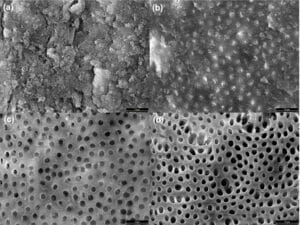
Image citation: Originally published in Boutsioukis, C. and Arias-Moliz, M.T. (2022) ‘Present status and future directions – irrigants and Irrigation Methods’, International Endodontic Journal, 55(S3), pp. 588–612.
Image description: Scanning electron microscope photomicrographs of dentine following chemo-mechanical preparation.
- A thick contaminated smear layer evident when distilled water was used as the irrigant
- Irrigation with 2.5% NaOCl during preparation resulted only in partial removal of the smear layer
- An additional final rinse with 17% disodium EDTA
- Continuous chelation, containing 2.5% NaOCl and 9% HEDP throughout preparation resulted in near-complete removaliv
Conclusion and future direction
Despite the longstanding success of the NaOCl–EDTA sequence, recent evidence shows that adding HEDP to NaOCl maintains antimicrobial function, reduces dentine damage, and streamlines the workflow. Although EDTA remains valuable, continuous chelation represents a meaningful evolution in irrigant science and a promising direction for modern endodontic practice.iv
Research into alternative weak chelators such as tetrasodium EDTA and clodronate are also under investigation.iv Ultimately, larger, long-term clinical studies involving more complex cases are necessary to establish whether continuous chelation improves patient outcomes. This will set the tone for further irrigant options in endodontics.

For more information about the BES, or to join, please visit the website www.britishendodonticsociety.org.uk or call 07762945847
 About the Author: Dr. Nikita Jiwan completed her Postgraduate Diploma in Restorative Dentistry in 2022 and is currently in her first year of the MClinDent Endodontic Programme at King’s College London. She is honoured to serve as the General Dentist Representative of the Early Career Group of the British Endodontic Society for the 2025 to 2026 term.
[i] Hülsmann, M., Heckendorff, M. and Lennon, Á. (2003) ‘Chelating agents in root canal treatment: mode of action and indications for their use’, International Endodontic Journal, 36(12), pp. 810–830.
[ii] Zehnder, M. (2006) ‘Root canal irrigants’, Journal of Endodontics, 32(5), pp. 389–398
[iii] Pandya, D.S. et al. (2025) ‘Endotoxin Levels after Calcium Hydroxide Placement in Root Canals Irrigated with Continuous or Sequential Chelation in Previously Treated Teeth with Symptomatic Apical Periodontitis: A Randomized Controlled Clinical Trial’, Journal of Endodontics, 51(11), pp. 1519–1525.
[iv] Boutsioukis, C. and Arias-Moliz, M.T. (2022) ‘Present status and future directions – irrigants and Irrigation Methods’, International Endodontic Journal, 55(S3), pp. 588–612.
[v] Rath, P.P. et al. (2020) ‘The effects of sequential and continuous chelation on dentin’, Dental Materials, 36(12), pp. 1655–1665.
[vi] Mai, S. et al. (2010) ‘Differential aggressiveness of ethylenediamine tetraacetic acid in causing canal wall erosion in the presence of sodium hypochlorite’, Journal of Dentistry, 38(3), pp. 201–206.
[vii] La Rosa, G.R.M. et al. (2024) ‘Effectiveness of continuous chelation irrigation protocol in endodontics: a scoping review of laboratory studies’, Odontology, 112(1), pp. 1–18.
[viii] Álvarez-Sagües, A. et al. (2021) ‘Efficacy of EDTA and HEDP Chelators in the Removal of Mature Biofilm of Enterococcus faecalis by PUI and XPF File Activation’, Dentistry Journal, 9(4), p. 41.
[ix] Hofpeter, K. et al. (2025) ‘Continuous Chelation Reduces Instrumentation Time and Straightening of Double-curved Simulated Root Canals in Bovine Dentin’ Journal of Endodontics, 51(3), pp. 367-372.