


Two approaches
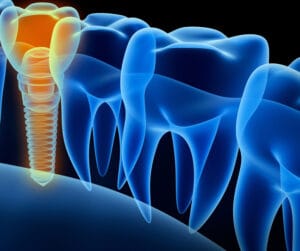
Choosing between immediate implant placement (IIP) and socket preservation, or, more broadly, alveolar ridge preservation (ARP), represents one of the more common dilemmas in modern dentistry.
On one hand, IIP often means fewer surgeries and a reduced treatment time, while ARP – grafting the site of tooth extraction with bone substitute materials – provides a predictable foundation for future procedures, but can defer implant placement by more than six months as the patient heals adequately.[i] Both choices have their practical applications, with success heavily dependent on case-by-case specifics.
The case for IIP
Perhaps the clearest benefit to immediate implant placement is the efficiency, reducing the number of surgeries needed as well as overall time in the chair for the patient, making it a potentially better choice in terms of patient convenience and budget. Biologically, the immediate placement of an implant helps to prevent resorption of the alveolar bone following tooth removal, which has long-term aesthetic benefits.[ii] Immediate provisionalisation, in addition, can have the added benefit of optimising the emergence profile, further supporting improved aesthetics.
Implant survival rate is very positive, statistically no better or worse for immediate implants than for delayed implants, at a reported rate of 98.4 percent vs 98.6 percent.[iii]
However, IIP is not without its limitations. Primary stability can be difficult to properly achieve in an area that has reduced bone density or quality. Clinicians should consider the increased technical demand and difficulty of inserting an implant into a fresh extraction socket when compared to placement in healed bone,[iv] due to a more unstable bone anatomy and increased possibility of complications.
The case for socket preservation/ARP
One of the notable advantages to socket preservation is its relative predictability. In allowing for complete healing to take place before the placement of the implants, clinicians are able to gain a more accurate picture of the final ridge dimensions,[v] as well as more precise treatment planning. This approach is especially valuable when extractions face complications that could lead to infection or substantial bone loss.
Studies demonstrate that grafted extraction sockets maintain a greater ridge width and height compared to ungrafted extraction sites. This preservation of the surrounding structural bone translates into easier implant placement, as well as a reduced need for subsequent corrective surgeries.[vi]
In terms of treatment planning, socket preservation can provide more flexibility than immediate placement, which provides a limited period of time for patient education and financial planning. In situations where immediate placement may be questionable – such as the presence of infection or thin buccal plates – socket preservation can present a more predictable option.[vii]
Time for decision making
Despite negligible differences in implant survival between the two approaches, there are notable distinctions to be found when it comes to specific outcomes.
Aesthetic results are varied. While studies report that immediate placement leads directly to superior soft tissue aesthetics,iv other research indicates that an ARP approach delivers more predictable aesthetic outcomes when it comes to a thin or compromised buccal plate.[viii]
Patient-reported outcomes tend to be close between the two approaches, with surveyed satisfaction remaining consistently comparable. However, studies did show that, though patients preferred the reduced surgical time of the IIP approach, the likelihood of post-surgical complaints tended to be higher with this surgical technique.[ix]
How can you advance your implant skills?
Clinicians must have the requisite knowledge to make the choice between immediate and delayed placement options on a case-by-case basis, and this requires structured training. For dental practitioners who wish to enhance or update their skill and education in the ever-evolving world of implantology, the ICE Postgraduate Dental Institute & Hospital provides thorough and extensive courses, spearheaded by eminent specialist oral surgeon Professor Cemal Ucer. The “Advanced certification in management of tooth loss: immediate implants vs socket preservation” offers comprehensive teaching on the management of tooth loss with evidence-based techniques. It also provides a clear roadmap for reliable decision-making, with theoretical and hands-on training designed to expand clinical, digital, and patient communication skills among practitioners.
Conclusion
Immediate implant placement and socket preservation are both evidence-supported approaches to post-extraction site management and smile restoration. As the foundation of evidence and research continues to grow, the success of implant practitioners will be based on the flexibility of their approach combined with their knowledge of procedures and their relative appropriateness. Understanding the strengths and limitations of different surgical approaches enables clinicians to optimise outcomes and prioritise patient satisfaction at all times.
Please contact Professor Ucer at ucer@icedental.institute or Mel Hay at mel@mdic.co
01612 371842
 Author: Professor Cemal Ucer (BDS, MSc, PhD, Oral Surgeon, ITI Fellow.
[i] Udeabor SE, Heselich A, Al-Maawi S, Alqahtani AF, Sader R, Ghanaati S. Current Knowledge on the Healing of the Extraction Socket: A Narrative Review. Bioengineering (Basel). 2023;10(10):1145. Published 2023 Sep 29. doi:10.3390/bioengineering10101145
[ii] Dyakova, M., Bespalova, N., Klochkov, A. & Durnovo, E., 2020. Preservation of Bone and Soft Tissue Components of the Alveolar Ridge during Immediate Implantation in the Aesthetic Zone of Jaws with Bone Deficiency. [Online]
Available at: https://pmc.ncbi.nlm.nih.gov/articles/PMC8353707/
[Accessed 26 Jan 2026].
[iii] Chatzopoulos, G. S. & Wolff, L. F., 2025. Assessing the Long‐Term Survival of Dental Implants in A Retrospective Analysis: Immediate Versus Delayed Placement. [Online]
Available at: https://pmc.ncbi.nlm.nih.gov/articles/PMC11885415/
[Accessed 26 Jan 2026].
[iv] Lee W. Immediate implant placement in fresh extraction sockets. J Korean Assoc Oral Maxillofac Surg. 2021;47(1):57-61. doi:10.5125/jkaoms.2021.47.1.57
[v] Araújo MG, Sukekava F, Wennström JL, Lindhe J. Ridge alterations following implant placement in fresh extraction sockets: an experimental study in the dog. J Clin Periodontol. 2005;32(6):645-652. doi:10.1111/j.1600-051X.2005.00726.x
[vi] Majzoub J, Ravida A, Starch-Jensen T, Tattan M, Suárez-López Del Amo F. The Influence of Different Grafting Materials on Alveolar Ridge Preservation: a Systematic Review. J Oral Maxillofac Res. 2019;10(3):e6. Published 2019 Sep 5.
Available at: https://pmc.ncbi.nlm.nih.gov/articles/PMC6788425/
[vii] Yankov YG. Socket Preservation and Guided Bone Regeneration: Prerequisites for Successful Implant Dentistry. Cureus. 2023;15(11):e48785. Published 2023 Nov 14. doi:10.7759/cureus.48785
[viii] Fok MR, Pelekos G, Jin L. Efficacy of Alveolar Ridge Preservation in Periodontally Compromised Molar Extraction Sites: A Systematic Review and Meta-Analysis. J Clin Med. 2024;13(5):1198. Published 2024 Feb 20. doi:10.3390/jcm13051198
[ix] Fan L, Zhao R, Zheng X, Yuan Z, Xu X, Gong J, 2025. Comparative efficacy of immediate implant placement and alveolar ridge preservation after tooth extraction: A comprehensive systematic review and meta-analysis of randomized controlled trials. [Online]
Available at: https://pmc.ncbi.nlm.nih.gov/articles/PMC12747038/