

An evidence-based approach to preserving pulp vitality
Vital Pulp Therapies (VPTs) are ‘treatment strategies aimed at maintaining the health of all or part of the pulp’1. Traditionally favoured for cases of small pulpal exposures or traumatic dental injuries, their application has broadened since the introduction of hydraulic calcium silicate cements (HCSC) with faster setting times, reliable sealing properties and excellent biocompatibility. Increasing evidence now supports their success in managing carious exposures even in cases with symptomatic irreversible pulpitis in permanent teeth2, establishing VPT as a biologically conservative and simpler alternative to root canal treatment in vital teeth.
Why preserve pulp vitality?
Maintaining pulp vitality preserves the dentine-pulp complex’s natural defence, sensory and regenerative functions. It also prevents or delays disease progression to necrosis and apical periodontitis and supports continued root development in immature teeth.
From a clinician’s perspective, VPTs are generally less technically demanding than root canal treatment, require shorter operative time and carry fewer risks of iatrogenic complications. Patients benefit from rapid resolution of symptoms, fewer visits and reduced costs.
Current guidelines provide clear recommendations for case selection and technique3.
Clinical approaches
Selective caries removal involves clearing peripheral caries and the amelodentinal junction (ADJ) to sound dentine, while leaving affected dentine over the pulp to prevent exposure, followed by immediate restoration. It is indicated for deep carious lesions in cases with no symptoms or symptoms of reversible pulpitis.
Indirect pulp capping refers to the placement of a biocompatible material, such a HCSC over a thin layer of hard dentine close to the pulp, followed by a definitive restoration. It is indicated in deep carious lesions without pulp exposure, where the pulp remains vital and symptoms were absent or consistent with reversible pulpits.
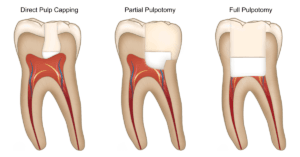
Direct pulp capping involves the placement of a biomaterial directly onto the exposed pulp, followed by the definitive restoration. This is indicated after pulpal exposure where haemostasis is achieved, in cases with no symptoms or symptoms of reversible pulpitis.
Partial pulpotomy involves removing a small portion of inflamed coronal pulp tissue beneath the exposure site to reach healthy tissue and achieve haemostasis. The exposed pulp is then covered with HCSC and appropriately restored. This is indicated in cases of carious or traumatic pulp exposure and or symptoms of irreversible pulpitis, provided haemostasis can be achieved and the radicular pulp remains vital.
Full pulpotomy entails complete removal of the coronal pulp to the canal orifices, followed by placement of HCSC in the pulp chamber and an appropriate restoration. It is indicated in cases with symptoms of irreversible pulpitis where the pulp remains vital in the canals and haemostasis can be achieved, offering a biologically conservative alternative to root canal treatment.
Clinical protocol guide
1. Diagnosis and assessment
Establish an endodontic diagnosis through history, examination, pulp testing and appropriate radiographs. Assess restorability and obtain informed consent, ensuring patients understand possible escalation of treatment if indicated.
2. Caries management
For deep caries, adopt selective caries removal as a minimally invasive approach. Clear the peripheral caries to sound dentine before progressing centrally. If pulpal exposure occurs, escalate to full caries removal with pulp capping or pulpotomy as appropriate.
3. Isolation
Perform VPT under strict aseptic conditions using rubber dam, magnification and cavity disinfection with sodium hypochlorite (NaOCl).
4. Haemostasis
Pulpal bleeding acts as surrogate marker for inflammation. Achieve haemostasis by applying gentle pressure with a cotton wool pledget moistened with diluted NaOCl for up to 5 minutes. If bleeding persists, remove additional inflamed tissue using a sterile diamond burr and repeat the haemostasis procedure.
5. Pulpal wound dressing
HCSCs such as mineral trioxide aggregate (MTA) and Biodentine demonstrate superior clinical outcomes to calcium hydroxide4. Biodentine provides shorter setting time and lower discolouration potential than MTA, however, bismuth oxide containing HCSCs must not be used on anterior teeth.
6. Restoration
Finish with a high-quality coronal seal and, where indicated, cuspal coverage to protect the remaining tooth structure.
Practitioners seeking further guidance on vital pulp therapy and endodontic care can consult the British Endodontic Society (BES) Guide to Good Endodontic Practice. The BES website also provides educational resources and the society hosts a variety of events to support continued professional development.
VPTs represent a shift toward biologically conservative, patient-centred endodontic care. When performed with appropriate case selection and sound technique, they can preserve pulp vitality, streamline treatment, and enhance long-term tooth survival, embodying the principles of minimally invasive dentistry.

For more information about the BES, or to join, please visit the website www.britishendodonticsociety.org.uk or call 07762945847
The Guide to Good Endodontic Practice can be accessed here: https://britishendodonticsociety.org.uk/news/39/a_guide_to_good_endodontic_practice
 Dr Marian Vallina BDS MJDF RCSEng MSc (Endo) DClinDent (Hons) (Endo) M Endo RCSEd, F Endo RCSEd, Specialist in Endodontics.
Dr Marian Vallina is a Specialist in Endodontics, Practice Principal at the Dental Referral Centre, Dronfield, and Clinical Teacher in Restorative Dentistry at the University of Sheffield. She serves on the committee of the Langham Endodontic Study Group and is an Ordinary Council Member of the British Endodontic Society.
References
- Duncan, H. F. et al. European Society of Endodontology position statement: Management of deep caries and the exposed pulp. Int. Endod. J. (2019). doi:10.1111/iej.13080
- Tomson, P. L. et al. Effectiveness of pulpotomy compared with root canal treatment in managing non-traumatic pulpitis associated with spontaneous pain: A systematic review and meta-analysis. Int. Endod. J. 56, 355–369 (2023).
- Duncan, H. F. et al. Treatment of pulpal and apical disease: The European Society of Endodontology (ESE) S3-level clinical practice guideline. Int. Endod. J. 56, 238–295 (2023).
- Cushley, S. et al. Efficacy of direct pulp capping for management of cariously exposed pulps in permanent teeth: a systematic review and meta-analysis. Int. Endod. J. 54, 556–571 (2021).