



There are various factors associated with the failure of dental restorations – one of the most prominent is that of fractures, particularly in cases involving posterior teeth.[i] One study saw that the median age of 413 replaced composite restorations was just 3 years, with fractures mainly to blame.[ii] The growing demand for long-lasting results, through minimally invasive treatments means that laboratory technicians are – or should be – seeking materials that are both biomechanically compatible and strong in composition.
Traditional materials, such as ceramics, can offer many favourable features, such as enhanced aesthetics that match real enamel, or ease of use within current workflows. However, these materials are often brittle under high pressure, which presents challenges not only long-term in function but also during fabrication. Chipping or cracking – whether during milling, adjustment or in situ – can inhibit success completely, sometimes even imposing the need for remakes or further intervention and increasing the risk of irreversible damage.
Fortunately, laboratories now have access to the BRILLIANT Crios from COLTENE – a reinforced composite CAD/CAM solution created with strength and aesthetics in mind. The composite is designed to absorb occlusal loads, distributing them more evenly for greater strength and resistance during both fabrication and clinical function – much like the natural composition of dentine. This results in the risk of fractures being significantly reduced, improving the longevity of the restoration
The management of fracture risk
BRILLIANT Crios supports a reliable CAD/CAM restorative workflow with a low elastic modulus – reducing stress at the interfaces – enhanced wear resistance, and improved tensile and compressive strength. Its mechanical behaviour more closely matches dentine than ceramic alternatives, which are more susceptible to chipping or breakage during processing due to crack propagation associated with material brittleness.
Published research on the composite CAD/CAM blocks prove that aesthetics doesn’t need to compromise strength. The unique composition of the BRILLIANT Crios offers resistance to both repetitive or sudden force – protecting it against failure. This is also incredibly useful for restorations that involve limited interocclusal space.
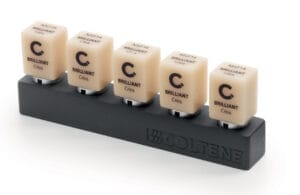
Another important situation that the BRILLIANT Crios assists in is cases that require building something that is suitable for high-load cases often prescribed due to parafunction, like bruxism. One study demonstrated that a ceramic filled restoration material offered a microhardness of approximately 28kg/mm2, whilst the BRILLIANT Crios delivers a remarkable 83kg/mm2.[iii] Hence, patients that suffer from parafunctional habits will heavily benefit from a material that promotes a higher level of flexibility and resilience.
Efficient CAD/CAM workflows
The additional firing process that is required for many ceramics is no longer necessary with the BRILLIANT Crios. This enables to streamline fabrication workflows, with restorations ready for finishing simply following bonding, luting, and curing – making BRILLIANT Crios an ideal choice for cases where reduced production time is essential, including same-day or quick-turnaround workflows in collaboration with clinicians.
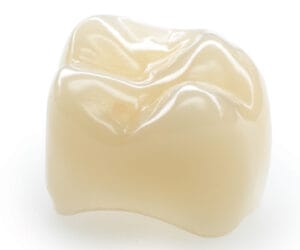
BRILLIANT Crios delivers a fast high-gloss polish. Immediately after grinding, the material presents an extremely homogeneous surface structure, meaning the restoration can be polished to an exceptionally high and lifelike gloss standard within just 3–5 minutes.
Blending into natural dentition remarkably, the BRILLIANT Crios is offered in a wide range of shades and translucencies, perfectly encompassing the requirements of both anterior and posterior sections – leading to an outstanding aesthetic finish.
Indications for BRILLIANT Crios include:
- Crowns
- Inlays and onlays
- Veneers
- Implant-supported crowns
The impressive grinding precision and speed make for the perfect combination of great results in a timely manner – significantly enhancing patient satisfaction.
Precision dentistry demands precision materials
For lab technicians, restorative outcomes are ultimately dependent upon a combination of technique and material selection. Working with one that offers a close match to natural dentine promotes the best longitudinal outcomes – particularly in avoiding fractures down the line. Even in the most complex cases, the BRILLIANT Crios from COLTENE supports these requirements by delivering beautifully aesthetic outcomes without compromising on strength – all within a minimally invasive, efficient workflow. Allowing a strong connection to be built between the laboratories and clinical professionals, this is something that ceramics simply cannot offer.
For laboratories aiming to deliver reliable, fracture-resistant and highly aesthetic restorations – particularly for challenging posterior or limited-space cases – BRILLIANT Crios from COLTENE offers a reliable, durable, and efficient alternative to ceramics. Contact the team today!

For more on COLTENE, visit https://colteneuk.com/CRIOS, email info.uk@coltene.com or call 0800 254 5115.
[i] von Gehren, M. O., Rüttermann, S., Romanos, G. E., Herrmann, E., & Gerhardt-Szép, S. (2023). A 23-Year Observational Follow-Up Clinical Evaluation of Direct Posterior Composite Restorations. Dentistry Journal, 11(3), 69. https://doi.org/10.3390/dj11030069
[ii] Alanazi, A. M., Mian, R. I., Alshammari, M. S., Al Ibrahim, I. K., & Alnasrallah, F. A. (2019). Evaluating the trends for restorative treatment, reasons and management of failures in general dental practices of hail region. Saudi Arabia, 9-12.
[iii] Elmoselhy HAS, Hassanien OES, Haridy MF, Salam El Baz MAE, Saber S. Two‑year clinical performance of indirect restorations fabricated from CAD/CAM nano hybrid composite versus lithium disilicate in mutilated vital teeth. A randomized controlled trial. BMC Oral Health. 2024 Jan 17;24(1):101. doi: 10.1186/s12903-023-03847-6. PMID: 38233771; PMCID: PMC10792922.