


The next decade in dentistry will no doubt be committed to understanding how artificial intelligence (AI) can be used to optimise various forms of care, from general dentistry to specialty services.
Implant dentistry in particular could benefit from the advancement, but only when clinicians understand how to implement AI safely, responsibly and effectively. AI is best seen as a new tool with a wide variety of capabilities when introduced to modern dental systems – but this change is happening in front of our eyes. Therefore, clinicians must understand its abilities and how it can immediately make changes to their workflows for improved patient outcomes.
Effective AI
AI models evaluate and make predictions or decisions regarding clinical insights based on information learnt during a training phase. In implant dentistry, an AI system may analyse and learn the features, relationships and patterns of data from case records, laboratory reports, clinical images, X-rays, and more.[i]
Clinicians must understand that the quality of the outputs therefore relies upon the training models used by the system provider. When choosing a solution for patient care, it is vital to use an AI system from a reputable and reliable name, for confidence in its results.
Just as a dental professional would use any other tool, the responsibility for patient care will always lie with the dentist, even when AI is used – if an error or hallucination is produced, the dental professional must be able to review the insights and omit that from further treatment planning workflows.
This intervention may be needed far less often than some may assume, as rwe come to find AI to be evermore reliable for a variety of needs.
Paint a full picture
Analysing radiographs with AI systems has a variety of advantages for clinicians. It can aid image evaluation and support competency in implant planning, as well as prevent wrong diagnoses or treatment planning decisions. Such faults could be caused by anything from inexperience to work intensity. Its use could even make a clinician’s use of time more efficient, reducing their workload.[ii]
Studies have reported successful AI implementation when detecting dental caries, root fractures, root morphologies, determining teeth and their numbering, and more.ii This proves it’s capable of analysing anatomical features.
In implant dentistry, AI systems must be able to identify and avoid neural structures when planning for a successful restoration.[iii] A 2024 systematic review collected results from four prominent scientific articles, and found that, through the use of machine learning principles, automated segmentation of the mandibular canal on CBCT scans can be accurate, time-efficient and highly consistent, even when different computer methods are used.iii
The accuracy of AI tools for identifying maxillofacial anatomical landmarks ranges from 58% to 99.7% when compared to manual and semi-automatic approaches, according to a 2024 review.[iv] This includes a significantly faster workflow, spanning from just 1.5 seconds to under 5 minutes. This suggests that AI systems will be able to identify structures (teeth, the mandibular canal, bone, soft tissue) reliably in many cases, though clinical caution is still required.iv
Don’t stop there
Combining all available information from CBCT scans and digital impressions, and ensuring a high-quality AI system can analyse it, enables confident case set-ups for treatment planning. The findings can support a clinician’s approach to care – but the impact of AI does not need to stop here. Some solutions may be able to support implant placement and crown design, to lead through the entire workflow.
Systems have been found to produce comparable clinical plans to those created by dental professionals, with closely aligned implant positions, angulations and depth.[v] Not only does this reduce planning time – in one study, AI-generated plans took 10 minutes to create, compared to the 30 minutes spent by a clinician on average – but it could also reduce the margin of error associated with manual planning.v
The consistency shows that algorithms can analyse complex anatomical structures and account for placement angles that achieve both high stability and aesthetics, which are paramount to overall success.v
Find your system
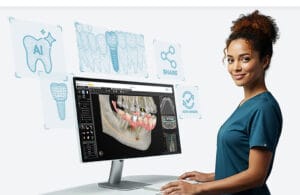
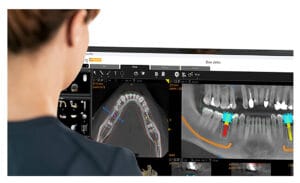
When choosing an AI system that suits your needs, from imaging analysis to treatment planning, it’s important to choose a solution that you can trust. Carestream Dental presents CS 3D Imaging Premium, with effective AI-powered implant planning software that simplifies and accelerates workflows by automating case set-up, data matching, virtual crown design and implant placement. As an add-on feature to the CS 8200 3D Advance Edition CBCT scanner, which presents versatility and quality for imaging results, clinicians can use AI in a manner that suits their care. This includes mapping the mandibular nerve canal in seconds, and optimising implant placement based on all anatomical information available.
Whilst the future of dental care is thought to include AI, it’s important to realise that said future may already be here. Embracing the opportunities created for your practice is only possible by choosing reliable systems, and using them safely for effective outcomes.

For more information on Carestream Dental visit www.carestreamdental.co.uk
For the latest news and updates, follow us on Facebook and Instagram @carestreamdental.uk

Author: Nimisha Nariapara – Trade Marketing Manager at Carestream Dental covering the UK, Middle East, Nordics, South Africa, Russia and CIS regions.
[i] Altalhi, A. M., Alharbi, F. S., Alhodaithy, M. A., Almarshedy, B. S., Al-Saaib, M. Y., Aljohani, A. S., … & Aljohani, A. B. D. U. L. R. A. H. M. A. N. (2023). The impact of artificial intelligence on dental implantology: a narrative review. Cureus, 15(10).
[ii] Kurt Bayrakdar, S., Orhan, K., Bayrakdar, I. S., Bilgir, E., Ezhov, M., Gusarev, M., & Shumilov, E. (2021). A deep learning approach for dental implant planning in cone-beam computed tomography images. BMC medical imaging, 21(1), 86.
[iii] Macrì, M., D’Albis, V., D’Albis, G., Forte, M., Capodiferro, S., Favia, G., … & Festa, F. (2024). The role and applications of Artificial Intelligence in Dental Implant Planning: a systematic review. Bioengineering, 11(8), 778.
[iv] Elgarba, B. M., Fontenele, R. C., Tarce, M., & Jacobs, R. (2024). Artificial intelligence serving pre-surgical digital implant planning: A scoping review. Journal of Dentistry, 143, 104862.
[v] Satapathy, S. K., Kunam, A., Rashme, R., Sudarsanam, P. P., Gupta, A., & Kumar, H. K. (2024). AI-assisted treatment planning for dental implant placement: clinical vs AI-generated plans. Journal of Pharmacy and Bioallied Sciences, 16(Suppl 1), S939-S941.