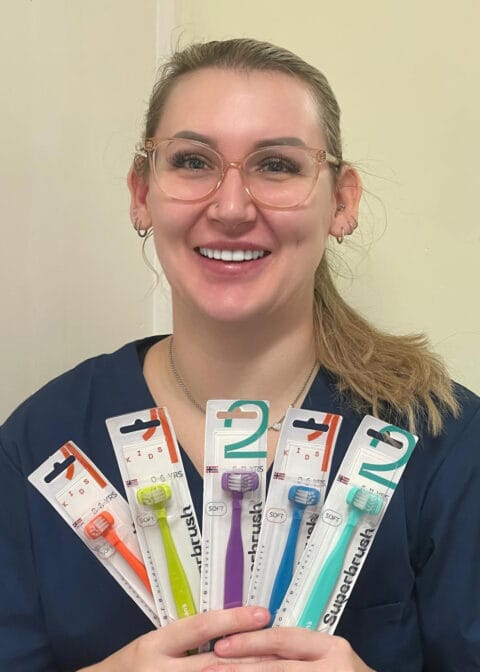
Surrey Community Dental Services, part of HCRG Care Group, has launched a new assisted-tooth brushing pilot to improve daily plaque control for patients who depend on others to clean their teeth, following an £8,608 award from HCRG’s Difference Fund.
The project is targeting one of the most persistent, yet under-addressed, practical failures in special care dentistry: how to achieve consistent, effective daily toothbrushing when patients rely on parents, family members or paid carers. More than 1,400 specialist three headed toothbrushes are being introduced across seven Surrey community dental sites (16 surgeries) for children and adults with learning disabilities, physical impairments, neurological conditions, frailty and post-surgical needs. Hundreds of patients are expected to benefit directly during the pilot phase.
The project is being led by Carly Greener-Simon, Surrey Community Dental Services.
The everyday reality behind preventable disease
For many special care patients, oral hygiene is entirely dependent on third-party support. Even where carers are committed and well-intentioned, assisted toothbrushing is frequently undermined by:
- restricted mouth opening and limited tolerance
- physical access and positioning difficulties
- variable technique between different carers
- time pressure in home and care-home settings
Carers and families frequently report a lack of availability of specialist assisted-brushing tools on the high street, making it difficult to establish and maintain effective oral hygiene routines even when they understand what is required. As a result, because these brushes are not easily sourced, daily oral care is often substituted with a standard toothbrush that is less suitable for the patient’s needs. This lack of availability creates an additional obstacle, meaning patients’ oral health needs may go unmet despite the best intentions of both staff and families.
By offering a hands-on demonstration and allowing the patient to take the recommended brush home, understanding, confidence and compliance would be significantly improved, reducing reliance on verbal explanations alone and enabling immediate implementation of correct techniques. Without this support, the outcome is a predictable clinical pattern of persistent plaque accumulation, untreated caries, advancing periodontal disease and repeated treatment under increasingly challenging conditions.
“Most of our patients/carers and parents already know they should be brushing twice daily with fluoride toothpaste,” said Carly Greener-Simon, Clinical Lead for Surrey Community Dental Services. “The problem is not the message. The problem is how you deliver effective brushing when someone else has to do it for you, twice a day, in real life. That’s where prevention breaks down.”
A simpler approach for complex situations
The pilot introduces a three-surface brushing method, where buccal, lingual and occlusal surfaces are cleaned simultaneously using short back-and-forth movements. The aim is to reduce dependence on fine motor skill and perfect technique, and instead offer a more forgiving, repeatable method for assisted brushing.
Delivery is fully embedded into existing clinical workflows. As part of routine appointments, dental teams will:
- identify patients who require third-party assistance with brushing
- supply an age-appropriate three headed toothbrush
- provide chairside, intra-oral demonstrations to parents, family members and paid carers
- integrate the approach into the patient’s individual oral-hygiene plan, without adding clinical time
“We’re not asking carers to become dental professionals,” said Carly Greener-Simon. “We’re giving them a tool that does more of the work for them, and showing them how to use it properly in the mouth they are actually dealing with.”
Measuring impact where it matters
The pilot will be evaluated using both clinical and experience-based measures, including:
- comparison of oral hygiene status at baseline and review appointments
- patient and carer feedback using the Friends and Family Test
- clinician assessment of tolerance, compliance and practical usability
- uptake and interest from care homes and supported-living services
The service will also track whether improved daily plaque control translates into reduced treatment demand and fewer preventable appointments, a key benefit for both patients and commissioners.
Health equity and system benefit
People with learning disabilities and complex needs consistently experience higher levels of preventable dental disease and poorer access to effective daily oral care. This project directly supports HCRG’s wider commitment to health equity and targeted prevention in vulnerable populations. If successful, the model could be replicated across other HCRG community dental services, supporting a shift from reactive treatment to stabilised daily prevention in assisted-brushing populations.
“This is about closing a very specific gap in the prevention system,” added Carly Greener-Simon. “If we can stabilise daily plaque control in patients who rely on others to brush their teeth, the downstream impact on disease burden, quality of life and treatment demand is substantial.”