

The choice of a restorative dental solution will always be based on delivering an effective, healthy, long-lasting, and aesthetic solution. Ever-developing products heighten the quality of the care that can be provided, whilst simplifying the workflow demanded of the dental professional.
Where clinicians may have previously kept a range of situational-specific materials, adhesives and cements on hand for the various cases that cross their path, modern solutions may be able to adapt to numerous situations. The introduction of universal resin cements has previously been called the “latest novelty” in the dental adhesive industry in a 2023 study[i] – but what sets this apart from more conventional cements, and should clinicians really begin refining their inventory to select such options?
Demands of a universal resin cement
Resin cements operate in different ways depending on the treatment site, the material that it needs to bond to, and its own individual properties. Traditionally, a cement would be either a self-adhesive solution, which does not require preparation of the dental surface,[ii] or a conventional adhesive, which requires some more clinical steps but typically shows excellent long-term performance.[iii]
The introduction of universal cements promised to bridge the gap and present several new advantages, often including the use in a variety of etching approaches, and the adhesion to a wide variety of dental substrates.[iv] The resulting solution can simplify the clinical workflow by minimising the occasions in which a choice between cements is necessary; instead, a dental professional can opt for a relied upon solution and be confident in a successful, long-lasting bond between restoration and dental tissue.
The literatureiii has laid out the demands for a “truly universal cement”, including the need to fulfil the following:
- Be indicated for application in self-adhesive and adhesive protocols
- Be indicated for luting to tooth tissues, as well as metallic, silica-based and zirconia-based restorative materials
- Be associated with a recommended universal adhesive resin, which can be used as a tooth and/or restorative material primer
- Either the universal resin cement or the adhesive resin should contain functional acidic monomers and, preferably, silane-coupling molecules to ensure chemical bridging
- Be a dual-cure material
Such characteristics emphasise the use of a universal resin cement as a versatile solution, suiting a myriad of workflows.
Choose your cure
A dual-cure resin cement is advantageous in a range of clinical situations. Clinicians will always aim to optimise the degree of conversion in polymerisation. Inadequate conversion is associated with a lower performance of the cement, creating clinical results such as microfiltration, increased water sorption, reduced colour stability, postoperative sensitivity, deficient mechanical properties, and more.[v]
The literature shows the range of advantages and disadvantages for both dual-cure resin cements and light-cured alternatives, however it’s important to note that different variables can have a significant impact on the result. The chemical activation in dual-cured cements is vital, and taking the time to ensure the correct photopolymerisation alongside self-curing can be the difference between restoration success and failure.[vi]
Self-adhesive modes can still be of use, and their design aids the simplification of the cementation process, reducing the need for pre-treatment.[vii] This could reduce chair time, improving the patient experience, whilst retaining confidence in an effective outcome – as long as the clinician chooses to use it only in appropriate cases.
A dual-cure solution gives clinicians a range of choices for treatment, adding to the versatility of a universal resin cement, and should be a heavily considered aspect when choosing an optimal solution.
Define your needs
There are a variety of universal resin cements entering the world of restorative dentistry, but it’s vital to choose solutions which offer effective results and simplify workflows. Clinicians should consider the relationship with an associated adhesive resin, and whether this can be used alone in the clinical workflow. By choosing the solutions as a pair, it may be possible to streamline the restorative material inventory, whilst maximising the clinical indications which can be treated with confidence.
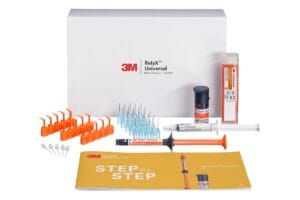
The 3M™ RelyX™ Universal Resin Cement from Solventum is an award-winning* solution that offers outstanding self-adhesive bond strength to dentine in both light- and self-cure modes. Its adhesive bond strength is further enhanced with the help of Scotchbond™ Universal Plus Adhesive, giving confidence across a range of restoration indications. Its unique formulation also ensures excess outflow stays put at the restoration margin for removal after tack curing, making the clinical workflow even simpler.
A universal resin cement offers a number of advantages to professionals. Understanding what makes an effective solution allows clinicians to upgrade and streamline their inventory, ready to make a difference in their next appointment.

To learn more about Solventum, please visit https://www.solventum.com/en-gb/home/oral-care/
For more updates on trends, information and events follow us on Instagram at @solventumdentalUK and @solventumorthodonticsemea
©Solventum 2024. Solventum, the S logo and RelyX are trademarks of Solventum and its affiliates. 3M and Scotchbond are trademarks of 3M company.
*Dental Advisor Awards, https://dentaladvisor.com/clinical-evaluation/3m-relyx-universal-resin-cement/#cu-tabs-3
[i] Breschi, L., Josic, U., Maravic, T., Mancuso, E., Del Bianco, F., Baldissara, P., … & Mazzitelli, C. (2023). Selective adhesive luting: A novel technique for improving adhesion achieved by universal resin cements. Journal of Esthetic and Restorative Dentistry, 35(7), 1030-1038.
[ii] Silva, J. M. C., Feitosa, R. A., Ferreira, D. L. A., & Viana, M. O. S. (2021). Use of self-adhesive resin cements in dentistry: a literature review. Journal of Health Sciences, 23(1), 51-55.
[iii] Maravić, T., Mazzitelli, C., Mancuso, E., Del Bianco, F., Josić, U., Cadenaro, M., … & Mazzoni, A. (2023). Resin composite cements: Current status and a novel classification proposal. Journal of esthetic and restorative dentistry, 35(7), 1085-1097.
[iv] Cadenaro, M., Josic, U., Maravić, T., Mazzitelli, C., Marchesi, G., Mancuso, E., … & Mazzoni, A. (2023). Progress in dental adhesive materials. Journal of dental research, 102(3), 254-262.
[v] David-Perez, M., Ramirez-Suarez, J. P., Latorre-Correa, F., & Agudelo-Suarez, A. A. (2022). Degree of conversion of resin-cements (light-cured/dual-cured) under different thicknesses of vitreous ceramics: systematic review. Journal of Prosthodontic Research, 66(3), 385-394.
[vi] David-Perez, M., Ramirez-Suarez, J. P., Latorre-Correa, F., & Agudelo-Suarez, A. A. (2022). Degree of conversion of resin-cements (light-cured/dual-cured) under different thicknesses of vitreous ceramics: systematic review. Journal of Prosthodontic Research, 66(3), 385-394.
[vii] Aldhafyan, M., Silikas, N., & Watts, D. C. (2022). Influence of curing modes on conversion and shrinkage of dual-cure resin-cements. Dental Materials, 38(1), 194-203.