


 James Balmforth, a dental technician at Nexus Dental Laboratory, describes the current workflows for scanning dental objects available in the lab, the challenges these present, and his experience using the Cubit360™, the revolutionary scanner from Mimetrik™.
Current frustrations
For many years, our bench-top lab scanner has dictated the pace of our work. Once the object is placed on the table for scanning, it cannot be disturbed. This means that a new scan must begin each time another element is captured. This is very inconvenient. The stop-start movements, the rotating table, the waiting and the constant interruptions created a workflow that felt clunky, slow, and exhausting. It worked – but it never worked with us. Typical model scans are possible with automated scans that effectively capture data. But there are usually further scans required. This takes up valuable time as we must constantly reposition the model.
It takes a great deal of time and patience to achieve something resembling accuracy when scanning physical impressions using our current lab scanners. Endless stitching and multiple scans are required to capture an impression in this way – there are simply too many inaccessible areas. This process misses a lot of key areas – undercuts and particularly narrow spaces, such as incisal edges – and is, therefore, unreliable and inaccurate.
Scanning dentures with traditional lab scanners presents unique challenges, especially those with attachments. The buccal flange of the denture can be so deep that the scanner cannot capture the data. Again, this leads to inaccuracy and complicated workflows.
Reaching the areas other scanners miss
The first time I used the Cubit360™, everything changed. It is certainly unique compared to other scanners, and felt very intuitive. Even without experience, I could tell instantly how much time was being saved. What would normally take minutes of rotation and repositioning was done in seconds. Quite honestly, it felt like scanning in a tenth of the time.
Cubit360™ completely transformed the scanning process. I was able to capture accurate data in areas that are traditionally hard to reach – undercuts, interproximal areas, and analogue implant sites.
I was initially sceptical about the possibility of scanning impressions using the Cubit360™, based on my experience with our previous scanner. I was delighted with this improvement. It allowed me to get clean and usable data straight from the impression tray – this opens up a world of possibilities for dental professionals everywhere. For example, by scanning impressions directly, we can skip the casting stages, using an accurate scan of the impression to jump directly into fully digital design.
Cubit360’s auto-alignment feature requires just one simple tertiary scan. With just a five second sweep, our previous scans are brought into relation – such as bite scans or a denture in situ scan.
Anyone can pick it up intuitively
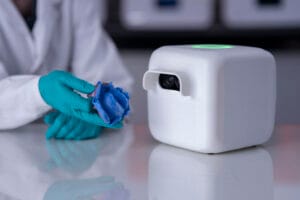
The Cubit360™ will save dental labs so much time going forward – both due to its quick scan capture time, and its ease of use. Any member of the lab team can master this technology – even the newest dental technician in the lab can take a quick scan and get back to work. Most importantly, Cubit360™ has the potential to remove so many analogue stages from our workflow. Simply scan the impression, process the case from the inverted scan, and move straight into design. All those manual stages that used to slow us down have suddenly disappeared.
Ripple effect outside the lab
The Cubit360™ has a big impact on the wider profession, with dentists able to implement it within the clinic too. As an example, clinicians can simply take an impression, take a quick scan, and send it directly to the lab. This means that the lab can flag any issues with the impression before the patient has even left the practice. This further improves the speed of patients’ care by eliminating postage, reducing retakes, and enabling quicker turnarounds.
For us as technicians, this means less physical labour and fewer bottlenecks. For clinicians, it means cleaner, faster, and more predictable results. And, for patients, it means an experience that finally reflects what modern dentistry should be.
With the Cubit360™, digital isn’t just an option – it becomes the natural default.

For more information about Mimetrik, please visit https://mimetrik.tech/