



New approaches to dental care offered by artificial intelligence (AI) may require a learning curve for clinicians. Solutions that use the technology now touch everything from office administration to business and marketing, as well as radiographic analysis and treatment planning. To ensure patients receive the best possible care when these technologies are in place, clinicians need to be able to confidently and competently utilise AI to their advantage.
AI is different from conventional computer programs, as it is learning and developing in real-time. Machine learning is the function behind everything from popular chatbots and social media feeds, to autonomous vehicles and medical solutions.[i] Understanding how this impacts dental care is important, as clinicians can more confidently use AI solutions once they appreciate how far it has come – and what it promises for the future.
How is AI trained?
AI technology is used to automate workflows, from the simple to the complex, for accurate outcomes that can be achieved more efficiently than if a person had to complete the same task. For example, in dentistry, a leading AI may be able to analyse and mark potential signs of caries or bone resorption from a radiograph in just seconds, whereas it might take minutes away from the busy day of a clinician if they were to analyse the radiograph alone.
AI also minimises the risk of human error from such tasks, though this isn’t to say that all AI technology is infallible; it is only as accurate as the information it is trained on, and hallucinations (incorrect or misleading results) may also occur due to incorrect assumptions about a prompt.[ii] When used in clinical dental care, clinicians should always assess the results produced by AI and make any appropriate changes before implementing them into a treatment plan, but can ultimately benefit from the efficiency and insights that the technology brings.
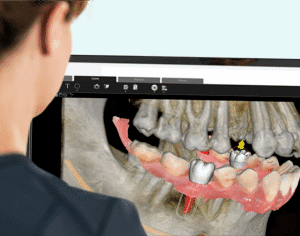
Machine learning AI is trained on datasets containing a range information, depending on the desired outcomes. For example, when creating an AI algorithm that annotates which teeth in a radiograph are actually dental implants, it will be trained on images that show dental implants and those that don’t. It then recognises patterns in each image, and makes judgments by comparing it to other results in its data-sets, much like how a human subconsciously knows the visual difference between a dental implant and a natural tooth when observed below the gingival margin based on their past experiences.
Deep learning, a subfield of machine learning, offers the ability for AI systems to learn from an increased size and complexity of data, requiring extensive computing power.[iii] It is frequently used for image analysis, and has gained prominence in biomedical research.iii
Gaining clinical confidence
Clinical interpretations of CBCT scans may find inconsistencies between two different professionals’ findings.iii This is especially true for less experienced practitioners; anyone who feels they are out of their competence when reporting on a CBCT scan should seek an opinion from an appropriately qualified professional.[iv] Introducing AI into workflows could reinforce findings, and make identifying clinical issues more straightforward.
Alongside learning how to more consistently and accurately assess radiographs in new treatments, clinicians could use AI in cases that they can already confidently manage. This would allow them to become accustomed to the insights produced, and note any advantages or limitations of a given system.
Speaking directly to those producing AI-powered technology in the dental space is advantageous. This would allow clinicians to understand how to make the most of new solutions, as well as be aware of potential future opportunities to enhance their workflows.
As well as guidance from an AI system provider, dental professionals could seek out clinical literature, in-person lectures or hands-on workshops that explore the technology in more depth. Opportunities for in-person learning may be best embraced, as dental professionals could ask questions directly to knowledgeable tutors, whilst potentially gaining immediate experience with advanced systems before investing in their own practice.
Embracing new solutions
When identifying new AI solutions for the dental practice, its important to choose systems that allow for straightforward learning and application.
The CS 8200 3D Advance Edition is a leading CBCT system from Carestream Dental, featuring versatile 4-in-1 imaging capabilities (CBCT, panoramic and cephalometric imaging and 3D object scans) and seamless integration with the AI-powered CS 3D Imaging software. The system is user friendly and automates key tasks such as panoramic curves and nerve canal mapping, CBCT scan and intraoral scan data matching, and even virtual crown design and implant placement.
Embracing AI solutions is only possible by learning how it can help dental care, as well as the background of machine learning. With this knowledge, clinicians will be ready for future advancements that simplify workflows and improve patient outcomes.

For more information on Carestream Dental visit www.carestreamdental.co.uk
For the latest news and updates, follow us on Facebook and Instagram @carestreamdental.uk
[i] Brown, S., (2021). Machine learning, explained. MIT Management Sloan School. (Online) Available at: https://mitsloan.mit.edu/ideas-made-to-matter/machine-learning-explained [Accessed September 2025]
[ii] Google Cloud, (n.d.). What are AI hallucinations? (Online) Available at: https://cloud.google.com/discover/what-are-ai-hallucinations [Accessed September 2025]
[iii] Mureșanu, S., Almășan, O., Hedeșiu, M., Dioșan, L., Dinu, C., & Jacobs, R. (2023). Artificial intelligence models for clinical usage in dentistry with a focus on dentomaxillofacial CBCT: a systematic review. Oral Radiology, 39(1), 18-40.
[iv] Patel, S., & Harvey, S. (2021). Guidelines for reporting on CBCT scans. International Endodontic Journal, 54(4), 628-633.
 Author: Nimisha Nariapara – Trade Marketing Manager at Carestream Dental covering the UK, Middle East, Nordics, South Africa, Russia and CIS regions.