

Precision and trueness both represent different aspects of accuracy. Precision refers to the consistency between a measurement and an approved reference, and trueness is the similarity between successive measurements and the same value.
Inconsistency in clinical and laboratory methods can have an adverse effect on the accuracy of the resulting prosthesis. Cumulative inconsistencies accrued at varying stages of the process may result in a less optimal fit for a restoration. As such, as the initial stage of the fabrication process, impression accuracy is absolutely crucial.[i] When selecting a method for impression taking, it is important that clinicians consider the various factors that might impact the outcome.
Impact of saliva on intraoral scan accuracy
One aspect which may affect intraoral scan accuracy is saliva. A clinical study of 50 dentate individuals under four different intraoral environmental conditions revealed that there was a 13% deviation caused solely by the presence of saliva. The study revealed the mean positive deviation to be 72µ and the negative to be 62µ, and found the reflectance behaviour of the beams emitted by the intraoral scanner to be unpredictable on complex surfaces.[ii]
This may mean that the different patterns of reflected light in tissues with different surface properties – teeth and gingiva – also affected the accuracy of the resulting scans. The research found that the maxilla was preferred when an intraoral scanner is used due to easier saliva isolation and the absence of movable structures (such as the tongue) which may otherwise have a negative impact on scan accuracy.ii
The need for accuracy when producing dental appliances and restorations
In order to produce the best fitting appliance or restoration for patients, it’s important to obtain the most accurate dental impression possible. This is relevant to numerous aspects of dentistry, including restorative, orthodontic, and dental implantology. For example, in order to provide precise customised orthodontic appliances, like lingual brackets or aligners, close attention must be paid to surface deviations at the micrometre level.ii
Additionally, the correct fit of implant-supported restorations is absolutely crucial for long-term treatment success and the avoidance of biomechanical issues. Research suggests that digital implant transfer accuracy using an intraoral scanner improved when the setting was dry compared to moist, again emphasising the impact that saliva has on the accuracy of digital impressions.i
Although intraoral scanners have become increasingly popular in recent years, research surrounding the accuracy of digital impressions for veneer restorations advises clinicians to be cautious – overcoming the associated learning curve and ensuring optimal conditions (including maintaining a dry surface during scanning).[iii]
Importance of traditional impressions
Research has found that most dentists are now familiar with intraoral scanners, however specialists have a better knowledge of them than general dentists. This is important as the operator’s background has an impact on scanning performance, demonstrating a need for improved training in this area to ensure accuracy is reliably achieved.[iv]
In certain cases, in particular full arch, clinicians must take into account the potential for inaccuracies when it comes to intraoral scanners compared to conventional alginate impressions. An in vivo study into the comparative trueness of intraoral scanners and alginate impressions found that there was 0.10mm of deviation in full arch cases between the two methods, and highlighted the need for clinicians to take this into consideration. This suggests that, in such cases, alginate impressions should be taken to ensure accuracy, and so as to avoid the potential issues caused by light reflection, scanner calibration, and excess saliva in the mouth.[v]
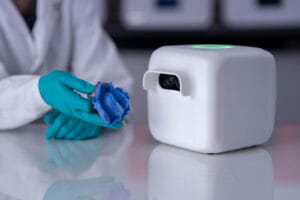
However, the choice to take conventional alginate impressions no longer means missing out on the extensive benefits of a digital workflow. With the Cubit360™ dental object scanner from Mimetrik™ – the world’s only six degrees of freedom scanner – dental impressions can be digitised to a far higher quality than intraoral scanners through fast and intuitive scan capture. Particularly suitable for complex treatment types, simply hold the impression in front of Cubit360 and scan to create a digital scan which can be shared instantly with the dental lab, eliminating the risk of loss or breakage during transit.
As intraoral scanning continues to gain popularity, it is crucial that clinicians are aware of the potential for inaccuracy in the resulting scans, and the factors that may contribute to this – such as saliva and lighting. Further to this, decision-making around when to use an intraoral scanner, and when alginate impressions remain the best option, especially in full arch cases, for example. Digital workflows remain accessible, even when conventional impressions are taken, thanks to the latest innovations in the field.

For more information about Mimetrik, please visit https://mimetrik.tech/
 Author: Alyn Morgan
[i] Tawfik, M.H.A., EL Torky, I.R. & El Sheikh, M.M. Effect of saliva on accuracy of digital dental implant transfer using two different materials of intraoral scan bodies with different exposed lengths. BMC Oral Health 24, 1428 (2024). https://doi.org/10.1186/s12903-024-05199-1
[ii] Camcı, H. and Salmanpour, F., 2020. Effect of saliva isolation and intraoral light levels on performance of intraoral scanners. American Journal of Orthodontics and Dentofacial Orthopedics, 158(5), pp.759-766.
[iii] Rojas-Rueda, S., Robles, M., Pagan-Banchs, M., Garcia, P., Algamaiah, H., Jurado, C.A. and Alshabib, A., 2025. Accuracy of Digital Impressions for Veneer Restorations: A Narrative Review and Case Illustration. Journal of Clinical Medicine, 14(11), p.3859.
[iv] Alqahtani, S.M., Chaturvedi, S., Alahmari, M.A., Alaleyani, A.M., Alqahtani, A.A., Sahal, A.A. and Salem, M., 2024. Digital impression (intraoral scanners) and factors affecting its accuracy–an insight into knowledge and awareness amongst graduates, and clinical practitioners. BMC Oral Health, 24(1), p.1323.
[v] Lee, K.C. and Park, S.J., 2020. Digital intraoral scanners and alginate impressions in reproducing full dental arches: A comparative 3D assessment. Applied Sciences, 10(21), p.7637.