


Dental implants are the gold standard for the treatment of missing teeth, offering patients a highly functional and aesthetic appliance which can be cleaned similarly to the natural teeth. As such, it is important to discuss all of the potential treatment options with patients seeking to replace a missing tooth, and explore the various procedures which may facilitate a long-lasting outcome.
One such option is a sinus graft procedure, which can make dental implants accessible and successful for more patients. Because of this, having the skills and knowledge to provide this treatment option can be valuable.
Sinus grafting for implant treatment
A sinus grafting procedure can be an essential aspect of dental implant treatment. It involves raising the floor of a maxillary sinus and filling the remaining space with bone grafting material. After healing for a number of months, this procedure leads to improved thickness and density of the jawbone, making the area more suitable for dental implant surgery.
This may be required if bone density has been lost due to periodontal disease, cancer, birth defects, or bone resorption following tooth loss. As mentioned, it is usually performed in preparation for dental implant placement as implants require dense, strong bone to provide adequate support and reduce the risk of treatment failure.
Research suggests that sinus floor elevation is highly effective for improving the success rates of dental implant treatment, with a three-year implant survival rate of 90.1%. Additionally, graft failure was low, with a failure rate of 1.9%.[i] This suggests that it is important to consider sinus augmentation as a part of a dental implant treatment plan in cases where there is insufficient bone density and thickness to support a more successful long-term outcome.
Expanding treatment offerings
In order to provide procedures such as this, it is important that the dentist is appropriately trained, their skills are up to date, and they work within their limits, appropriately referring patients, as outlined in the GDC’s Standards for the Dental Team.[ii] As such, it is essential to seek high quality educational opportunities in order to take on more advanced dental implant cases and, in turn, reduce the number of patients you refer to more experienced clinicians.
This being said, it’s important to understand that this process can take time, and it can be helpful to seek the guidance of a mentor to assist you along the way, offering advice and opportunities to learn.
Hands-on learning
In order to adopt new skills and, ultimately, expand the treatments you can offer patients, it’s important to choose courses which best support your learning style. There are four key learning styles – visual, auditory, read/write learning, and kinaesthetic – each offering the learner unique advantages. However, not all learning types will be suited to every course, with kinaesthetic (hands-on) learning often the most difficult to access, particularly within formal institutions.[iii] Hands-on learning, therefore, offers the opportunity for delegates to practice their newly learned skills and develop them in a practical way. Whilst many people will have a preference for one type of learning style, most will benefit from all types. As such, multimodal education is recommended, to ensure that those with varying learning styles are able to get the most out of their learning experience.
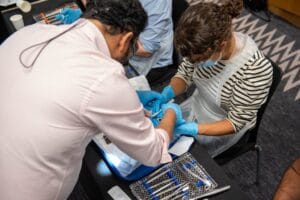
When it comes to expanding your knowledge of complex or advanced dental skills, such as hard and soft tissue augmentation and sinus grafting, it is important to select a training course which offers the opportunity to solidify your knowledge of the theory with a practical hands-on exercise.
ASHA Club offers a wide range of courses, aiming to further clinicians’ knowledge and expertise in dental implant treatment. Coming up this December is the Comprehensive Cadaver Training in Advanced Hard and Soft Tissue Augmentation (With Sinus Grafting). The programme consists of one theory day (for those who have not already completed the Advanced Horizontal & Vertical Augmentation course) followed by two days of hands-on cadavers practical learning. Furthermore, those who complete ASHA Club courses have the opportunity to be mentored by ASHA founder and course presenter Dr Selvaraj Balaji.
If you are looking to offer a high standard of dental implant treatment, and expand your offerings to include more advanced cases, adding hard and soft tissue grafting alongside sinus grafting to your toolbelt can be incredibly valuable. These advanced procedures will help to ensure you offer your patients the best possible outcomes for long-term implant stability.
Find out more at https://www.ashaclub.co.uk/courses
Comprehensive Cadaver Training in Advanced Hard and Soft Tissue Augmentation (With Sinus Grafting)
11th, 12th & 13th December 2025
To book, please call: 07974 304269 or email: info@ashaclub.co.uk
Author: Dr Selvaraj Balaji

[i] Pjetursson BE, Tan WC, Zwahlen M, et al. A systematic review of the success of sinus floor elevation and survival of implants inserted in combination with sinus floor elevation. Part I: lateral approach. 2008. In: Database of Abstracts of Reviews of Effects (DARE): Quality-assessed Reviews [Internet]. York (UK): Centre for Reviews and Dissemination (UK); 1995-. Available from: https://www.ncbi.nlm.nih.gov/books/NBK75241/
[ii] GDC. Standards for the dental team. Accessed Aug 25. https://standards.gdc-uk.org/pages/principle7/principle7
[iii] Understanding your learning style. Wilfrid Laurier University Study Skills & Supplemental Instruction Centre. 2008.