

 Dr Nikhil Kanani tackles a case of white spot removal.
A 38-year-old female patient presented at the dental practice for a consultation. The patient had white spots on her teeth that had been there for as long as she could remember. She subsequently felt self-conscious and avoided smiling in photos. Along with the removal of the white spots, the patient also expressed that she did not like the visible existing composite restoration on the incisal edge of her UL1 tooth.
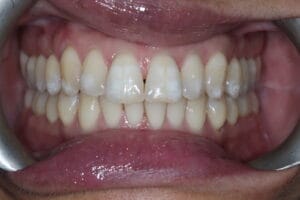
A full assessment of her dentition was carried out. Generalised diffuse white patches were visible, with the worst patches on UR4-UL4 facially – these were likely secondary to fluorosis. The UL1 was aesthetically failing as an incisal composite restoration. Oral hygiene was good, with no signs of caries. There was localised gingival inflammation and calculus deposits.
Treatment choice
The patient was recommended to see a dental hygienist for oral hygiene instruction and scaling prior to treatment. Two options were then presented. The first would use ICON to mask the white patches on UR4-UL4, followed by composite to mask the more opaque areas and replace the incisal composite at UL1. The alternative was to place indirect porcelain veneers on UR4-UL4.
Preferring the most minimally invasive and cost-effective option, the patient wished to proceed with the first treatment. She was made aware that, due to the depth and opacity of some of the white patches on her teeth, the treatment may not be able to mask all areas. The patient agreed to this and only wanted UR4-UL4 treated.
Do the white thing
The patient whitened her teeth at home using the Enlighten whitening system. This spanned 3 weeks with 10% and 16% carbamide peroxide. An in-chair whitening session was also carried out, using 6% hydrogen peroxide. These results satisfied the patient as a clear difference was noticeable.
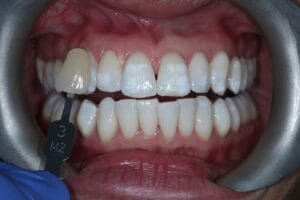
Two weeks following the in-chair whitening, the patient returned for ICON treatment on UR4-UL4. Rubber dam isolation from teeth UR6-UL6 was carried out with a heavy gauge non-latex dental dam. Using aluminium oxide particles and tungsten carbide burs, the existing incisal restoration at UL1 was removed, carefully protecting the healthy existing enamel. Icon-Etch (15% hydrochloric acid gel) was placed on the white patches on UR4-UL4 facially for two minutes before being washed off. This etch and rinse process was carried out three times.
To determine whether the depth of etching was enough to fully mask the white patches, Icon-Dry was placed on the treated areas. Having the same refractive index as enamel, this helped gauge the success of the treatment. However, the white patches were still visible after this. Etching, rinsing and the application of Icon-Dry was repeated until most of the white areas were no longer visible. Some white patches were too deep and could not be totally masked with ICON alone.
The teeth were then dried and hydrophobic resin was applied and left to infiltrate for three minutes. Any excess was removed and all the contact points were flossed, followed by curing for 40 seconds per tooth. The resin was reapplied and removed one more time in the same way.
Enamel defects, areas of white spot still present and the incisal edge of UL1 were restored with shade BL-L enamel and dentine Empress Direct composite. Due to the oxygen inhibited layer, curing through glycerine was implemented. Polishing was performed using Soflex discs and the ASAP polishing protocol. This completed treatment.
Post-treatment review
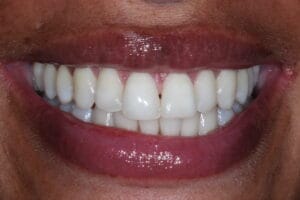
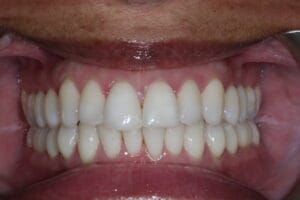
The patient returned for a review two weeks later and was ecstatic with the result; it had exceeded her expectations. The case went well but in hindsight the white spot removal could have been extended to UR5-UL5 as these teeth are in the patient’s smile line. Case selection for ICON white spot removal cases is crucial as opaque white lesions are usually deeper into the enamel and therefore much harder to mask.
Author bio: Dr. Nikhil Kanani is a General Dentist working in Private Practice in Battersea and on Harley Street. He has a passion for striving to provide the highest possible quality dentistry to his patients and especially enjoys putting patients at ease and providing the best holistic care that he possibly can.
He has a special interest in Aesthetic Restorative dentistry and implants. He won Best Young Aesthetic Dentist at the 2022 Clinical Dentistry Awards.
He loves mentorship and teaching and is the founder of the Private Practice 101 course aimed at giving dentists the knowledge and tools necessary to achieve their potential and transition into private practice.
For more information about the BACD, please visit www.bacd.com