


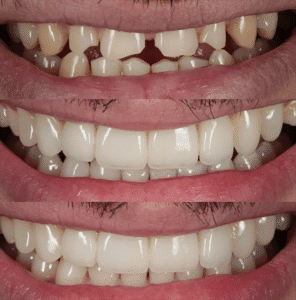
Composite veneers have become a well-accepted alternative to their ceramic counterparts for many years now, and are an effective addition to any restorative clinician’s arsenal. As patients seek to improve the form, shape and colour of their teeth, the composite veneer stands out as a versatile, aesthetic solution.
The preferred alternative
Porcelain veneers are predictable, of that there is little doubt, with the literature citing survival rates of 95.5% over ten years,[i] and ceramic solutions have survival rates of 93.5% over a decade and 83% over 20 years.[ii] However, there are some issues for patients. Porcelain solutions are typically expensive, and may be out of the price range of some patients[iii] (especially if multiple restorations are required across the dentition), and they also require some tooth preparation – treatment may then span multiple appointments.ii
For these reasons, amongst others, the direct composite veneer may be the most effective choice for individuals. Clinicians need to know when it is appropriate to use, however, and be trained to place such restorations.
To apply or not to apply
Composite veneers can have functional and aesthetic benefits in a number of circumstances. When considering the treatment of discolouration or other damages, particularly to anterior teeth, a minimally invasive direct composite veneer could be deemed the first choice of treatment; an indirect approach would require removal of sound enamel or dentine, and a higher cost for the patient due to laboratory involvement.[iv]
In a world where requests for cosmetic restorations are steadily rising, the composite veneer is an ideal solution, with the literature highlighting specific benefits for younger people. They may seek out aesthetic solutions, but the clinician must consider that their dentition still has time to change – tooth eruption may not be entirely finished, and the gingival margins can also change, with exposure of the cervical margins affecting the aesthetics of an anterior veneer.[v] A direct composite veneer may be an appropriate choice since the minimally invasive approach leaves room for adjustments and repairs in the future, if the dentition changes further.
The direct composite veneer is not entirely effective in all clinical situations, especially when a patient has extensive damage to the dentition. The literature finds improved colour-match, fracture resistance and retention outcomes when a direct composite veneer is placed on vital teeth, as opposed to a non-vital structure. Endodontically treated teeth that undergo pulp removal typically require significant removal of tooth structure, which lowers their resistance to fracture[vi] – and the same notion can be applied to restorations for teeth with traumatic injuries. In these cases, opting for a crown is likely necessary.
An appropriate approach
Whilst the direct application of composite veneers may mean a simpler treatment process for the patient, since it can be delivered in one appointment, the same cannot always be said for the clinician. A free-hand direct technique requires high levels of skill, but even still may result in an unpredictable outcome.[vii] However, alternative approaches have emerged and can be successful in the correct circumstances; effective case selection comes with training and increased knowledge.
The use of injectable composites with silicone matrices can deliver effective, aesthetic results with a more predictable approach – the literature shows that matrices can accurately replicate the wax-up that they are based off of to a high degree of accuracy.[viii] With the guide of a silicone matrix, a clinician can use ample control throughout the workflow, but treatment may be extended for the patient as the silicone matrix requires design and production based off of the existing dentition.
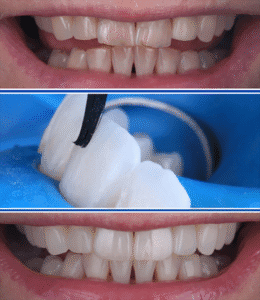
There is also the direct-indirect (semidirect) veneer technique, which combines the benefits of both approaches as the name suggests. Still completed in a single visit, the clinician sculpts the composite material onto the tooth without adhesive preparation, where it is light activated and removed for extraoral heat tempering and finishing. This step can improve the physical properties of a restoration, and here the patient can benefit greatly.[ix] The direct-indirect concept has been found to have significantly less microleakage and a better sealing ability than the solely direct technique.[x]
Find your support
Direct composite veneers must only be placed by a clinician with the appropriate training and clinical confidence as per the Standards for the Dental Team, published by the General Dental Council.[xi] Clinicians should seek out educational courses from trusted providers to first develop their skills.
The Ortho Restorative (Level 2) course from IAS Academy, which focuses on composite veneers alongside incisal edge bonding, is an optimal choice for many dental professionals looking to advance their skillset. The two-day programme combines theory with hands on practice for a comprehensive understanding, as dental professionals also tackle advanced ortho-restorative examinations, the Dahl principle, and more.
Composite veneers can be appropriate for many patients, but ineffective for others. Understanding the indications for this minimally invasive approach, and the techniques that optimise a predictable outcome, ensures patients get the care they need – and plenty to smile about.

For more information on upcoming IAS Academy training courses, please visit www.iasortho.com or call 01932 336470 (Press 1)
Dr Tif Qureshi founder and a clinical director of IAS Academy

Dr Tif Qureshi founder and a clinical director of IAS Academy, qualified from Kings College London in 1992. He is a Past President of the British Academy of Cosmetic Dentistry, an International faculty that provides mentored education for general dentists on a pathway from appropriate simple to comprehensive orthodontics.
Tif has a special interest in simple orthodontics and truly minimally invasive dentistry. He has committed his life’s work to empowering dentists to provide important alternative techniques. He offers a wide variety of treatments to many more patients, while always respecting the fundamental precepts of orthodontics.
Tif also pioneered the concept of Progressive Smile Design through Alignment, Bleaching, Bonding – a course that combines tooth alignment, composite bonding and teeth whitening to produce superior smiles using techniques with the absolute minimum of invasiveness available today.
An experienced teacher in the Dahl concept, Tif shows how this technique is used to plan tooth alignment and minimise invasive dentistry in the development of a beautiful smile.
Tif now lectures and published scientific articles internationally.
[i] Alenezi, A., Alsweed, M., Alsidrani, S., & Chrcanovic, B. R. (2021). Long-term survival and complication rates of porcelain laminate veneers in clinical studies: a systematic review. Journal of clinical medicine, 10(5), 1074.
[ii] Mazzetti, T., Collares, K., Rodolfo, B., da Rosa Rodolpho, P. A., van de Sande, F. H., & Cenci, M. S. (2022). 10-year practice-based evaluation of ceramic and direct composite veneers. Dental Materials, 38(5), 898-906.
[iii] Larson, J., Archibald, J., (2019). Everything You Need to Know About Composite Veneers. Healthline. (Online) Available at: https://www.healthline.com/health/composite-veneers [Accessed June 2025]
[iv] Coelho-de-Souza, F. H., Gonçalves, D. S., Sales, M. P., Erhardt, M. C. G., Corrêa, M. B., Opdam, N. J., & Demarco, F. F. (2015). Direct anterior composite veneers in vital and non-vital teeth: a retrospective clinical evaluation. Journal of dentistry, 43(11), 1330-1336.
[v] Zimmer, R., Amorim, A. H., Portella, F. F., & Arossi, G. A. (2024). Clinical longevity of direct resin-based composite veneers on anterior teeth. Revista da Faculdade de Odontologia-UPF, 29(1).
[vi] Coelho-de-Souza, F. H., Gonçalves, D. S., Sales, M. P., Erhardt, M. C. G., Corrêa, M. B., Opdam, N. J., & Demarco, F. F. (2015). Direct anterior composite veneers in vital and non-vital teeth: a retrospective clinical evaluation. Journal of dentistry, 43(11), 1330-1336.
[vii] Kouri, V., Moldovani, D., & Papazoglou, E. (2023). Accuracy of direct composite veneers via injectable resin composite and silicone matrices in comparison to diagnostic wax-up. Journal of Functional Biomaterials, 14(1), 32.
[viii] Kouri, V., Moldovani, D., & Papazoglou, E. (2023). Accuracy of direct composite veneers via injectable resin composite and silicone matrices in comparison to diagnostic wax-up. Journal of Functional Biomaterials, 14(1), 32.
[ix] Fahl Jr, N., Ritter, A., (2020). Composite Veneers: The Direct-Indirect Technique. Quintessence Publishing USA. (Online) Available at: https://www.quintessence-publishing.com/downloads/preview_22921_fahl_composite_veneers.pdf [Accessed June 2025]
[x] Abdulrahman, M. S. (2021). Evaluation of the Sealing Ability of Direct versus Direct‐Indirect Veneer Techniques: An In Vitro Study. BioMed Research International, 2021(1), 1118728.
[xi] General Dental Council, (2019). Standards for the dental team. (Online) Available at: https://www.gdc-uk.org/standards-guidance/standards-and-guidance/standards-for-the-dental-team [Accessed June 2025]