

When creating dental restorations, accuracy is essential for optimal patient outcomes.
In recent years, many dental professionals have taken the leap and adopted digital workflows. However, it is important to understand the impact that modern technology might have on clinical outcomes. As such, the materials and equipment used in dental labs and practices must offer excellent results and be used effectively by dental professionals.
In order to understand the strengths and weaknesses of different methods of impression taking, it’s important to consider the evidence and select the best solution based on each clinical scenario.
Direct vs indirect impressions
When approaching each case in practice, it is important to consider the pros and cons of traditional vs digital impressions as they apply to that case. Traditional impressions record the surface continuously, whereas digital systems are only capable of recording dots at certain points, filling in the gaps in the data algorithmically. With an intraoral scanner (IOS) this approach improves speed of the scan both to take and process, but does lead to concerns about accuracy, particularly impacting on more complex cases.[i]
Studies show that crowns produced using IOS scans can have a marginal fit deficiency of up to 120 microns.[ii] In order to achieve high quality outcomes, particularly in complex cases, it is important to consider whether this is accurate enough, and if a gap of this size actually has clinical significance or not.
In restorations with marginal gaps larger than 30 µm, accelerated caries development is reported and this accelerates further the further above 30 µm the gaps reach. [iii] This is a considerable problem as crowns made from intraoral scans struggle to achieve gaps of less than 100 µm.[iv] Although clinical outcomes from these ‘digital impressions’ are considered acceptable, there is potential to significantly increase accuracy, which intuitively will lead to optimised patient outcomes.
Clinical factors relating to scanning and complications of full arch cases
In order to achieve good results, intraoral scanners require multiple viewing angles. This can be difficult to achieve due to practical physical restrictions, such as extent of mouth opening and being unable to scan all tooth surfaces when neighbouring teeth are present.[v]
In full arch cases, research states that conventional polyvinyl siloxane impressions display the highest levels of accuracy, followed by intraoral scanners, with irreversible hydrocolloid impressions (alginate) the least accurate (which also deteriorates very quickly within just 12 hours).[vi] Additional to the challenge of full arch cases, in order to achieve good results with an analogue method, it is essential that the impression technique must be executed meticulously. This is not always the case due to time restrictions and other pressures on the dental team, making it difficult to maintain the highest standards of analogue impressions. As such, the current (though sub-optimal) results achieved with an intraoral scanner may out-perform a poorly taken traditional impression.
A further complication to consider when it comes to management of full arch cases is that intraoral scans generally fail to take into consideration mandibular flexion, potentially reducing the global accuracy of a scan significantly. This phenomenon was first reported in 1931 with much work published since, but is largely ignored by intraoral scanners with very few compensating for mandibular flexion[vii] leading to problems with fit and potential early failure, particularly of larger fixed restorations.
The future of digital dentistry
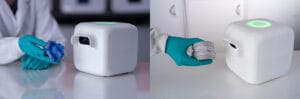
Although the impact of digital dentistry has been growing rapidly, it’s important to understand that traditional impressions still very much have a place and critically, to appreciate how the two methods can work in synergy for improved patient care. To facilitate this hybrid approach, the team at Mimetrik™ has developed the world’s only six degrees of freedom dental object scanner, the Cubit360TM. The user holds the impression or dental model in front of the scanner, rather than using a robotic method, enabling continuous, real-time scanning with no mechanical delays or need for cumbersome metal mounting frames. This means a complete gapless scan of an impression or dental model in a matter of seconds.
Dental impressions are still the foundation for any prosthodontic workflow. In order for technicians and clinicians to provide patients with dental restorations which fit properly, it’s essential that the tools they use are fit for purpose. There are a number of areas where intraoral scanners are lacking when it comes to precision and the ultimate creation of prostheses which fit well, and there are many cases where traditional impression material could be used to achieve better outcomes. As new technology emerges for use in dental labs and practices we can, however, expect to see exceptional outcomes without compromise. Improving ease of use, time, and accuracy, while at the same time reducing the need to post impressions saving more time and money, and improving sustainability.
For more information about Mimetrik, please visit https://mimetrik.tech/
 Author: Alyn Morgan
Alyn Morgan qualified from the University of Leeds School of Dentistry in 1995. He worked in general dental practice for 12 years and undertook his postgraduate training in Endodontics at the Eastman Dental Institute, where he was awarded an MSc with Distinction in 2009.
He worked as the Director of Endodontic CPD at the Eastman for several years and is currently Endodontic Teaching Lead at the Leeds Dental Institute, whilst maintaining a specialist endodontic practice at U Dentistry in Ilkley.
He has presented well over 200 hands-on courses in endodontics, lectured nationally and internationally as a keynote speaker at numerous conferences and study days and acted as a key opinion leader and adviser to several multi-national dental companies.
He is the immediate Past President of the British Endodontic Society, and the co-founder and CEO of a spin-out company from the University of Leeds, Mimetrik Solutions. The companydevelops innovative clinician-led solutions in the field of digital dentistry, and to date has attracted over £3.5m in grant funding and investment.
[i] Róth, I., Géczi, Z., Végh, D.C., Hegedüs, T., Pál, A., Hermann, P. and Schmalzl, J., 2025. The role of artificial intelligence in intraoral scanning for complete-arch digital impressions: An in vitro study. Journal of Dentistry, 156, p.105717.
[ii] Chou W-T, Chuang C-C, Wang Y-B, Chiu H-C (2021) Comparison of the internal fit of metal crowns fabricated by traditional casting, computer numerical control milling, and three-dimensional printing. PLoS ONE 16(9): e0257158. https://doi. org/10.1371/journal.pone.0257158
[iii] Karan, Shima & Loraki, Kowsar & Ghanatir, Elham. (2024). Reasons for Composite Restoration Replacement in an Iranian Population: Composite Restoration Replacement in Patients. Galen Medical Journal. 13. e3618. 10.31661/gmj.v13iSP1.3618.
[iv] Son, YT., Son, K. & Lee, KB. Trueness of intraoral scanners according to subgingival depth of abutment for fixed prosthesis. Sci Rep 12, 20786 (2022). https://doi.org/10.1038/s41598-022-23498-x
[v] Fratila, A.M.; Saceleanu, A.; Arcas, V.C.; Fratila, N.; Earar, K. Enhancing Intraoral Scanning Accuracy: From the Influencing Factors to a Procedural Guideline. J. Clin. Med. 2025, 14, 3562. https://doi.org/10.3390/jcm14103562
[vi] Salgueiro, D., Quilodrán, I. and Rosas, C., 2021. Accuracy of intraoral scanners and conventional impressions in full-arches: a systematic review. Int J Odontostomat, 15(4), pp.835-842.
[vii] Caggiano, Mario et al. “Biomechanical Implications of Mandibular Flexion on Implant-Supported Full-Arch Rehabilitations: A Systematic Literature Review.” Journal of clinical medicine vol. 12,16 5302. 15 Aug. 2023, doi:10.3390/jcm12165302