


Dr Jenni Rawes tackles a case of composite bonding for missing laterals, using injection moulding and digital smile design.
A female patient presented at the practice in September 2024, wanting a brighter smile and replacement of her old composite veneers before her wedding in May 2025. She had received composite bonding on the canines as a child but had noticed over time that they had since discoloured.
The patient was new to the practice and a full assessment of her dentition was carried out. She presented with a Class II division II incisor relationship; her lateral incisors had never erupted, canines were in the position of the laterals and deciduous canines were retained, impacting the proportions and making her smile appear as though there were four central incisors. There was slight attrition of the lower incisors and grouped function on both sides. The patient was dentally healthy, with no caries or gingivitis and minimal gingival recession.
Planning and preparation
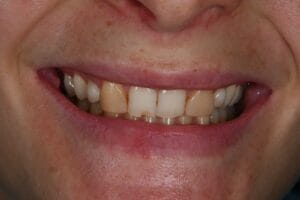
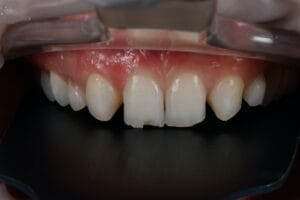
Different treatment options were discussed including: orthodontics, treatment of the deciduous canines, replacing the existing two composite veneers with new veneers, or removing the veneers (porcelain/composite) and balancing the proportions on the four anterior teeth. The latter option was preferred and she decided to retain her deciduous canines without any treatment on these teeth.
A digital smile design was created and shown to the patient, visualising the improved proportions to balance the new smile and helping the patient to see the benefits of treating the anterior four teeth rather than just the two as before. Following this, the buccal surfaces of the veneers were removed and the teeth were whitened using Boutique Whitening 16% Carbamide Peroxide. The patient was happy with the colour change.
Injection moulding
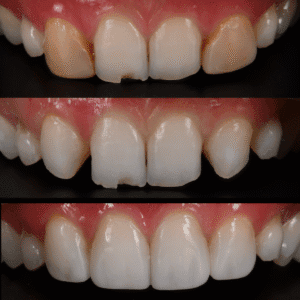
Satisfied with the smile design, a mock-up was created. A silicone build-up stent was made and Bisacryl Protemp was applied to the teeth. This made sure there were no occlusion issues. The patient was happy with this so the treatment proceeded. A clear silicone matrix was placed for injection moulding; this offers flexibility and ease in achieving complex designs and predictability. Injection moulding was performed using PFTE tape on the adjacent teeth and G-ænial composite was used for its high strength to injection mould into the silicone stents on the alternate teeth. The patient was pleased with the results. The teeth were then polished and tertiary anatomy was added.
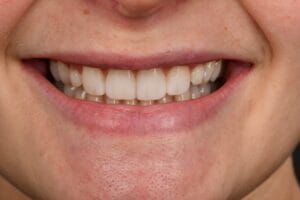
The treatment finished in December 2024 and the patient’s expectations were met, ready for the wedding in May. The main challenge in the case was the positioning of the canine teeth in place of the lateral incisors; these are naturally bigger teeth whereas the central incisors were quite narrow. As such, balancing the proportions was difficult without preparing the teeth, making sure the canines appeared smaller than the central incisors.
The challenge was overcome through thorough assessment, planning and digital smile design, which allowed us to determine how to contour the teeth, using the line angles to improve the proportions and make them appear more natural and balanced. This camouflaged the canines into the lateral incisors for an aesthetically satisfying outcome.
Reflections
Initially, the patient was very cautious of the outcome as she was hesitant about big changes prior to her wedding. This was why her first preference was to only replace the composite veneers she had already. After showing the digital smile design, the proportions were discussed, highlighting how treating the four teeth rather than just the two improved the proportions whilst still being minimally invasive. The mock-up further helped the patient see for herself the proposed outcome, emotionally investing in the concept and seeing the aesthetic benefits before committing to the full treatment. Demonstrating the treatment plan through digital designs and mock-ups is always recommended.
The case was carried out with no complications and it was mutually satisfying to see the final, improved smile that the patient could take to her wedding, and beyond.

 Bio: Dr Jenni Rawes is a general and cosmetic dentist who delivers minimally invasive techniques to achieve healthier, brighter smiles for her patients. Graduating in 2020, Dr Rawes offers a variety of services, such as whitening, crowns, veneers, composite bonding and Invisalign treatments, from her base at the Ten Dental+Facial practice. She is an active member of the British Academy of Cosmetic Dentistry and stays up to date on the latest changes with courses and conferences.