

It’s no secret that the UK’s population is ageing. In 2022, 12.7 million Brits were aged 65 or over, accounting for 19 per cent of the population.[i] Projections for 2072 see this rise to 27 per cent, an increase caused by advancements in healthcare and the lowest reported levels of birth in half a century.[ii]
The impact of an ageing population is well documented in dentistry: the longer people live, the higher the prevalence of edentulism.[iii] This increases the demand for dental implants, dentures and other restorative treatments. But what if the teeth could be more easily protected so that oral diseases are prevented? And how can older patients be motivated to maintain such a proactive approach?

Old habits
A lifetime of preventive action can increase quality of living for older demographics, but research into the effect of preventive oral habits introduced among older individuals is largely unexplored.[iv] Oral health is a major factor for healthy ageing, with good oral hygiene being associated with improved general health and reduced morbidity and mortality. This is due to two reasons: first, that patients who look after their teeth are also likely to take care of the rest of the body and practice healthy lifestyle choices and, second, because of the strong links found between oral diseases and chronic diseases, both of which influence the other.[v]
Good oral health improves tooth retention by reducing the risk of caries and periodontitis.[vi] An essential component of this is interdental cleaning; the mechanical removal of trapped food debris and plaque from between adjacent tooth spaces is associated with a lower prevalence of oral disease. One long-term study found that older individuals who flossed at least once a week on average lost one tooth over a 5-year period, whilst individuals who did not floss on average (and lived in greater isolation) had lost four teeth.[vii] The impact of this is multi-faceted: edentulism affects masticatory function, self-esteem and overall quality of life. Of particular concern is the dietary change and declining nutritional intake for those with severe edentulism – the adverse consequences of not being able to eat certain foods can increase the risk of wider health problems.[viii] So, interdental cleaning must be encouraged for more at-risk patients.
New habits
Motivating older patients to floss on a daily basis can be a struggle. A survey found that many patients recommended 8-11 as the age range for interdental self-care to begin, as this creates a habit that will last a lifetime.[ix] But not everybody will start at that age and introducing the habit late may not guarantee the same level of compliancy.
However, the view that the elderly cannot learn new habits as effectively as younger generations (perhaps attributed to perceived cognitive decline) is a common misconception. In reality, older adults have better routines, such as daily medication intake, and higher self-regulation.[x] Along with the ability to delay gratification, older patients are actually well suited to develop new habits, especially those that help their health. By boosting awareness of the role that interdental cleaning can play in reducing oral disease, tooth loss and general health problems, elderly patients can be more proactive with their oral care and maintain a consistent quality of life.
Making it easy
 One possible challenge with encouraging flossing is that older patients may report sensitivity in the soft and hard oral tissues, have reduced hand or arm movement, and have weaker eye sight, all of which can impair interdental cleaning success.[xi]
To help at-risk patients and support a comfortable cleaning routine, electric flossers are recommended for their ease of use and excellent outcomes. Eliminating the need for using both hands and avoiding the sometimes-tricky coordination of string floss, electric flossers are more practical for older patients.
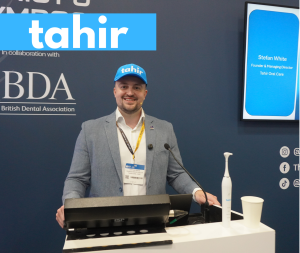
Recommend Tahir One from Tahir Oral Care to achieve optimal hygiene outcomes among at-risk patients. A three-in-one solution that acts an electric toothbrush, flosser and tongue cleaner, it delivers a truly comprehensive cleaning experience. With the Sensitive and Deep Clean settings, patients can tailor their oral care to meet their specific needs, ensuring every tooth is given equal attention and plaque build-up is prevented. Protect against oral disease with the total cleaning power of Tahir One and support older demographics to reduce the risk of oral disease.
Meeting the challenge
As the UK’s population continues to age, healthcare providers must rise to meet the challenges that it poses. The interconnected nature between oral disease, edentulism and chronic health conditions is notable, and setting realistic goals for older patients to maintain their teeth and gingivae can increase motivation and form a long-lasting, positive habit.

The Tahir One Electric Flosser is available for patients at tahiroralcare.com and through Harrods. For practice enquiries and professional ordering, visit tahiroralcare.com
Author: Stefan White, Founder and Managing Director of Tahir Oral Care
[i] Barton, C., Sturge, G. and Harker, R. (2024). The UK’s changing population. [online] House of Commons Library. Available at: https://commonslibrary.parliament.uk/the-uks-changing-population/ [Accessed 17 Aug. 2026].
[ii] Lawrie, E. and Cuffe, R. (2026). “It’s not a nice world out there”: Birth rates hit a 50-year low. BBC News. [online] 27 May. Available at: https://www.bbc.co.uk/news/articles/cvgzdq23xpgo [Accessed 17 Aug. 2026].
[iii] Qiuping Zhou, Jing Kang, Walter Yu Hang Lam, Colman McGrath,
Edentulism and all-cause mortality among middle-aged and older people in China: A 9-year cohort study, Journal of Dentistry, Volume 166, 2026, 106512, ISSN 0300-5712, https://doi.org/10.1016/j.jdent.2026.106512.
[iv] Marchesan, J.T., Byrd, K.M., Moss, K., Preisser, J.S., Morelli, T., Zandona, A.F., Jiao, Y. and Beck, J. (2020). Flossing Is Associated with Improved Oral Health in Older Adults. Journal of Dental Research, 99(9), pp.1047–1053. doi:10.1177/0022034520916151.
[v] Fu, Di, Shu, X., Zhou, G., Ji, M., Liao, G. and Zou, L. (2025). Connection between oral health and chronic diseases. MedComm, [online] 6(1). doi:10.1002/mco2.70052.
[vi] Al-Rafee, M. (2020). The epidemiology of edentulism and the associated factors: A literature Review. Journal of Family Medicine and Primary Care, 9(4), p.1841. doi:10.4103/jfmpc.jfmpc_1181_19.
[vii] Marchesan, J.T., Byrd, K.M., Moss, K., Preisser, J.S., Morelli, T., Zandona, A.F., Jiao, Y. and Beck, J. (2020). Flossing Is Associated with Improved Oral Health in Older Adults. Journal of Dental Research, 99(9), pp.1047–1053. doi:10.1177/0022034520916151.
[viii] Nih.gov. (2026). Checking your browser – reCAPTCHA. [online] Available at: https://pmc.ncbi.nlm.nih.gov/articles/PMC13050390/ [Accessed 17 Aug. 2026].
[ix] Nih.gov. (2026). Checking your browser – reCAPTCHA. [online] Available at: https://pmc.ncbi.nlm.nih.gov/articles/PMC13050390/ [Accessed 17 Aug. 2026].
[x] Cepni, A.B., Shehata, N., Ullah, F. and Johnston, C.A. (2024). Habit Formation in Older Adults. American Journal of Lifestyle Medicine. [online] doi:10.1177/15598276241301743.
[xi] Dental care for older people. (2017). [online] Oral Health Foundation. Available at: https://www.dentalhealth.org/dental-care-for-older-people [Accessed 17 Aug. 2026].