

SprintRay MIDAS brings digitally designed indirect restorations into the dental practice.
For many restorative cases, the choice has traditionally felt binary: place a direct resin-based restoration chairside or prescribe an indirect restoration produced by a laboratory or milling workflow.
Both have an important role, but there is space between them. A direct restoration may not always be ideal for a demanding case, while an indirect restoration can mean laboratory turnaround, a temporary and a second appointment.
MIDAS introduces a third pathway: a digitally designed, indirectly produced restoration that can be printed in the practice and delivered during the same visit. It combines the immediacy of chairside treatment with the control and consistency of a digital indirect workflow.
A more biomimetic approach
This middle ground is increasingly relevant as dentistry moves towards minimally invasive and biomimetic treatment philosophies. The objective is not simply to select the hardest material available, but to preserve healthy tooth structure and choose a restoration that works harmoniously with the remaining tooth.
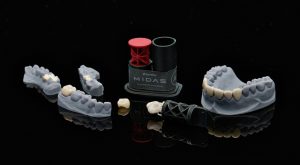
Digitally designed inlays and onlays offer an alternative where a large direct restoration may not be preferred, but where a full-coverage crown could remove unnecessary healthy tissue. By combining highly ceramic-filled resin formulations with precise digital design and additive manufacturing, MIDAS creates a practical new option within this restorative space.
Why MIDAS is different
Conventional resin 3D printers draw liquid material from an open tank. While effective for many applications, highly filled restorative materials are more viscous and difficult to process using traditional printing methods.
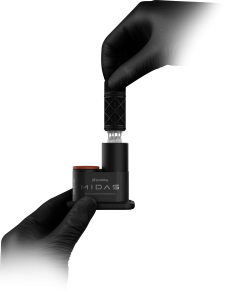
MIDAS overcomes this through SprintRay’s patented Digital Press Stereolithography technology. The material, dosing mechanism and build platform are contained within a single-use capsule. During printing, the material is pressed into the build area, enabling MIDAS to process the highly filled formulations required for definitive restorations.
Intelligent design, with the clinician in control
SprintRay Studio provides a cloud-based, AI-supported design workflow. Once the appropriate scans are uploaded, the software generates an initial restoration proposal. The clinician can then review and adjust the margin, contacts, occlusion, position, and morphology before printing.
The software carries much of the routine design workload while leaving clinical decisions in the clinician’s hands. This makes suitable cases accessible without requiring advanced CAD expertise or a dedicated in-practice designer.
A workflow measured in minutes
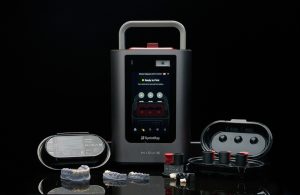
Each MIDAS Capsule identifies its material, shade, manufacturing batch and expiry date, while the printer guides the user through placement.
Up to three capsules can be loaded simultaneously. Depending on the indication, one capsule can produce one crown, up to two inlays or onlays, or up to four veneers. Printing typically takes approximately 7–10 minutes.
The restoration is then cleaned, post-cured using SprintRay NanoCure and finished according to the selected protocol. Depending on the case and finishing method, the complete scan-to-placement workflow can take approximately 45–60 minutes.
A third restorative pathway
For patients, this can mean no temporary and no return appointment. For clinicians, it provides greater control over design and treatment. For practices, it offers a more accessible route into single-visit indirect dentistry – without the cost, footprint, and complexity of a conventional milling unit.
MIDAS does not replace every direct restoration, milling workflow or laboratory relationship. Instead, it creates a valuable option between them: direct convenience, digital indirect precision, and more conservative restorative possibilities.

For more information, visit sprintray.com/en-uk