

The hands of dental healthcare workers are reservoirs for pathogens. From holding instruments to interacting with digital solutions, computers and patients themselves, there is a long line of ways in which harmful bacteria can be picked up.
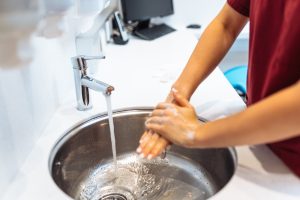
Hand hygiene prevents the build-up and transmission of microbes within the daily workflow of the practice, reducing the risk of cross-contamination and protecting patients and the dental team from infection. Low hand hygiene compliance must not be allowed among staff. Intense workloads (especially for oral surgery services) demand frequent hand washing and can increase the risk of complacency, making consistent adherence to correct hand hygiene protocols essential.
Of particular concern is infection control awareness among dental students – the dental professionals of the future. A survey in Morocco among this demographic found that 74.1% had low levels of hand hygiene knowledge and 63.7% had a low level of practice.[i] In effect: they weren’t washing their hands enough because they didn’t all know why they should. Similarly poor outcomes have also been reported in Spain and the Netherlands, suggesting a wider global trend.[ii]
Improving education and compliance for infection control is the mission objective for Dentisan, an award-winning supplier of innovative decontamination products and a provider of Dentilearn in-practice CPD training sessions. When it comes to hand hygiene, Dentisan’s comprehensive hand care portfolio provides the solutions needed to stay HTM 01-05 compliant.
DentiWash
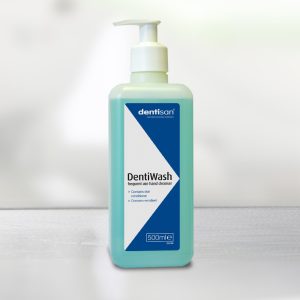 Frequent hand washing can aggravate the skin, causing dryness, irritation and potentially splitting the skin. However, dental professionals must wash their hands between every patient appointment and if they are visibly soiled. DentiWash is ideal: it contains skin conditioner and emollient to moisturise the hands and keep the skin barrier strong. Solvent-free, its fast and effective cleansing action makes DentiWash a reliable regular amidst a busy workflow, helping contain the transmission of microbes and ensure the dental team and patients remain healthy.
DentiGel
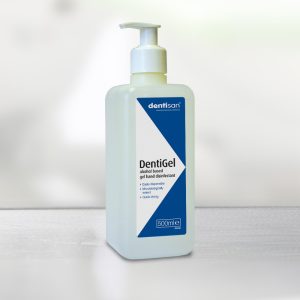 Ready for immediate use, DentiGel is a trusted alcohol hand rub and skin disinfectant that should be used after hand washing. Providing an additional level of protection from the pathogens found in the dental practice, the solution is supplied in a 500ml pump dispenser, delivering the correct volume for continual use. Utilising a quick drying formula, DentiGel is exceptionally gentle on the skin, incorporating emollients and skin conditioners so that hard-working hands don’t dry out and crack. Well-suited to the dental practice, DentiGel also meets European hand sanitiser standards, having been microbiologically tested to comply with BS EN 1500.
DentiSure Foam
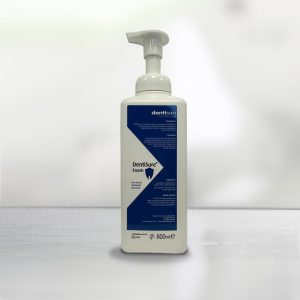 For an alcohol-free alternative, that is equally effective in post-washing hand care, DentiSure Foam is a practice essential. Used on clean, dry skin between washes and rubbed in until it fully disperses, DentiSure Foam is notable for its effectiveness against enveloped viruses, including coronaviruses. This is because it has achieved EN14476 – a European standard that pertains to the evaluation of virucidal activity – and has been tested to BS EN 1500 too.[iii] Each order of DentiSure Foam comes in a 600ml pump dispenser that is ready to use and HTM 01-05 compliant. This is also available in refill pouches for foaming touchless dispensers.
Replenish
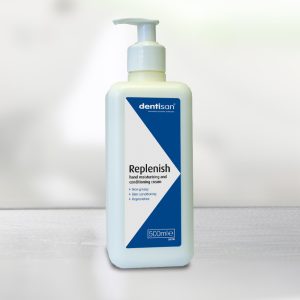 Supplementing the protective qualities of DentiGel, DentiWash and DentiSure Foam, Replenish is a moisturising and conditioning hand cream to be used in the dental practice by team members who require a robust hand hygiene policy. This is because Replenish lives up to its name: it is a soft, non-greasy solution that keeps the skin sufficiently moisturised and enables dental team members to perform their duties without irritated hands. Stored in a 500ml pump, Replenish is easy to use and meets the HTM 01-05 recommendation to “use a hand cream following hand-washing at the end of a session to counteract dryness and as required.”[iv]
For additional components to your hand hygiene protocols, Dentisan can provide Touchless Liquid/Foam Dispensers, wall-mounted cradles and refill pouches, ensuring that the specific needs of your practice are met.
The Dentisan product portfolio is tested and trusted. To improve both awareness and compliance of hand hygiene protocols, consider the first-class solutions available from Dentisan and book a Dentilearn in-practice CPD session for your practice today!

For more information about Dentisan, please visit https://dentisan.co.uk/
Book your in-practice CPD by emailing your request to the expert in your area:
For the Midlands, North Wales & North of England, contact Jenny: jenny.nixon@getinge.com
For the South of England, Wales & Channel Islands, contact Anne: anne.harris@getinge.com
For Scotland, Ireland & Northern Ireland, contact Holly: holly.dickinson@getinge.com
[i] Ait-ou-amar, S., Beyane, E. and Ennibi, O. (2024). Hand washing knowledge, attitudes and practices among dental students. International Dental Journal, 74, p.S40. doi:10.1016/j.identj.2024.07.693.
[ii] García Mato, E., Buceta Gamallo, F., Sande López, L., Varela Aneiros, I., Diniz Freitas, M., Limeres Posse, J., Diz Dios, P. and Rivas Mundiña, B. (2025). Handwashing practice among dental students: lessons unlearned from the COVID-19 pandemic. BMC medical education, doi:10.1186/s12909-025-07403-4.
Persoon, I.F. and Volgenant, C.M.C. (2026). Hand Hygiene Accuracy of Students and Staff at a Dutch Dental School. European Journal of Dental Education. doi:10.1111/eje.70097.
[iii] Steinhauer, K., Meister, T.L., Todt, D., Krawczyk, A., Paßvogel, L., Becker, B., Paulmann, D., Bischoff, B., Eggers, M., Pfaender, S., Brill, F.H.H. and Steinmann, E. (2021). Virucidal efficacy of different formulations for hand and surface disinfection targeting SARS CoV-2. The Journal of hospital infection, doi:10.1016/j.jhin.2021.03.015.
[iv] Department of Health (2013). Decontamination Health Technical Memorandum 01-05: Decontamination in Primary Care Dental Practices 2 0 1 3 E D I T I O N. [online] Available at: https://www.england.nhs.uk/wp-content/uploads/2021/05/HTM_01-05_2013.pdf [Accessed 27 Aug. 2026].