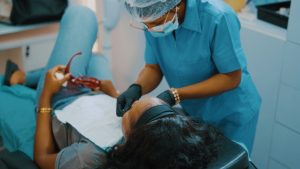
If anybody was asked to describe a dentist’s uniform, they are likely to mention scrubs, gloves, surgery caps and even visors or eye protection. This is because a core pillar of infection control is the compliant use of Personal Protective Equipment (PPE). Creating a physical barrier between the dental practitioner and the patient, PPE reduces the risk of cross-contamination and the spread of infectious diseases.
Despite being so noticeable and prevalent, PPE compliance can vary. For example, a study on the Tamil Nadu region in India found that only 60.4 per cent of dentists strictly adhered to the use of PPE in routine dental practice, whilst 100 per cent had an awareness of its role.[i] In the UK, failure to use PPE appropriately breaches the infection control standards as set out by the CQC, putting the dental team, patients and the practice at risk.[ii] To avoid this, one area to pay close attention to is when PPE fails and when it needs replacing.
Besides dental scrubs, PPE is largely focused on protecting the hands and face. This means wearing gloves for all clinical procedures, and masks, visors or face shields to provide a barrier during aerosol-generating procedures, during treatment and when decontaminating instruments.[iii]
Gloves
As hands directly interact with instruments, surfaces and patients more than any other part of the body, wearing gloves is essential to prevent the spread of infectious pathogens. Patients should not be treated until all members of staff in the treatment room are wearing a new pair. However, every appointment carries the risk of needing to replace the gloves, with the principal indications being:
- Any tears or rips
- Wetness
- If visibly soiled
- If the appointment lasts an extended period of time e.g. over one hour (this is because hand sweat and latex hydration can cause micro-perforations)[iv]
Whilst many of these indications can be unavoidable, there are some control measures to reduce the risk of physical damage, as noted in HTM 01-05. This includes keeping finger nails neatly clipped, removing any rings with edges, following the manufacturer’s storage recommendations and ensuring the hands are thoroughly dried before wearing the gloves to reduce friction (which weakens the material).[v]
Facial protection
Like gloves, facial masks must be changed between every single patient or immediately if it becomes wet, damaged or visibly soiled. If a patient requires an extended procedure, masks should be changed at regular intervals of typically 20-60 minutes.[vi] Aerosol heavy environments caused by treatments like ultrasonic scaling or high-speed drilling accelerate the need to replace masks within an appointment as their filtration efficiency decreases. Dental professionals should take care to avoid touching or dangling the mask during or between appointments and they should never be reused.
Pressure of supply shortages
An anxiety worsened by the pandemic was the risk of running out of PPE. On no account should single-use PPE like gloves and facial masks be reused between appointments, even if the dental professional can see no rips or visible signs of contamination.
The risk of another pandemic or a disrupted supply chain is low but never zero. In this scenario, dental practices must remain compliant with HTM 01-05 and proceed with caution.[vii] This involves triaging emergency cases and using the limited PPE supply to treat those in the greatest need. Out of date PPE must not be used, even as a last resort, and counterfeit or unregulated alternatives should not be supplied either. The dental practice must suspend appointments if the correct PPE is unavailable, and should not open until the supply chain is secure.[viii]
Filling in the gaps
Infection control protocols are just as important as PPE maintenance. When removing a used pair of gloves, hands must be thoroughly washed and dried if visibly contaminated. Once complete, the rest of the PPE can be disposed of: plastic disposable apron, then facial mask, then any face and eye protection. After all this, the hands must be washed again.
Dental professionals can feel confident in their hand hygiene when using DentiWash, a trusted hand cleanser from Dentisan. Ideal for frequent use, such as in between appointments and PPE changeover, the solution is solvent free and protects against dryness and irritation due to the skin conditioner and emollient included in its unique formula. HTM 01-05 compliant, you can rely on the Dentisan portfolio to protect you, your patients and your practice from harmful pathogens.
Because it so frequently used, it can be easy to take PPE for granted and overlook its correct application. However, dental professionals must remain vigilant in maintaining their equipment and staying on the right side of infection control regulations to reduce the risk of disease transmission.

For more information about Dentisan, please visit https://dentisan.co.uk/
Book your in-practice CPD by emailing your request to the expert in your area:
For the Midlands, North Wales & North of England, contact Jenny: jenny.nixon@getinge.com
For the South of England, Wales & Channel Islands, contact Anne: anne.harris@getinge.com
For Scotland, Ireland & Northern Ireland, contact Holly: holly.dickinson@getinge.com

Author: Jenny Nixon, Business Development Director at Dentisan
[i] Srinidhi, S., Stephen, S., Mohankumar, K., D’Cruz, T.M., Subbiah, K., Subbiah, G.K., Nagappan, N. and Mani, B. (2023). Assessment of Role of PPE in Preventing the Spread of Infection among the Dental Surgeons: A Prospective Study. Journal of Pharmacy and Bioallied Sciences, [online] 15(Suppl 1), p.S362. doi:10.4103/jpbs.jpbs_546_22.
[ii] www.cqc.org.uk. (n.d.). Dental mythbuster 38: Infection prevention and control – Care Quality Commission. [online] Available at: https://www.cqc.org.uk/guidance-providers/dentists/dental-mythbuster-38-infection-prevention-and-control [Accessed 25 Aug. 2026].
[iii] Sdcep.org.uk. (2016). Personal protective equipment | Practice Support Manual – SD. [online] Available at: https://www.psm.sdcep.org.uk/topics/health-and-safety-general/personal-protective-equipment/ [Accessed 25 Aug. 2026].
[iv] CDC (2024). Best Practices for Personal Protective Equipment. [online] Dental Infection Prevention and Control. Available at: https://www.cdc.gov/dental-infection-control/hcp/dental-ipc-faqs/personal-protective-equipment.html [Accessed 25 Aug. 2026].
[v] Department of Health (2013). Decontamination Health Technical Memorandum 01-05: Decontamination in Primary Care Dental Practices 2 0 1 3 E D I T I O N. [online] Available at: https://www.england.nhs.uk/wp-content/uploads/2021/05/HTM_01-05_2013.pdf [Accessed 25 Aug. 2026].
[vi] Garland, K.V. (2018). What Level of Mask Should Dental Hygienists Use? [online] Dimensions of Dental Hygiene. Available at: https://dimensionsofdentalhygiene.com/article/what-level-of-mask-should-dental-hygienists-use/ [Accessed 25 Aug. 2026].
[vii] Department of Health (2013). Decontamination Health Technical Memorandum 01-05: Decontamination in Primary Care Dental Practices 2 0 1 3 E D I T I O N. [online] Available at: https://www.england.nhs.uk/wp-content/uploads/2021/05/HTM_01-05_2013.pdf [Accessed 25 Aug. 2026].
[viii] GOV.UK. (n.d.). COVID-19: infection prevention and control dental appendix. [online] Available at: https://www.gov.uk/government/publications/wuhan-novel-coronavirus-infection-prevention-and-control/covid-19-infection-prevention-and-control-dental-appendix [Accessed 25 Aug. 2026].