Dr Edward Bateman rebuilds posterior support and rejuvenates a worn smile with the resilient and aesthetic BRILLIANT Crios from COLTENE, milled in-house for a minimally invasive result.
Managing the worn dentition demands careful sequencing, a clear understanding of the patient’s occlusion, and restorative materials that can be adjusted and refined as treatment progresses. Where posterior support has been lost and the anterior teeth are bearing an excessive load, a staged and reversible approach is invaluable. The following case demonstrates how chairside milled BRILLIANT Crios (COLTENE) restorations, combined with a digital workflow, delivered an aesthetic and functional outcome while keeping tooth preparation to a minimum.
Patient background
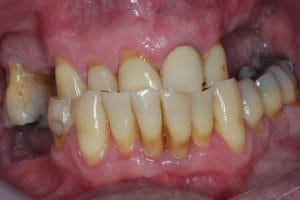
A 66-year-old man attended as a new patient, having been an irregular attender over the previous five years. He had previously been a regular attender for check-ups elsewhere. His primary concerns were a loose lower front tooth and dissatisfaction with his smile, which he felt had become very worn, with the teeth no longer particularly visible. He had a history of multiple extractions over the years, which had left him with significant gaps and a compromised bite.
Clinical assessment
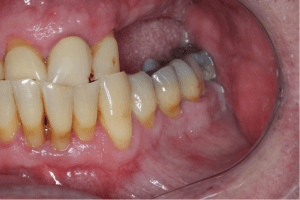
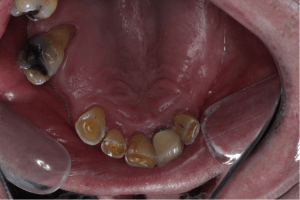
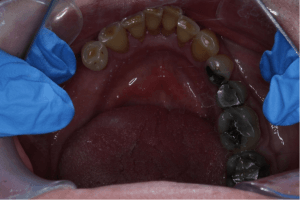
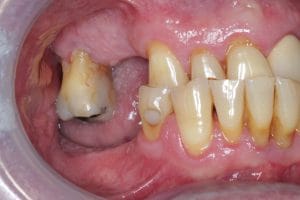
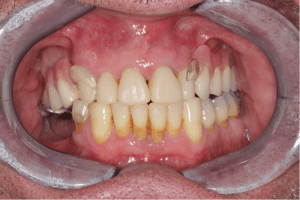
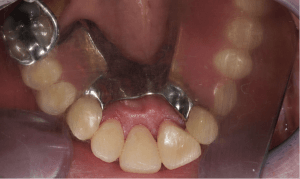
Clinical examination revealed missing teeth in the upper right, upper left, and lower right quadrants, resulting in a marked lack of posterior support. Consequently, the patient presented with an edge-to-edge bite on the front teeth only, which had led to excessive wear of the anterior dentition. The lower incisors had over-erupted, with the LL1 grade 2 mobile, and the UR6 had also over-erupted into the available space.
Despite these challenges, the patient was periodontally healthy and his oral hygiene was fair. The absence of active periodontal disease provided a sound foundation on which to plan restorative treatment, with the priority being to address the destructive loading on the anterior teeth.
Treatment planning
The relationship between the overloaded front teeth, the edge-to-edge bite, and the resulting excessive wear was discussed in detail with the patient. The key objective was to provide posterior teeth in order to improve the bite and to create the space required to restore the worn front teeth. Implants were discussed as a means of replacing the missing posterior units, but these fell outside the patient’s budget.
It was therefore agreed to provide removable chrome dentures for both the upper and lower arches, with the aim of improving and opening the bite. The aesthetic challenge of clasping the front teeth was discussed, and clear flexible clasps were selected to minimise their visibility. The plan was that, once the patient was comfortable wearing the dentures, composite veneers would be placed on the UR3, UR2, UR1, and UL2, and the crown on the UL1 would be replaced with a composite crown, all fabricated in BRILLIANT Crios. The lower incisal edges would be smoothed and sealed with composite, and whitening would be carried out at the outset to establish the desired shade.
Treatment execution
Treatment began with hygiene therapy, followed by impressions for bleaching trays. Whitening was carried out over three weeks, after which a further two weeks were left to allow the shade to stabilise and the bond strength to recover before any adhesive restorations were placed.
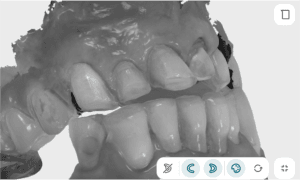
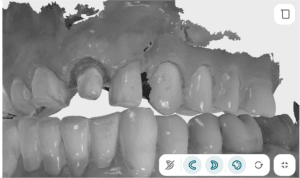
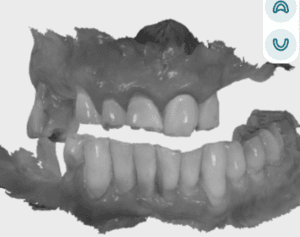
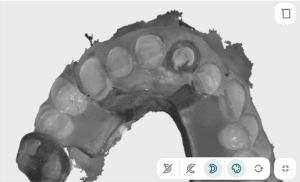
A scan was then taken at the opened bite in order to fabricate the partial upper and lower dentures. This was achieved by scanning with a leaf gauge in place at the desired degree of opening, allowing the new vertical dimension to be captured accurately. The dentures were fitted, and direct composite was added to the teeth to improve their length. No tooth preparation was carried out at this stage, so that if the patient was unable to tolerate the increased occlusal vertical dimension, the additions could be removed and the situation reverted without harm.
At the three-week review, the patient reported that he was unwilling to wear the lower denture, finding it impossible to tolerate. It was agreed to continue with the upper denture only and to review progress. After a further three weeks, the patient was wearing the upper denture well and felt comfortable, so it was agreed to proceed with the definitive restoration of the front teeth, preparing the teeth on one day and fitting the following day.
Two weeks later, the UR3, UR2, and UR1 and the UL2 were prepared for composite veneers, while the UL1 crown was removed and the tooth reprepared. The over-erupted lower teeth were adjusted and sealed with composite so that the incisal edges were even. A scan was taken and the restorations were designed using Trios Design Studio, then milled from LT A3 BRILLIANT Crios blocks on a Roland DWX-42W mill in the practice on the same day. The restorations were polished and sandblasted ready for fitting. The following day, the veneers and crown were cemented using COLTENE SoloCem.
Outcome
The patient was very happy with the final aesthetics, with both his smile and his bite improved in a minimally invasive manner. Encouragingly, the mobility of the lower front tooth resolved once the adverse loading had been removed, confirming that the original problem had been occlusal in nature rather than periodontal.
Case reflections
BRILLIANT Crios was particularly well suited to this case. The resilience of the milled composite, combined with the ability to mill quickly in-house and achieve good aesthetics, made it an ideal choice. Of particular importance in a wear case where the bite is being changed, the material is easily adjustable in the mouth, allowing the occlusion to be refined as treatment progressed.
The outcome would have been further improved had the patient been able to tolerate the lower partial denture, as this would have provided additional posterior support and a more balanced occlusion. Nonetheless, the result achieved was more than sufficient to meet the patient’s needs, delivering a comfortable, aesthetic, and conservative restoration of a worn and compromised dentition.


For more on COLTENE, visit https://www.coltene.com/europe/ email info.uk@coltene.com or call 0800 254 5115.
 Author bio: Dr Edward Bateman BDS MJDF RCS Eng FCGDent is Principal Dentist at Tain Dental Care in Ross-shire (GDC 103480). He graduated from Glasgow University in 2006 and was awarded Fellowship of the College of General Dentistry in 2022. He has clinical interests in aesthetic dentistry and orthodontics, and is a committed dental educator.