The design of any healthcare environment has a direct impact on patient care. It influences how patients feel, how they react to the professional team, and whether they decide to return in the future. The physical surroundings will also affect the quality of care that professionals can deliver and the efficiency of this care provision, as well as the satisfaction, retention, and productivity of staff.
The design of your dental practice must be carefully considered. Not only must the environment be functional to support workflow efficiency, but it must also promote calmness, confidence, and trust, elevating the patient experience beyond clinical necessity.
An evidence-based field
There is a growing body of evidence that links workplace design with increased employee productivity, performance, and satisfaction.[i] In a difficult economic climate fraught with recruitment challenges, the positive impact that a motivated team has on staff retention will be important for every practice.[ii]
Implications have also been published regarding staff wellbeing, with a well-designed workplace helping to reduce staff sickness and absence.[iii] In particular, an ergonomic space should be created that reduces the need for clinicians to stretch or strain their bodies during treatment, which can improve the quality of their clinical work, as well as their quality of life, and personal health.[iv] With approximately 70% of dental providers experiencing work-related musculoskeletal disorders in the UK, the opportunity to minimise their occurrence should be championed by all dental business owners.[v]
But that’s not the only way in which the design of healthcare environments can positively influence the patient experience. Firstly, staff wellbeing – both physical and mental – has been linked with improved patient satisfaction.[vi] An effective environment, including audio and visual elements, also helps to reduce anxiety, pain, and stress among patients.[vii] In addition, design features that ensure privacy can add to an individual’s sense of control over their treatment, which further improves their comfort.[viii] The best results are achieved when patients’ feedback is sought and alterations made according to their real-world experiences.[ix]
A practical approach
Translating all this into practice means applying core design principles when visualising and renovating your space. From a practical perspective, it’s important to consider the regulations that might guide or restrict alterations to the building itself. For commercial properties like dental practices, the rules pertaining to structure, fire safety, ventilation, access, and electrical safety are among the most important to understand.[x] Liaison with a Building Control Body will be necessary to apply for approval ahead of major works. This is separate to the planning permission needed, which must be sought from your local council prior to altering the building structure, aesthetic, or purpose.[xi]
As is true of most legal frameworks and legislation, the language in these documents can be convoluted with technical jargon. Consequently, the advice and support of experts in the field will be invaluable. Collaborating with those who do this every day, who understand the latest changes and the smallest nuances relevant to dentistry, makes the entire process run more smoothly.
But the design of your practice must be more than simply compliant with the regulations: it must be optimised to support professional efficiency, promote patient comfort, and to effectively present the practice’s branding. To bring your vision to life it is important to create a mock-up of the different areas to see how they will look and how they will connect. Small alterations can be made at this early stage where needed for enhanced cohesion, or to make the investment work harder for longer.
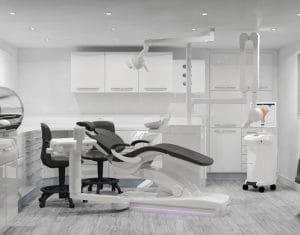
When you work with Clark Dental, you gain access to a team with decades of experience in designing, installing, and maintaining exceptional dental practices across the UK. As a premium service that offers superior products, Clark Dental can help you create a practice that elevates both the professional and patient experience and delivers tangible patient, team, and financial benefits. Create a stunning 3D render of your proposed design in cutting-edge software to better visualise every detail, paving the way for a timely and highly successful project conclusion.
Investment for results you can measure
The design of a dental practice is much more than improvement of the interior aesthetics. It is an opportunity to enhance the workplace for clinicians and the team, to boost job satisfaction and improve staff retention in the long-term. It also positively influences the patient experience, elevating the quality of their care and their comfort throughout their dental journey. A structured approach to practice design, utilising the talents of experts in the field, is important to ensure that all investment delivers results you can really measure.

For more information call Clark Dental on 01268 733 146, email info@clarkdental.co.uk or visit www.clarkdental.co.uk
Author: Stuart Clark, CDO at Clark Dental

[i] Workplace design and employee productivity. Nature research intelligence topic summaries [beta] Nature Research Intelligence. https://www.nature.com/research-intelligence/nri-topic-summaries/workplace-design-and-employee-productivity-micro-27124 [Accessed April 2026]
[ii] Dorji, Tenzin. (2024). Systematic Review Protocol: Determining Factors Affecting Workforce Retention in Dentistry. 10.21203/rs.3.rs-4883987/v1.
[iii] Richardson, A, Potter, J, Paterson, M, Harding, T, Tyler-Merrick, G , Kirk, R, Reid, K and McChesney, J, 2017. Office design and health: a systematic review. New Zealand Medical Journal, 130 (1467), p. 39. ISSN 0028-8446
[iv] Gauthaman J, Ganesan A. Ergonomic Interventions in the Dental Setups and Their Role in Preventing Musculoskeletal Disorders among Dentists: A Systematic Review. J Lifestyle Med. 2025 Feb 28;15(1):18-25. doi: 10.15280/jlm.2025.15.1.18. PMID: 40376692; PMCID: PMC12076048.
[v] Chenna D, Pentapati KC, Kumar M, Madi M, Siddiq H. Prevalence of musculoskeletal disorders among dental healthcare providers: A systematic review and meta-analysis. F1000Res. 2022 Sep 16;11:1062. doi: 10.12688/f1000research.124904.2. PMID: 36505095; PMCID: PMC9709350.
[vi] Bragge P, Delafosse V, Kellner P, Cong-Lem N, Tsering D, Giummarra MJ, Lannin NA, Andrew N, Reeder S. Relationship between staff experience and patient outcomes in hospital settings: an overview of reviews. BMJ Open. 2025 Jan 7;15(1):e091942. doi: 10.1136/bmjopen-2024-091942. PMID: 39773811; PMCID: PMC11749438.
[vii] Laursen J, Danielsen A, Rosenberg J. Effects of environmental design on patient outcome: a systematic review. HERD. 2014 Summer;7(4):108-19. doi: 10.1177/193758671400700410. PMID: 25303431.
[viii] Huisman ERCM, Morales E, Hoof J, Kort H. (2012). Healing environment: A review of the impact of physical environmental factors on users. Building and Environment. 58. 70 – 80. 10.1016/j.buildenv.2012.06.016.
[ix] Marcheschi, E., Sigurjónsson, Á., Ulrich, R. et al (2019). The physical environment and its effect on health outcomes: a systematic review.. ARCH19 Proceedings
[x] The Buildings regulations 2010. UK Statutory Instruments. No. 2214. Schedule 1. https://www.legislation.gov.uk/uksi/2010/2214/schedule/1 [Accessed April 2026]
[xi] Planning permission and building regulations. Housing and local services. https://www.gov.uk/browse/housing-local-services/planning-permission-regulations-information [Accessed April 2026]