






Waste management in the dental practice is more than a compliance exercise. An effective workflow has a significant impact on everything from operational efficiency to profitability, sustainability, and even patient satisfaction. The key for many businesses is to start on the right track. Improved purchasing and supply chain decisions, as well as carefully managed clinical routines, will minimise the risk of wasting products, time, energy, and money.
Optimising procurement
Procurement can impact waste in several ways. Firstly, ordering only what the practice will use is crucial as expired stock is a massive waste of both product potential and money, highlighting the importance of careful inventory control.
Secondly, intelligent procurement is integral to a circular economy, which minimises waste across the entire product lifecycle. This takes into account every step in the production workflow, from resource utilisation and energy requirements, through to end disposal. In particular, intentional product purchase can positively influence plastic waste, reducing the impact that this has on the natural environment.[i]
In the same way, purchasing decisions can be designed specifically to reduce material wastage.[ii] In dentistry, this concept promotes the need to choose technologies and solutions that will facilitate low waste generation during daily tasks. Selecting like-minded suppliers who share this commitment to sustainability further elevates effective waste management throughout the whole supply chain for maximum impact.[iii] This is likely to have a far greater positive impact than focusing on waste generation and disposal within the practice alone.
Supplier selection
Several criteria can be evaluated as part of this supplier assessment. The product packaging, delivery method, recycling schemes for used items, product shelf life, and so much more should be considered. While each one seems small on its own, the cumulative outcome will be far greater than the sum of its parts.
Of course, all of this must be balanced with quality, ensuring that the standard of patient care is not compromised in any way. Improving your business’s green credentials will only be successful when it is combined with exceptional clinical outcomes, a smooth patient journey, and a safe environment for all.
Patient perception
Sustainability is a growing cause for concern in today’s society, which is helping to drive change among businesses worldwide. In the UK, 92% of the general public support a more sustainable NHS, with over a third of people agreeing that this would be important even if it increased costs.[iv] There is also evidence to show strong support among patients for a greener healthcare system where this doesn’t affect quality of care, safety, or equity of access.[v] In fact, studies suggest that sustainability may play a role in the clinical decision-making process for many individuals who wish to align their treatment experience with bioethical principles.[vi] This requires consideration for the environmental impact of the treatment solutions presented.
As such, there appears to be genuine merit in offering greener dentistry when it comes to attracting and retaining patients. For practices that are ahead of the curve, it offers a unique value proposition that creates a competitive edge and will help propel business growth.
The practicalities
To achieve all of this while maintaining operational and financial efficiency, dental practices must review and refine their waste management protocols on the ground. Beyond manufacturer and supply chain concerns, the practice is responsible for everyday waste segregation and disposal.
To reduce the amount of energy required for waste treatment, the NHS Waste Clinical Strategy should be consulted[vii] which offers a useful framework, whether you provide NHS dentistry or not. The goal is to significantly reduce the volume of items sent for high-energy treatment processes, helping to cut carbon emissions generated during waste disposal by 30%.
To facilitate correct waste segregation, it is important to locate the appropriate waste containers and bags at the point of waste production, which should be colour-coded for convenience and compliance with best practice guidelines.[viii]
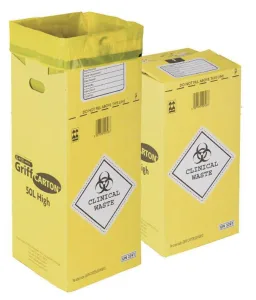 The most common colours applicable to dentistry include yellow (clinical highly infectious waste), orange (clinical infectious waste), tiger (offensive waste), white (amalgam and gypsum wastes, separated further), and black (mixed municipal waste). However, there may also be a need for purple containers (cytotoxic and cytostatic waste) or blue (medicinal waste). It is also crucial that the right containers are available, with rigid sharps containers designated for needles, for example, protecting the dental team and waste collectors from potential harm.
Working with Initial Medical makes this entire process as efficient as possible. Experts in waste management, the team can provide all the products you need to maintain excellent waste segregation and disposal protocols across the business. These include rigid cardboard waste containers for soft waste streams, made from 75% recycled materials and with an 89% reduction in raw material carbon dioxide emissions. They also offer practice audits and tailored recommendations to elevate your compliance and safety standards, as well as a reliable waste collection and recycling service.
Preparing for the future
Effective waste management in the dental practice is about more than complying with the regulations. It is also a reflection of the business values being implemented, and contributes to financial and operational efficiency. Furthermore, strengthening sustainability now will better position every practice to meet growing patient demand in the near future.
To find out more, get in touch at 0808 304 7411 or visit the website today www.initialmedical.co.uk
About Initial Medical
Initial Medical set the standard in healthcare and infectious waste management in the UK, providing a reliable, effective, and fully compliant service built around customer needs and delivered by our highly trained local teams. We are ISO 9001:2015 accredited, with technology fully integrated into our operations, providing full traceability of service delivery, electronic waste documentation, and the best customer experience possible. We also offer innovative healthcare waste management services and infection control products, to help break the chain of transmission and prevent cross contamination.
Initial Medical are a company with a ‘World Class’ Health and Safety record, and ISO 45001:2018 accreditation. We are also accredited to ISO 14001:2015 environmental standards and pride ourselves on our sustainable approach with a focus on delivering eco-friendly products and operational solutions.
Author: Rebecca Waters – Rentokil Initial

Media Enquiries:
For more information, please contact:
01227 265700
[i]Al-Sinan MA, Bubshait AA. The Procurement Agenda for the Transition to a Circular Economy. Sustainability. 2022; 14(18):11528. https://doi.org/10.3390/su141811528
[ii] Ajayi, SO and Oyedele, LO (2018) Waste-Efficient Materials Procurement for Construction Projects: A Structural Equation Modelling of Critical Success Factors. Waste Management. ISSN 0956-053X DOI: https://doi.org/10.1016/j.wasman.2018.01.025
[iii] Hicks, Christian & Heidrich, Oliver & Mcgovern, Tom & Donnelly, T.. (2004). A functional model of supply chains and waste. International Journal of Production Economics. 89. 165-174. 10.1016/S0925-5273(03)00045-8.
[iv] Public and staff opinions. Greener NHS. National ambition. NHS England. https://www.england.nhs.uk/greenernhs/national-ambition/public-and-staff-opinions/ [Accessed May 2026]
[v] Knagg, R., Dorey, J., Evans, R. and Hitchman, J. (2024), Sustainability in healthcare: patient and public perspectives. Anaesthesia, 79: 278-283. https://doi.org/10.1111/anae.16159
[vi] Cohen ES, Kringos DS, Grandiek F, Kouwenberg LHJA, Sperna Weiland NH, Richie C, Hehenkamp WJK, Aarts JWM. Patients’ Attitudes Towards Integrating Environmental Sustainability Into Healthcare Decision-Making: An Interview Study. Health Expect. 2025 Feb;28(1):e70155. doi: 10.1111/hex.70155. PMID: 39828934; PMCID: PMC11743189.
[vii] NHS England, (2023). NHS clinical waste strategy. (Online) Available at: https://www.england.nhs.uk/estates/nhs-clinical-waste-strategy/ [Accessed May 2026]
[viii] Health Technical Memorandum 07-01: Safe and sustainable management of healthcare waste. NHS England. 2022 edition. https://www.england.nhs.uk/wp-content/uploads/2021/05/B2159iii-health-technical-memorandum-07-01.pdf [Accessed May 2026]


