

Dental implant placement is a complex treatment that many clinicians aspire to carry out in their careers.
Confidence in the clinical approach is key. Within implant dentistry, there are many aspects of care that may be modified depending on the patient’s desire for a specific aesthetic result or the anatomy of a treatment site.
The use of a screw-retained or cement-retained restoration on an implant is one such variable. Whether there is a truly optimal approach is still up for debate amongst practitioners.[i] However, selecting the most appropriate technique can be transformational in the success of the implant treatment itself. It’s important for clinicians to develop their knowledge around each retention style and their impacts on treatment needs or key outcomes.
Lock it in
Placement of an implant supported restoration with cementation or screw retention will be beneficial in different circumstances. Both have been applied for single, multiple and cross-arch solutions.[ii]
Screw retention has been described as an approach that allows for easier maintenance.ii This benefits professional hygiene treatments, and allows for simpler repairs or intervention at the surgical site, since the crown can be removed by a clinician without destroying the prosthesis.
The ability to retrieve a fixed implant crown to enact professional level hygiene routines is beneficial to both the practitioner and the patient. If complications are predicted or suspected, particularly in the earliest stages of implant placement, the treatment site can be easily cleaned, and monitored closely from that moment forwards. The literature notes that this could support elderly patients or those who live with disabilities and require extra support, who may have difficulty properly following oral hygiene instructions and cleaning the area around a restoration.ii They will, in turn, heavily rely upon the oral hygiene support offered at clinical appointments.
Treatments for peri-implantitis also require access to the site.ii Left untouched, it may lead to the complete failure of a dental implant. A 2022 study looking at the success of 376 implants found failure as a result of peri-implantitis-related bone loss in 2.3% of cases.[iii] Knowing that professional treatment can be completed without the likely destruction of the implant crown may help patients be more receptive to care, and negates the need to remake the prosthesis when care is required directly at the treatment site.
A screw loose
Despite the positives surrounding retrieval of the implant crown, screw retained implants come with their own problems. The biomechanical structure of a cemented prosthesis may be better at distributing weight from occlusal forces than the screw-retained solution, minimising long-term complications.[iv]
Complications resulting in failure have been associated with loosened screws, especially in the posterior region.[v] Risk factors for this includes single crowns in the posterior, misfit prostheses and the screw diameter being smaller than other components of the implant, meaning clinicians must consider both the design of the implant, and its placement in the mouth, when considering if screw-retainment is a suitable approach.v
Choosing cement
The use of cement-retained prostheses should be optimised with appropriate case selection. Its application may offer advantages when an anterior implant is not in a favourable position, and this also applies in the posterior dentition.ii Some cases may require an unfavourable implant placement to conform with the anatomy of the dentition and jaw, and will inevitably not be suitable for a screw-retained prosthesis. The use of a cement-retained approach allows a clinician to confidently achieve an optimal final position for occlusal and aesthetic needs in these instances.
Cementing is also ideal in cases where aesthetic outcomes are prioritised, for example in the anterior dentition. Using this approach means a restoration can blend seamlessly into the surrounding natural dentition, with better access for contouring and lifelike surface characteristics on the prosthesis.[vi] There is also the notable benefit of not requiring a screw access hole,[vii] which once seen can immediately shatter the illusion of a natural-appearing tooth.
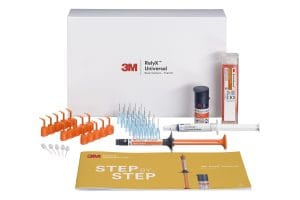
Cement-retained prostheses can only be placed for an aesthetic and successful result when a clinician uses solutions they trust. The RelyX Universal Resin Cement from Solventum, formerly 3M Health Care, offers effective adhesion to implant abutments, with the ability to be also used with virtually all dual-cure resin cement indications. Crowned a Top Award Winner by Dental Advisor for the fifth consecutive year, RelyX Universal Resin Cement is reliable, aesthetic and simple to clean up – a solution that was recommended by 100% of Dental Advisor consultants.*
Both screw-retained and cemented implant restorations can deliver optimal results for patients. The use of each approach will depend on the desired outcomes for each individual, and clinicians must consider all available evidence before proceeding with care.

To learn more about Solventum, please visit https://www.solventum.com/en-gb/home/oral-care/
©Solventum 2024. Solventum, the S logo and RelyX are trademarks of Solventum and its affiliates. 3M is a trademark of 3M company.
*Dental Advisor Awards 2025, https://dentaladvisor.com/clinical-evaluation/3m-relyx-universal-resin-cement/#cu-tabs|0
About Solventum
Solventum, enabling better, smarter, safer healthcare to improve lives. As a new company with a long legacy of creating breakthrough solutions for our customers’ toughest challenges, we pioneer game-changing innovations at the intersection of health, material and data science that change patients’ lives for the better while enabling healthcare professionals to perform at their best. Because people, and their wellbeing, are at the heart of every scientific advancement we pursue. We partner closely with the brightest minds in healthcare to ensure that every solution we create melds the latest technology with compassion and empathy. Because at Solventum, we never stop solving for you.
[i] Shadid, R., & Sadaqa, N. (2012). A comparison between screw-and cement-retained implant prostheses. A literature review. Journal of Oral Implantology, 38(3), 298-307.
[ii] Wittneben, J. G., Joda, T., Weber, H. P., & Brägger, U. (2017). Screw retained vs. cement retained implant‐supported fixed dental prosthesis. Periodontology 2000, 73(1), 141-151.
[iii] Thiebot, N., Hamdani, A., Blanchet, F., Dame, M., Tawfik, S., Mbapou, E., … & Alantar, A. (2022). Implant failure rate and the prevalence of associated risk factors: a 6-year retrospective observational survey. Journal of Oral Medicine and Oral Surgery, 28(2), 19.
[iv] Cicciu, M., Bramanti, E., Matacena, G., Guglielmino, E., & Risitano, G. (2014). FEM evaluation of cemented-retained versus screw-retained dental implant single-tooth crown prosthesis. International Journal of Clinical and Experimental Medicine, 7(4), 817.
[v] Lemos, C. A. A., de Souza Batista, V. E., de Faria Almeida, D. A., Júnior, J. F. S., Verri, F. R., & Pellizzer, E. P. (2016). Evaluation of cement-retained versus screw-retained implant-supported restorations for marginal bone loss: A systematic review and meta-analysis. The Journal of prosthetic dentistry, 115(4), 419-427.
[vi] Fiorillo, L., D’Amico, C., Ronsivalle, V., Cicciù, M., & Cervino, G. (2024). Single Dental Implant Restoration: Cemented or Screw-Retained? A Systematic Review of Multi-Factor Randomized Clinical Trials. Prosthesis, 6(4), 871-886.
[vii] Kim, Y. K., Conejo, J., Wagner, D. J., Britton, E., & Schoenbaum, T. R. (2024). Contemporary Rationales for Cemented Implant Restorations in the Esthetic Zone. Journal of Esthetic and Restorative Dentistry.