


There is often a familiar moment in dentistry. The clinician can see clearly what is happening: a crack, early signs of a lesion, warning signs of failure in a restoration, but when attempting to explain it to the patient, they realise it’s not quite translating. The patient might nod, but without visual aids, it’s possible they will not be able to make sense of a verbal description of something they’ve never seen before. When a treatment is recommended, the patient says they’ll think about it. And, often, they don’t return.
This isn’t a new problem, but it is a persistent one – and one that has a measurable impact on patient outcomes, on a practice’s revenue, and on the clinical relationship.

Why patients hesitate to commit
There are many potential reasons for a patient to feel hesitant about the future of their treatment. Finances, dental anxiety, availability, etc., all factor in. However, research does consistently show that treatment acceptance is closely tied to patients’ comprehension of the overall case.[i] When a patient understands clearly what is wrong, why it matters, and what will likely happen without proposed treatment, acceptance rates have been shown to improve significantly.
The challenge is that dental anatomy, and dental pathology, are generally hidden to the untrained eye, particularly in the early stages. Verbal explanation asks them to form a picture of something they likely have no frame of reference for. Studies examining the relationship between visual aids and patient decision-making confirm a correlation for a simple reason: seeing creates an ownership, a realism, that hearing does not.[ii]
Beyond treatment acceptance, there is a broader question of patient trust. Patients who feel genuinely informed about their oral health are more likely to attend regularly, maintain home care routines, and engage meaningfully in treatment planning decisions.i The appointment therefore has the potential to become a conversation rather than a transaction, and that shift has implications for long-term patient retention as well as short-term treatment acceptance.
The big barrier
The gap between what a clinician sees and what a patient understands has likely persisted not because the value of visual communication is in doubt, but because clinicians have had difficulty integrating the existing tools into the workflow. Early intraoral cameras tended to be bulky and produced inconsistent image quality. They often required so much time to operate that those using them reported they routinely felt more disruptive than beneficial.[iii]
The overall adoption of digital systems across dentistry has changed both the technology available and patient expectation, whether consciously or subconsciously. They arrive at their appointment accustomed to receiving visual information. They research their symptoms, look at clinical images, and may expect the professionals they interact with to communicate with them in a similar way. With the right technology to show a patient their own oral images, a practice will be able to meet those expectations.
Operationally, the question for GDPs is less about whether intraoral imaging supports better communication – the evidence is clear that it doesiii – and more about how to integrate this in a reliable and frictionless way to every appointment. If a camera is difficult or time-consuming to use, it will not be used consistently, and consistency can make all the difference when it comes to patient communication.
Removing the friction
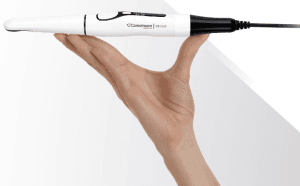 The features that determine whether an intraoral camera becomes a genuine clinical tool or an underused investment are often the practical ones: how quickly it can be picked up and used, how reliably it produces a usable image, and how easily that image reaches the patient.
Carestream Dental’s new CS 1300 intraoral camera has been designed with these considerations at its core. Its HD resolution delivers sharp, detailed images to support clarity of communication, while a 280° rotating head and ergonomic handpiece allows comfortable and simple access to all areas of the mouth. Adjustable LEDs with selectable cool and warm colour temperature modes reduce glare and ensure consistent illumination across different oral environments. Dual autofocus modes and a 10–100mm focus range cover everything from close macro detail to full arch views with a single device. Driver-free USB plug-and-play connectivity makes sharing between operatories straightforward, and integration with CS Imaging places captured images directly within the patient’s digital record.
The communication gap in dentistry is real, and its costs – in patient outcomes, in treatment uptake, in the quality of the clinical relationship – are well documented. The tools to close this gap are now accessible. Showing patients more visual information is no longer a supplementary step in the appointment. Increasingly, it is the crux of the appointment itself.

For more information on Carestream Dental visit www.carestreamdental.co.uk
For the latest news and updates, follow us on Facebook and Instagram @carestreamdental.uk
Author: Nimisha Nariapara – Trade Marketing Manager at Carestream Dental covering the UK, Middle East, Nordics, South Africa, Russia and CIS regions.

[i] Ho JCY, Chai HH, Luo BW, Lo ECM, Huang MZ, Chu CH. An Overview of Dentist-Patient Communication in Quality Dental Care. Dent J (Basel). 2025;13(1):31. Published 2025 Jan 14. doi:10.3390/dj13010031
[ii] Noordman J, Noordam D, van Treeck J, et al. Visual decision aids to support communication and shared decision-making: How are they valued and used in practice?. PLoS One. 2024;19(12):e0314732. Published 2024 Dec 3. doi:10.1371/journal.pone.0314732
[iii] Attanasi K. Digital Dental Imaging. Dimensions of Dental Hygiene. Published January 11, 2013. https://dimensionsofdentalhygiene.com/article/digital-dental-imaging-129/