


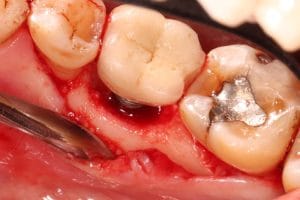
Dental implants have transformed restorative dentistry in recent history. Long-term survival rates are impressive, and understanding of clinical indications continues to expand. But as the implant-bearing population grows and ages, a parallel challenge is emerging. Peri-implantitis – a progressive inflammatory disease that causes bone loss around osseointegrated implants – is not a rare complication of the procedure. Recent data suggests approximately 20–22% of adults with dental implants have peri-implantitis, with more than half of implant patients affected by peri-implant diseases over a ten-year period.[i] This is a challenge for practitioners – one that will have a continuing effect on everyday dentistry as long as patients still seek these restorations.
Peri-implant mucositis vs peri-implantitis
Though peri-implant mucositis can be a precursor to peri-implantitis, this does not necessarily mean they call for the same clinical responses. The difference between the deceptively similar presentations is an important one, as what works for the former is generally insufficient for the latter, and peri-implantitis can be an extremely destructive condition leading to implant failure.
Peri-implant mucositis is reversible inflammation confined to soft tissues without bone loss: the warning sign of a more serious problem. Identified and managed early on through non-surgical means and risk factor control, peri-implant mucositis can be reversed and the restoration could be preserved for long-term success.[ii]
Peri-implantitis involves progressive marginal bone loss alongside soft tissue inflammation. It is, therefore, considered to be a more severe disease, despite featuring the same inflammatory symptoms, due to the irreversible loss of supporting bone it causes. This in turn risks the stability of the implant. As the disease advances, the task of the practitioner becomes significantly harder.[iii]
Who is at risk?
There are several significant risk factors that can be identified at assessment. A history of periodontitis is a well-documented one, with studies indicating a four times greater risk of peri-implantitis in patients with a chronic history compared to one without.[iv] Smoking carries a relative risk of almost three times as much,[v] and uncontrolled diabetes and obesity bring additional risk,[vi] alongside local factors such as poor implant positioning, and designs that impede access for oral hygiene purposes.[vii]
Many high-risk patients are identifiable before implant placement. Appropriate case selection, optimised periodontal health, and good maintenance habits are primary prevention strategies, not optional extras. Patients with poor maintenance habits or compliance face substantially higher rates of disease progression.
Recognising problems in practice
Peri-implantitis has an inconveniently silent early phase. Patients are often asymptomatic until disease is well established. At review appointments, practitioners should assess bleeding on probing, increased probing depths, and radiographic bone levels.ii
Without baseline radiographs and probing records taken at or shortly after placement, quantifying bone loss is estimation rather than measuring. When baseline records don’t exist, establishing new data immediately remains clinically valuable for future comparison.
Any patient presenting with discomfort around an implant, or gingival inflammation that may be disproportionate to their oral hygiene, warrants careful investigation.
When conservative management isn’t enough
The consensus in current research is that peri-implant mucositis may be effectively managed with non-surgical debridement and risk factor control[viii] – and this is also the first step for peri-implantitis. However, for established disease, non-surgical approaches have a more limited effect when significant bone loss has already occurred.
Surgical management, from access flap debridement to regenerative approaches, becomes necessary for moderate to advanced disease. A 2025 review found disease resolution in approximately 60% of cases under supportive care, with bone loss stopped in around 70%.[ix] These are encouraging numbers, but the predictability of success declines drastically as severity increases. Early surgical intervention consistently outperforms delayed treatment.
The case for expert referral
Surgical peri-implantitis management requires advanced training, equipment, and experience that falls outside most general practice environments.
Managing peri-implantitis beyond the early disease often calls for expert referral, as delayed treatment of advancing disease consistently reduces the likelihood of successful outcomes. Referring early, with full clinical documentation, gives expert teams the best opportunity to halt progression.
The One to One Dental Clinic on Harley Street, London, offers combined periodontist and implant surgeon expertise under one roof, providing the multidisciplinary care that complex peri-implantitis cases require. Critically, for referring practitioners, patients are returned to the referring practice following treatment. The referral therefore bolsters the overall long-term patient relationship whilst ensuring individuals receive the critical treatment than maintains their oral health and maximises restorative success.
Recognising peri-implantitis as a genuine and growing clinical risk, and responding with appropriate monitoring, intervention, and referral, is how general dental practitioners can help in tackling this growing challenge in the dental implant industry, as well as best serve their implant patients and maintain a great long-term clinical reputation.

To learn more about referrals to the One to One Dental Clinic, visit https://121dental.co.uk/referrers/ or contact 0207 486 0000
 Author: Dr Fazeela Khan-Osborne is the founding clinician of the FACE dental implant multi-disciplinary team for the One To One Dental Clinic, London
[i] Galarraga-Vinueza ME, Pagni S, Finkelman M, Schoenbaum T, Chambrone L. Prevalence, incidence, systemic, behavioral, and patient-related risk factors and indicators for peri-implant diseases: An AO/AAP systematic review and meta-analysis. J Periodontol. 2025;96(6):587-633. doi:10.1002/JPER.24-0154
[ii] Heitz-Mayfield LJA, Salvi GE. Peri-implant mucositis. J Clin Periodontol. 2018;45 Suppl 20:S237-S245. doi:10.1111/jcpe.12953
[iii] Rokaya D, Srimaneepong V, Wisitrasameewon W, Humagain M, Thunyakitpisal P. Peri-implantitis Update: Risk Indicators, Diagnosis, and Treatment. Eur J Dent. 2020;14(4):672-682. doi:10.1055/s-0040-1715779
[iv] Serroni M, Borgnakke WS, Romano L, et al. History of periodontitis as a risk factor for implant failure and incidence of peri-implantitis: A systematic review, meta-analysis, and trial sequential analysis of prospective cohort studies. Clin Implant Dent Relat Res. 2024; 26(3): 482-508. doi:10.1111/cid.13330
[v] Martinez-Amargant, J., de Tapia, B., Pascual, A., Takamoli, J., Esquinas, C., Nart, J., & Valles, C. (2023). Association between smoking and peri-implant diseases: A retrospective study. Clinical Oral Implants Research, 34, 1127–1140. https://doi.org/10.1111/clr.14147
[vi] de Oliveira PGFP, Bonfante EA, Bergamo ETP, et al. Obesity/Metabolic Syndrome and Diabetes Mellitus on Peri-implantitis. Trends Endocrinol Metab. 2020;31(8):596-610. doi:10.1016/j.tem.2020.05.005
[vii] Monje A, Kan JY, Borgnakke W. Impact of local predisposing/precipitating factors and systemic drivers on peri-implant diseases. Clin Implant Dent Relat Res. 2023;25(4):640-660. doi:10.1111/cid.13155
[viii] Pereira R, Sabri H, Nava P, Alrmali A, Wang HL. Treatment Strategies for Peri-Implant Mucositis: The Final Stop for Preventing Peri-Implantitis. Int J Dent. 2025;2025:6901156. Published 2025 Apr 28. doi:10.1155/ijod/6901156
[ix] Monje A, Pons R, Ramanauskaite A, Castro A, Schwarz F, Chambrone L. Long-term surgical treatment outcomes of peri-implantitis. Periodontology 2000. 2025; 00: 1-16. doi:10.1111/prd.12643