

Dr Simrit Ryatt, Dentolegal Consultant at Dental Protection, revisits a compelling clinical case study that emphasises the gravity of a “never event” and how sometimes extractions are not as simple as they first appear
 It was a frantic Friday the 13th. All five surgeries were fully booked with routine appointments, and the day lists were further strained by emergency patients squeezed into every available gap.
The Central Decontamination Room (CDR)
The CDR was at maximum capacity, and the two designated decontamination staff were rushed off their feet. Nurse T was an experienced dental nurse, while H was a trainee enrolled in a training academy. It was H’s first day in the CDR. Despite being provided with learning materials detailing the strict unidirectional flow required for safety, H had not relished the assignment. Finding the background reading unappealing, she had failed to pay much attention to it.
Surgery 1: Dr. J and Mrs. W
In Surgery 1, Dr. J had just taken a radiograph for his second emergency patient, 74-year-old Mrs. W. She presented with a swollen right cheek and acute pain originating from the lower right first molar (46). The X-ray revealed that the 46 was crowned and root-filled, with a periapical radiolucency on the mesial root. Mrs. W requested an extraction, intending to add the tooth to her existing lower partial denture later.
Noting he had only seven minutes remaining in the emergency slot, Dr. J agreed to the extraction and administered local anaesthetic. While waiting for the onset, he asked his nurse to locate the “cowhorn” (#23) forceps and prepare the extraction kit. Anticipating that Mrs. W might be resistant to the local anaesthetic, Dr. J prepared a second cartridge, leaving it standing by.
The extraction was remarkably swift; the 46 was luxated and removed in one piece. Dr. J triumphantly showed Mrs. W the intact tooth while she bit down on gauze to stem the bleeding. After inspecting the socket – which appeared sound – Dr. J provided post-operative instructions. Meanwhile, his nurse cleared the room and took the used equipment to the CDR for disposal and processing.
Surgery 2: Dr. M and Mr. C
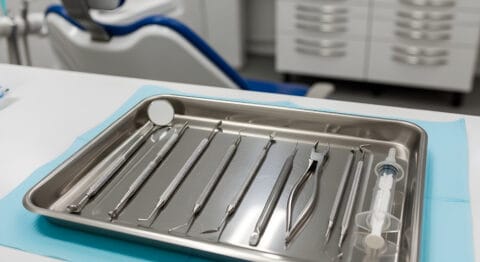
Nearby, Dr. M was preparing for Mr. C’s routine composite restorations. Dr. M confirmed the treatment plan, picked up a loaded syringe from a fresh-looking tray, and administered the anaesthetic. Mr. C was then ushered back to the waiting room.
As Dr. M turned to update the clinical notes, he noticed his nurse had frozen, staring in confusion at the instrument tray. The syringe had been placed next to what appeared to be a used pair of cowhorns and luxators. It transpired that H, the trainee nurse, had accidentally handed Dr. M’s nurse a contaminated tray from Surgery 1. Relying on the assumption that the tray had been checked and the syringe pre-loaded by his own nurse, Dr. M had failed to scan the rest of the tray before injecting Mr. C.
The “Never Event”
The team quickly realised the gravity of the error: Dr. M had used Mrs. W’s contaminated syringe on Mr. C. This was a “never event” – a serious, preventable medical error carrying a significant risk of transmitting blood-borne viruses such as Hepatitis B, Hepatitis C, and HIV.
Dr. M immediately contacted the local Accident and Emergency (A&E) department, recognising that time is a critical factor for Post-Exposure Prophylaxis (PEP). Although a review of Mrs. W’s history suggested she was “low risk”, the protocol required a formal assessment. Obviously, it was important to ensure patient confidentiality was respected so care was taken to inform and advise each of the two patients involved separately regarding the need to attend A&E.
Distraught and feeling entirely blameworthy, Dr. M apologised profusely. He followed up with phone calls to both patients and sent flowers the following day. The incident was formally recorded and flagged for a full team reflection.
Complications and litigation
Mrs. W’s ordeal was not over. While at A&E for her blood tests, her anaesthetic wore off, leaving her in unbearable pain and feeling a “sharpness” against her tongue. She was eventually assessed by a Maxillofacial Registrar who diagnosed a lingual fracture of the mandible. The registrar manually reduced the bone and questioned whether the tooth – a lone-standing molar – had been sectioned. Mrs. W confirmed it had been “pulled in one piece.”
Weeks later, Dr. J received a claim from a dental negligence solicitor, representing Mrs. W. Supported by an independent oral surgery expert, the solicitor alleged that the 46 had been extracted without reasonable care. They argued that because the 46 was a lone-standing molar with weakened surrounding bone, it required careful surgical planning, including sectioning. Furthermore, the consent process had failed to highlight the high risk of mandibular fracture.
Upon review, a dentolegal consultant at Dental Protection concluded that an independent expert would likely support the claimant’s allegations. With no viable defence, the Dental Protection team settled the claim on Dr. J’s behalf.
Conclusion of the cross-contamination incident
Dr. M’s proactive and thoughtful handling of the incident appeared to have been advantageous, as when the negative results from the patients’ blood tests arrived, neither patient raised a complaint or pursued litigation about this element.
The positive outcome of Dr. M’s adverse incident clearly highlights the importance of communication and managing events when mistakes are made.