


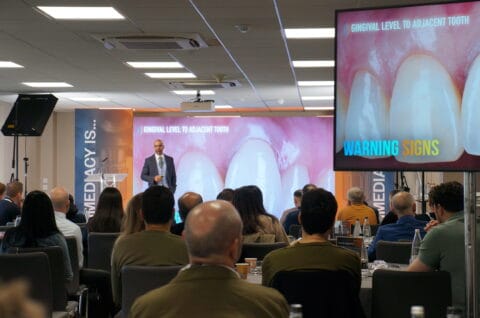
 Under the theme “Immediacy Is…” the BioHorizons Camlog UK & Ireland Symposium focussed on immediate implant protocols and how they can help to deliver faster, more predictable outcomes for patients. Across two days at the De Vere Beaumont Estate in Windsor, the programme, led by experts in dental implantology, guided attendees through the immediacy journey, drawing on the latest research and years of clinical experience. All proceeds from the Symposium were donated to an important charitable cause – Naomi House & Jacksplace and awareness was raised about Dentists’ Health Support Trust (DHST) with all attendees too.
Setting the tone
Prof Dr Katja Nelson set the tone for the symposium, describing the application and rationale behind immediate implant protocols, with insights into the 2025 Consensus Report on the Clinical Recommendations for Immediacy in Implant Dentistry. She discussed the value of immediate loading, as well as the importance of an intact buccal bone, jump gap filling, and ideal implant positioning for a high success rate. She also touched on the benefits of a digital workflow, and highlighted that only 22% of clinicians currently have capacity to offer this, with even fewer using it as standard. What followed was a programme packed with inspiring cases, relevant discussion, and forward-thinking debate from Dr Gonzalo Blasi, Dr Nik Vourakis, Dr Nick Fahey, Dr Paul Swanson, Dr Viraj Patel, Dr Jamie Kerr, Dr Imran Nasser, Dr Ramón Gómez Meda, and Dr Alex Payne.
Digital workflow
What defines success in implant dentistry, as opposed to merely survival? This was debated widely, with speakers exploring the various parameters that clinicians should measure and monitor to ascertain the success of the final outcome. The benefits associated with using digital workflows was made clear, with digital planning and guided surgery, leading to optimal placement, whilst also enhancing patient communication and safety.
Delegate Dr Katy Sharpe, from Dental Smiles, commented: “It has been really nice to focus on immediacy, and the programme has been really well thought out, including helpful information about the risk factors associated with the approach. The main takeaways for me have been the information about achieving primary stability and the jump gap. As a beginner in implantology, I now have a to-do list to take back to the practice. It’s really nice that BioHorizons and Camlog have put on this event for its customers.”
Biological parameters
Management of biological parameters is essential for the provision of immediate implants. The speakers discussed the various factors taken into consideration when planning treatment, including conversations around primary stability, and achieving secondary stability, whilst acknowledging that high torque doesn’t always equal stability, and emphasising the importance of preventing micromovement during healing. Soft tissue preservation was also discussed, and the value of augmentation to achieve a sufficient buccal wall thickness. Finally, the identification and management of patient biological factors were considered, including diabetes, vitamin D deficiency, stress, cholesterol, and allergy, to help minimise risk factors.
Immediate implants in the aesthetic zone
The aesthetic zone can present a number of challenges when providing dental implants, the speakers provided helpful tips for clinicians to improve their outcomes. Immediacy was positioned as the preferred protocol, with ridge preservation and delayed placement a ‘back-up’. Additionally, guided surgery was recommended to ensure accurate 3D implant positioning and enhance efficiency. Further to this, speakers explored cutting-edge research into the biomechanics of implant-abutment connections and the impact of microgaps for long term outcomes, as well as the importance of managing patients’ expectations in the age of social media and Chat GPT.
Attendee Dr Prashant Amin, from Revital Dental Care, said: “I have found the symposium really interesting, and have learnt a lot that I can take back to the practice, especially when it comes to protocols for immediate implant treatments.”
Immediacy in full-arch procedures
The provision of FP1, FP2, or FP3 full-arch solutions are sometimes necessary in cases where much of the dentition has a hopeless prognosis. The speakers showed how digital planning and AI simulations assist with design and achieving patient consent, with a fully guided surgical and prosthetic workflow recommended in these cases. Other non-negotiables discussed included: avoiding acutely infected sites, achieving good primary stability, good AP spread, more than 2mm of buccal bone, sufficient keratinised tissue, and justifying clearance. The importance of high-quality, cleansable provisional restorations was also emphasised to achieve optimal soft tissue architecture and set patient expectations, which should be left in place for many months to allow the soft tissue to heal and achieve optimal volume.
Dr Devon Williams, from Saint Michael’s Dental Practice, commented: “This was my first time attending the BioHorizons and Camlog Symposium and I have really enjoyed it. I feel that I have learnt a lot about the management of soft tissue, and it has been very helpful to see examples from the speakers.”
For product information or further education from BioHorizons and Camlog, please visit https://theimplanthub.com/