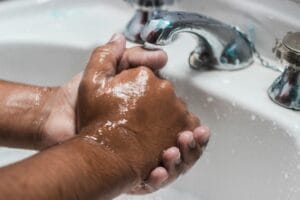
Handwashing should be second nature – but this may not always be the case. A 2025 study found that, in hospitals, nearly 45% of bathroom users failed to carry out hand hygiene, with non-compliance peaking at 61.8% in some weeks.[i] This shows that for both patient or healthcare practitioner, reminders are needed to keep hands clean.
Since the early 19th century, handwashing has been one of the most important practices to reduce infection transmission in healthcare settings.[ii] For dental professionals, the exposure to bodily fluids like saliva and blood carries a risk of infection. Knowing the how and why of hand hygiene helps reduce this risk.
Some skin in the game
Understanding how infections are transmitted through the hands reinforces why handwashing is necessary, and what it stops. There are multiple layers of skin that cover the hands: the epidermis, dermis and hypodermis. Together, they act as a barrier against pathogens, ultraviolet light (UV), chemicals and mechanical injury, whilst also regulating body temperature.[iii]
Healthy skin is colonised with resident flora; microorganisms that inhabit the epidermis and skin surface. These naturally attack microbes, such as those acquired through direct and close contact with dental patients, contaminated objects or environmental surfaces.ii However, the body’s indigenous microbiota cannot protect the skin alone – handwashing and/or hand disinfection is a more reliable way to prevent infection transmission – but it must be effective.
There are five sequential steps for the transmission of health-care associated pathogens from one patient to another via a dental practitioner’s hands. First, organisms are present on the patient’s skin (or have been shed onto nearby objects and surfaces). These are then transferred to the dental practitioner’s hands. From there, the organisms must survive for several minutes, overcoming the epidermis’ defensive mechanisms. The crucial stage is incorrect hand hygiene – failing to eliminate the pathogenic organisms keeps the hands contaminated. Finally, when the practitioner interacts with a new patient, these lead to cross-transmission.[iv] The first two steps are often unavoidable; hand hygiene is where the chain of transmission must be broken.
Getting to grips with the basics
The indications for handwashing are well known: when the hands are visibly soiled / contaminated with blood or other bodily fluids, before eating, and after bathroom use. For the dental team, there are many more instances where immediate handwashing is required, including:
- Before touching or coming into contact with a patient
- Before performing a clean or aseptic procedure
- After an exposure risk to bodily fluids
- After glove removal
- After touching an inanimate object in the patient’s immediate surroundings, even if no direct patient contactii
As such, handwashing is a frequent part of the daily workflow. In cases where the hands are visibly contaminated, a proper clean under running water is imperative. However, wearing gloves should stop this from being a regular occurrence. For the most part, hand cleansers may be more commonly used to protect the hands – they are quick to use anywhere and at any time.
Necessary evils
Whilst frequent hand hygiene protocols keep both practitioners and patients safer, there are side-effects. Consistently washing hands dries out the skin, as does the regular application of alcohol-based disinfectants, resulting in flaky hands that may also feel sensitive to touch.[v] This is contact dermatitis, an occupational hazard that can also increase the risk of picking up and transmitting microbes.[vi]
Members of the dental team may also have an eczema breakout, especially if using new hand hygiene products. Here, the chemicals worsen the symptoms, such as itchiness and discolouration, limiting what dental practitioners are able to do and interrupting the daily workflow.vi To reduce the side effects of frequent hand hygiene, dental practices must find solutions that can eliminate microbes whilst keeping the hands moisturised.
Reduce side-effects
DentiWash is a first-class hand cleanser from Dentisan. HTM 01-05 compliant,[vii] it is a cornerstone of the daily workflow because of its effective cleansing action. DentiWash contains skin conditioner and emollient, preventing dry skin and instead soothing, hydrating and protecting the hands from infection. This supports frequent use without causing irritation, ensuring both dental practitioners and patients are at a reduced risk of infection.
Hand hygiene should never be overlooked and must be second-nature to dental practitioners. With a firm understanding of why handwashing is important and when it must be done, the whole dental team can feel empowered in their daily responsibilities knowing that they and their patients are safe.

For more information about Dentisan, please visit https://dentisan.co.uk/
Book your in-practice CPD by emailing your request to the expert in your area:
For the Midlands, North Wales & North of England, contact Jenny: jenny.nixon@getinge.com
For the South of England, Wales & Channel Islands, contact Anne: anne.harris@getinge.com
For Scotland, Ireland & Northern Ireland, contact Holly: holly.dickinson@getinge.com
 Author: Jenny Nixon – Business Development Dentisan
[i] Surrey.ac.uk. (2025). Nearly 45% of hospital toilet users fail to wash their hands, study finds | University of Surrey. [online] Available at: https://www.surrey.ac.uk/news/nearly-45-hospital-toilet-users-fail-wash-their-hands-study-finds.
[ii] Toney-Butler, T.J., Carver, N. and Gasner, A. (2023). Hand hygiene. [online] National Library of Medicine. Available at: https://www.ncbi.nlm.nih.gov/books/NBK470254/.
[iii] Yousef, H., Alhajj, M. and Sharma, S. (2024). Anatomy, Skin (Integument), Epidermis. [online] PubMed. Available at: https://www.ncbi.nlm.nih.gov/books/NBK470464/.
[iv] World Health Organization (2009). Transmission of pathogens by hands. [online] Nih.gov. Available at: https://www.ncbi.nlm.nih.gov/books/NBK144014/.
[v] Makhakhe, L. (2023). The flip side of frequent sanitising and hand washing. South African Family Practice, 65(1). doi:https://doi.org/10.4102/safp.v65i1.5595.
[vi] Watson, K. (2021). Side Effects of Hand Sanitizer, Risks, and How to Use It Safely. [online] Healthline. Available at: https://www.healthline.com/health/side-effects-of-hand-sanitizer#side-effects-of-hand-sanitizer.
[vii] Department of Health (2013). Decontamination Health Technical Memorandum 01-05: Decontamination in Primary Care Dental Practices 2 0 1 3 E D I T I O N. [online] Available at: https://www.england.nhs.uk/wp-content/uploads/2021/05/HTM_01-05_2013.pdf.