

Crown restorations have long held a pivotal role in restorative dentistry, with their ability to balance long-term function and aesthetics remarkably. Whilst their purpose has remained broadly the same over the years, the materials and technique have each evolved to match the changing patient expectations, gradually digitalising workflows, and advances in material science. Understanding the history and evolution behind these materials supports better treatment and understanding of the current landscape dental professionals now work within – continuously adapting to the new and ever-changing demands.
Early restorative approaches
Around 180AD, the American Dental Association states that the Etruscans were practicing dental prosthetics with the use of gold crowns and fixed bridgework – specifically for the aesthetic purpose of demonstrating wealth.[i] However, over the years they have been repurposed to deliver results that offer functionality as well as aesthetic that matches that of more natural dentition rather than for ostentatious purposes.
Much of the 20th century saw crown material selection navigated almost solely by durability and marginal integrity.[ii] Metal-based crowns – particularly those designed with gold alloys – were notably understood as the representation of long-term success.[iii] This was particularly due to their ability to withstand occlusal force and resist fracture – making them reliable restorations, especially in posterior regions.
Clinically speaking, the materials used in this era offered exceptional performance – with survival rates exceeding anything seen before from other restorative materials proposed or used at the time. However, as dentistry and both patient awareness and expectations evolved, the aesthetic limitations of full-metal crowns proved an issue – with patient preference requiring restorations that integrated more seamlessly with natural dentition.
The aesthetic compromise
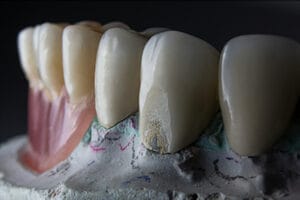
The late 1800s saw a major improvement in dental crowns as Dr. Charles H. Land patented the porcelain ‘jacket’ crown – allowing a visibly broken tooth to appear whole and fixed.[iv] However, it became apparent that it was vulnerable to microscopic cracking – impacting the tooth and surrounding gingiva. By the late 1960s and into the 1970s, porcelain-fused-to-metal (PFM) crowns emerged, offering a solution to both the functional and aesthetic requirements of crowns.[v] Despite the advancement, limitations were still rife, presenting issues such as opaque margins,[vi] limited light transmission,[vii] and the risk of porcelain chipping.[viii] Over time, gingival recession exposes underlying metal margins – compromising the aesthetic intention entirely.
The expansion of all-ceramic solutions
Approaching the early 2000s, developments supported the wider use of all-ceramic crown materials. Improved processing techniques and the introduction of materials such as zirconia – which afforded excellent durability, aesthetic appeal, and long-term stability – expanded clinical indications, allowing clinicians to more closely replicate the translucency and depth of natural enamel restoratively.[ix]
Although these materials offered clear aesthetic advantages – improving patient satisfaction – they introduced further dependencies. Due to the intense fabrication, they relied more heavily on laboratory workflows which limited flexibility within practice and increased turnaround times. The compromise of more improved clinical outcomes was workflow efficiency – particularly in cases where same-day solutions were desirable.
Digital dentistry
Over the past decade, digital dentistry has augmented the reshaping of crown fabrication further. With AI design and intraoral scanning, clinicians are now able to produce crowns in-house – minimising turnaround time and enhancing patient satisfaction insurmountably.
Though chairside restorations excel efficiency and convenience, an increased demand for the right materials became apparent. Not only did the crown materials need to offer the same level of aesthetics and durability that patients expected, but they now needed to perform predictably well, under time constraints.
Persistent limitations and compromise
Despite significant progress in every era of crown advancements, each stage has involved compromise. Clinicians have constantly had to essentially been required to balance strength against aesthetics, speed against durability, or efficiency against predictability – each of which should ideally not be compromised at all. Material choice has often led this decision, dictating workflows rather than being designed to support them.
Recent years prove that material development can meet the competitive demands more easily – establishing high translucency materials that both look like and perform like natural dentition – whilst offering compatibility with efficient workflows.
Next-level crown materials and workflows
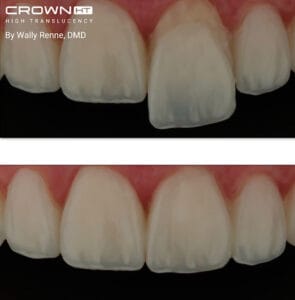
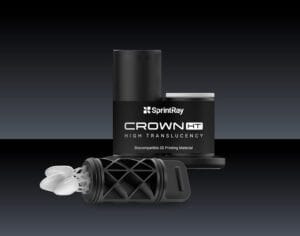
Leading the way in innovative crown material is SprintRay. Their Crown HT is a high-translucency resin with >60% ceramic – delivering remarkable and excellent aesthetics. Delivering lifelike light diffusion that replicates natural teeth, the Crown HT is ideal for fabricating definitive crowns and minimally invasive restorations including inlays, onlays, and veneers. Mirroring the functional performance of surrounding dentition, the Crown HT guarantees long-lasing, durable restorations – without compromising aesthetics.
The future of crown restorations
The evolution of dental crown materials represents the field’s continuous endeavour for balance – between durability, functionality, and aesthetics. Digital technologies, clinical understanding, and revolutionising materials each play a role in uncompromised developments – allowing clinicians to deliver excellent restorations that adhere to the modern expectations of patients, without hidden complexities.

For more information on the SprintRay 3D printing solutions changing the game in dentistry, please visit https://sprintray.com/en-uk/
 Author: Ross Phillips – SprintRay Area Manager UK & Nordics
[i] Cowell Dental (2024) Historic repairs: the evolution of dental crowns. Available at: https://www.cowelldental.com/blog/2024/09/22/historic-repairs-the-evolution-of-dental-crowns/
(Accessed: 24 December 2025).
[ii] Rehm, P., Derks, H., Lesaar, W. et al. Restoration of 1325 teeth with partial-coverage crowns manufactured from high noble metal alloys: a retrospective case series 18.8 years after prosthetic delivery. Clin Oral Invest 26, 849–861 (2022). https://doi.org/10.1007/s00784-021-04063-8
[iii] Wigmores Smiles (2025) 10 Dental Crown Materials Compared: Pros, Cons & UK Costs, available at: https://www.wigmoresmiles.co.uk/post/dental-crown-materials
(Accessed: 24 December 2025).
[iv] Helvey, G.A., 2013. Classification of dental ceramics. Inside Dent, 13, pp.62-76.
[v] Durr-E-Sadaf, ., Ahmad, Z. (2011). Porcelain fused to metal (PFM) crowns and caries in adjacent teeth. Journal of the College of Physicians and Surgeons Pakistan, 21(3), 134-7. Available at: http://ecommons.aku.edu/pakistan_fhs_mc_surg_dent_oral_maxillofac/11
[vi] Dental Crown Studio (2025) PFM crowns: porcelain‑fused‑to‑metal pros & cons. Available at:https://dentalcrownstudio.com/dental-crown-terms/pfm-porcelain-fused-to-metal
(Accessed: 24 December 2025)
[vii] Denpedia (2025) PFM crowns: porcelain fused to metal. Available at: https://denpedia.com/pfm-crowns-porcelain-fused-to-metal/ (Accessed: 24 December 2025)
[viii] Journal of Contemporary Clinical Practice (JCCP) (2025) Comparison of different crowns in maxillary posterior rehabilitation: a comparative study. Available at: https://www.jccpractice.com/article/comparison-of-different-crowns-in-maxillary-posterior-rehabilitation-a-comparative-study-256/
[ix] Almajed, O. S. (2024). Shaping smiles: A narrative review of crown advancements in pediatric dentistry. Cureus, 16(1).