


During this year’s BDIA Dental Showcase, the atmosphere shifted perceptibly as British interior designer and entrepreneur Kelly Hoppen CBE took to the Main Stage. Known for her understated luxury and instinctive approach to spatial harmony and signature style of neutral palettes, Kelly brought an unexpected yet compelling perspective to dentistry – one rooted in emotion, experience and meaningful design.
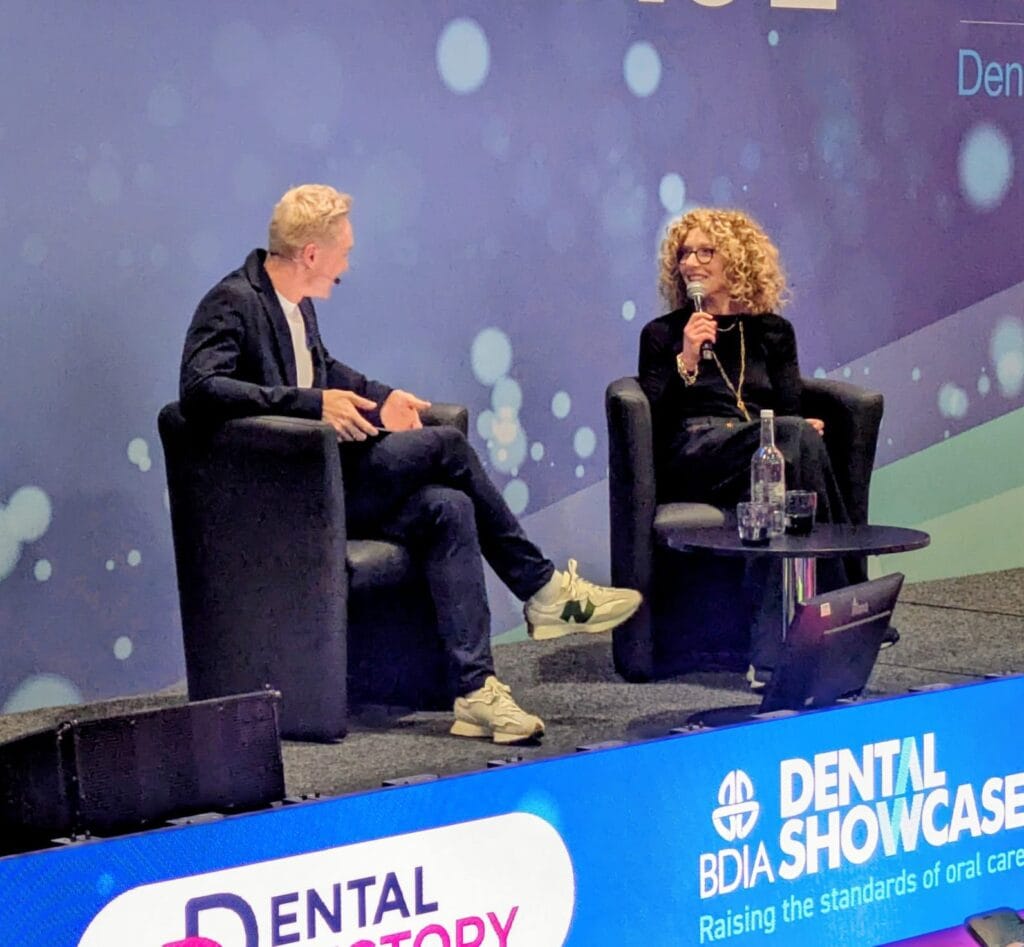
Sponsored by Dental Directory, the live on-stage interview felt like an intimate and honest conversation about brand identity, beauty and transformation. She began disarmingly, speaking, ironically, of her own dental anxiety. It was a candid admission that immediately reframed the discussion: if someone so synonymous with calm, curated environments feels unease in the dental chair, what hope is there for the average patient?
Her answer, of course, lies in design.
Spaces, she argued, have the power to soothe or to unsettle. In dentistry, where clinical requirements often limit material choices, creativity becomes even more vital. Natural materials, which she uses in the resorts and A-list homes she designs, are often impractical for dentistry, but convincingly textured alternatives can evoke the same warmth. Colour palettes, too, play a crucial role – soft neutrals, layered tones and tactile finishes can transform a sterile room into something far more inviting. “Small changes,” she noted, “can have a big impact,” a mantra that seemed to resonate across the room.
This philosophy feeds into what Kelly described as the “wellness of dentistry” – a holistic approach that considers, beyond treatment outcomes, the patient’s emotional journey. The waiting room, she insisted, should be no different from a VIP lounge. It is the first impression, the prelude to the experience, and too often it is neglected.
With trademark wit, she recalled a moment on ITV’s This Morning when she remarked that a home resembled a dentist’s waiting room – furniture lined stiffly against the walls, devoid of intimacy or flow. The audience laughed, but her point was precise: why do we accept such uninspired layouts in spaces where comfort is most needed? Arrangement, she suggested, is as important as aesthetics. Bringing furniture inward, creating conversational clusters, and softening lines can fundamentally change how a space feels.
Branding, too, emerged as a central theme. A strong logo and cohesive design scheme are essential tools in shaping perception. A luxury dental practice, for example, must tell a story. It must feel considered. Yet this must be balanced carefully with the demands of clinical excellence. The most beautiful space, Kelly warned, is meaningless if it compromises functionality or fails to integrate leading equipment seamlessly. The art lies in harmony – where cutting-edge technology coexists effortlessly with refined design. Working with experts in the field often affords the greatest chance of success. In dentistry, Dental Directory is always on hand to provide bespoke advice on practice design, equipment selection and maintenance, and so much more.
Kelly’s discussion of sensory design was particularly evocative. Sight, touch and sound all play their part, but smell, she suggested, is often overlooked. With a mischievous smile, she admitted she would prefer the scent of chocolate to distract her from the experience – “though perhaps not practical,” she added, to laughter. Still, the underlying message was clear: engage the senses thoughtfully, and you form a personal perception.
Lighting, too, was elevated from afterthought to centrepiece. Kelly spoke of circadian lighting – systems that mimic natural daylight rhythms – to support both patient comfort and staff wellbeing.
What made the session particularly compelling was Kelly’s openness about imperfection. “People think I have never made mistakes,” she said, almost incredulous. But mistakes, she argued, are intrinsic to growth. They refine sharpen judgement and ultimately lead to better outcomes. It was a refreshing counterpoint to the polished images often associated with her work.
In a moment that cut through the conversation with quiet force, Kelly was asked to reflect on her experience as a woman in business, and she answered with characteristic pragmatism. “I ignored the fact I was a woman,” she said, recalling her early years on building sites from the age of 14 – environments traditionally dominated by men, where credibility had to be earned rather than assumed. It was not a declaration of defiance so much as a statement of focus: her work, her vision and her standards were always the priority. Yet beneath the simplicity of that approach lies something more profound – a refusal to be defined by expectation.
Kelly’s career, built on instinct and resilience, speaks to a broader shift in the narrative around women in business: to command presence effortlessly, through consistency, talent, and an unwavering sense of self.
Perhaps the most resonant part of her talk was about people. Kelly spoke warmly of her team, emphasising their importance to her success. Despite her global profile, she still considers her business a small one. “We eat lunch together,” she said simply. The message was unmistakable: care for your staff, and they will care for your clients/patients.
As the session ended, it was clear that Kelly had done more than discuss design on a surface level. She had challenged an industry to rethink its spaces – as both clinical settings as environments capable of comfort, beauty and even a touch of indulgence.

For more information on the products and maintenance services available from Dental Directory, please visit ddgroup.com or call 0800 585 586