

In modern restorative dentistry, an increasingly common aesthetic concern for patients involves staining – particularly in restorations. The subtleties associated with staining can affect both the confidence and smile satisfaction of a patient, whilst also impacting surrounding dentition over time. Compared to functional complications or recurring decay that require more invasive treatment, the management of staining can be simpler.
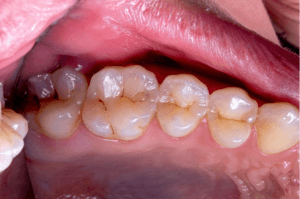
However, successfully managing staining requires a comprehensive understanding of patient factors, as well as the meticulous consideration of materials used to restore aesthetics. The material properties, maintenance protocols involved, and finishing techniques chosen each contribute to the effectiveness of stain management – addressing the visual outlook of the results without compromising structural or functional integrity.
Clinicians should understand that different patient behaviours, dietary and lifestyle habits, and oral hygiene each contribute to discolouration over time, which makes proactive treatment vital.[i]
Understanding staining
Firstly, it’s important to distinguish between extrinsic discolouration[ii] – which relates to staining of surfaces due to rough texture or micro-texture – and deeper, more complex intrinsic staining – that is more difficult to resolve.[iii] Intrinsic staining in restorations specifically happens within the restorative material and can be caused by material composition,[iv] incomplete polymerisation,[v] ageing, trauma,[vi] or chemical changes over time.[vii]
Some common extrinsic stains result from the regular consumption of coffee, tea, red wine, tobacco, and other dark foods.[viii] The level of deposit adherence correlates significantly with the smoothness of the surface. For example, with restorations, the more polished and less rough the surface is, the less likely that rapid discolouration will occur compared to those with rougher finishes. Small irregularities on the tooth or restoration – particularly at margins or between enamel and material – can trap pigments, negatively affecting the aesthetics and reducing patient satisfaction.[ix]
Practical technique adaptations
To minimise the risk of stainingboth the surface material and finishing technique the clinician uses are important.[x] Dental professionals can adapt treatments, prioritising polishing methods and protocols that inherently reduce the coarseness of surfaces, with minimal adaptations to instrument choice and use. This might include adaptations in pressure or technique – significantly altering the quality of the surface finish.
Another important factor is to use appropriate abrasives and polishing pastes to achieve a high-gloss finish that will help to resist staining. Chromogens inherently harbour in grooves and dents, meaning that great attention to marginal transitions and between spaces is essential.[xi] The regular attendance of professional dental hygiene appointments can assist in managing the deposits of chromogens before they penetrate and begin to stain the micro-textured surface.
An additional and often understated factor of long-term success is patient education. This involves updating knowledge of brushing techniques and oral hygiene habits, advising on dietary chromogens, and recommending a non-abrasive toothpaste – each of which are invaluable for the maintenance of colour stability for patients.[xii] Furthermore, the implementation of these strategies allows the delivery of durable outcomes with long-lasting aesthetic satisfaction for patients.
Material selection for the best colour stability
The material selection has a huge influence on the management of extrinsic staining. When deciding on a composite material, the following considerations must be in place: filler size differences, water sorption,[xiii] and monomer composition – which each impact the colour pigment uptake over time.
For example, lower water sorption allows materials to resist stain penetration whilst also preserving the life of the colour – particularly for patients that consume high staining substances.[xiv] Choice of material does not, however, solely affect the aesthetic outcome, with different composite materials influencing both the appearance and longevity of restorations.
The best materials for the job
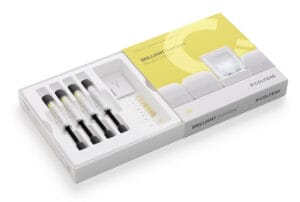
For clinicians seeking a restorative material that balances clinical efficiency, long-term aesthetics, and durability, the BRILLIANT EverGlow from COLTENE offers absolute excellence. The universal submicron hybrid offers convenient sculptability and form stability, a long-lasting high lustre, and excellent polishability. The advanced shade system permits three translucency levels and enhanced Duo Shades that deliver a flexible use for single-shade and multi-shade layered restorations.
Delivering durable aesthetics
Prevention of staining on restorations requires a comprehensive approach that includes a deep understanding of the patient – including habits and requirements – the judicious selection of materials, professional finishing, and regular maintenance.
The assurance of highly polished, smooth surfaces can reduce early chromogen adherence, and choosing materials that resist staining altogether afford long-term colour stability too. Integrating strategies and ensuring a comprehensive approach in treatment can deliver durable, reliable, and aesthetically-pleasing restorations, allowing patient satisfaction and confidence to soar.

For more on COLTENE, https://coltene.dental/clinician-special/brilliant-everglow/ email info.uk@coltene.com or call 0800 254 5115.
 Author: Vik Sharma Sales Director Coltene Group
[i] Faris, T.M., Abdulrahim, R.H., Mahmood, M.A. et al. In vitro evaluation of dental color stability using various aesthetic restorative materials after immersion in different drinks. BMC Oral Health 23, 49 (2023). https://doi.org/10.1186/s12903-023-02719-3
[ii] Prathap, S., Rajesh, H., Boloor, V. A., & Rao, A. S. (2013). Extrinsic stains and management: A new insight. J Acad Indus Res, 1(8), 435-42.
[iii] Kapadia, Y., & Jain, V. (2018). Tooth staining: A review of etiology and treatment modalities. Acta Sci Dent Sci, 2(6), 67-70.
[iv] Al-Dulaijan, Y. A., AlGhamdi, M. A., Azmy, E., Al-Kholy, M. R. Z., Almulhim, K. S., & Helal, M. A. (2023). Color Stability of Nanoparticles-Modified Dental Resin-Based Composites. Applied Sciences, 13(6), 3870. https://doi.org/10.3390/app13063870
[v] Abuljadayel, R., Mushayt, A., Al Mutairi, T., & Sajini, S. (2023). Evaluation of bioactive restorative materials’ color stability: effect of immersion media and thermocycling. Cureus, 15(8), e43038.
[vi] Aakash K., Jayakarthik S. S., Mathumala Subramanian, Arunachalam M., & Sathish Kumar M. (2025). Extrinsic And Intrinsic Staining In Dentistry: Mechanisms, Clinical Implications, And Management Strategies. International Journal of Creative Research Thoughts (IJCRT), 13(1), e843–e851. Retrieved from https://www.ijcrt.org/papers/IJCRT2501548.pdf
[vii] Cinelli, F., Scaminaci Russo, D., Nieri, M., & Giachetti, L. (2022). Stain Susceptibility of Composite Resins: Pigment Penetration Analysis. Materials, 15(14), 4874. https://doi.org/10.3390/ma15144874
[viii] Yakubova, I. I., Ostrianko, V., Skrypnyk, Y., & Volovodovskiy, R. (2025). Extrinsic black staining of teeth: a review. Wiad. Lek, 78, 210-215.
[ix] Alvarenga ACF, Kantovitz KR, Turssi CP, Basting RT, Vieira-Junior WF, França FM. Effect of finishing and polishing systems on surface roughness and color stability of aesthetic restorations exposed to staining solution. Acta Odontol Latinoam. 2024 Sep 30;37(2):162-171. doi: 10.54589/aol.37/2/162. PMID: 39484779; PMCID: PMC11589999.
[x] Marufu C, Kisumbi BK, Osiro OA, Otieno FO. Effect of finishing protocols and staining solutions on color stability of dental resin composites. Clin Exp Dent Res. 2022 Apr;8(2):561-570. doi: 10.1002/cre2.555. Epub 2022 Mar 29. PMID: 35349747; PMCID: PMC9033545.
[xi] Erturk-Avunduk, A.T., Atılan-Yavuz, S., Filiz, H. et al. A comparative study of polishing systems on optical properties and surface roughness of additively manufactured and conventional resin based composites. Sci Rep 14, 25658 (2024). https://doi.org/10.1038/s41598-024-77449-9
[xii] Watts, A., Addy, M. Tooth discolouration and staining: a review of the literature. Br Dent J 190, 309–316 (2001). https://doi.org/10.1038/sj.bdj.4800959
[xiii] Khoroushi M, Shirban F, Kaveh S, Doustfateme S. Effect of three nanobiomaterials on microhardness of bleached enamel. Restor Dent Endod. 2016 Aug;41(3):196-201. doi: 10.5395/rde.2016.41.3.196. Epub 2016 Jul 14. PMID: 27508161; PMCID: PMC4977350.
[xiv] Khoroushi M, Shirban F, Kaveh S, Doustfateme S. Effect of three nanobiomaterials on microhardness of bleached enamel. Restor Dent Endod. 2016 Aug;41(3):196-201. doi: 10.5395/rde.2016.41.3.196. Epub 2016 Jul 14. PMID: 27508161; PMCID: PMC4977350.