

The denture try-in appointment is a collaborative effort between patient, clinician and laboratory team to ensure a prospective dental restoration has been ideally crafted. It is a great opportunity for a patient to understand what their new smile will look like, and importantly, it gives all parties the chance to identify any problems.
Often, this appointment will be shared between the patient and the practice team. Any feedback, or the go-ahead for final prosthesis creation, will be passed onto the dental technician after the appointment. This doesn’t take away the value that they offer; despite not being there in person, their actions taken before and after the try-in appointment will dramatically affect the final outcome.
To understand how dental technicians can best support clinical teams, it’s important to identify how a try-in denture can be optimised, and recognise the potential for effective interventions.
Affecting shade and shape
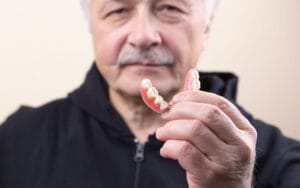
One of the most prominent features of any smile, and a key aspect of any denture, is the teeth.
Studies show that dentists tend to place a greater emphasis on teeth than lips when evaluating a smile alone, but when looking at their interaction with the face as a whole, the impact of the teeth diminishes.[i] During the try-in denture appointment, however, one can expect that both patient and professional will be looking closely at the teeth before all else.
Long before the creation of the preliminary try-in dentures, dental technicians should have a complete understanding of what patients are looking for in their new restoration, and this includes aspects such as tooth shape and shade.
Patients have been shown to judge smile aesthetics, perhaps unconsciously, based on factors such as the width of visible teeth and irregular shaping of the central incisors.[ii] An ideal maxillary central incisor should be approximately 80% in width compared with its height, but the literature notes a possible variability between 66% and 80%.[ii]
Tooth shade will also play a key role in overall aesthetics. It is the most common smile component to cause dissatisfaction.[iii] A brighter tooth shade is generally perceived as more attractive,[iv] and clinicians must communicate exactly which shade is preferred. For some, a bright Hollywood smile may be the ideal, whereas others prefer a more natural appearance. If patients have previously had dentures that they liked the appearance of, it may be preferable to simply replicate these.
The best fit
The try-in appointment is not used to simply judge aesthetics. Instead, the dental team needs to assess the fit, support and function of the provisional denture. Its placement will have an impact on the support of the lip, with aesthetic implications; the buccal corridors; and patient speech, though complete adaption in this latter aspect may not always be achieved in the try-in appointment.[v]
It is the dental technician’s responsibility to craft a provisional prosthesis for the newly designed dentition that meets all requirements. The literature cites common mistakes such as thickened labial flanges, which often create a bulge of the upper lip just under the nose.[v] This then creates an unwanted thin-lipped appearance.[v] Instead, most upper lips on natural teeth have a concave appearance, and so a thin labial border is preferred. In the mandible, a thickened labial flange may not push out the lower lip, but instead affect the denture position when speaking or at rest.[v]
The dental technician should use all available impressions and images to help create an optimal fit, and be prepared to make any adjustments – no matter how slight – after the try-in appointment.
Replicating the gingiva
An effective wax will aid in the creation of the gingival structure whilst retaining its shape when the denture is placed intraorally. One shouldn’t dismiss the importance of aesthetics here. Whilst patients will anticipate the appearance of the teeth, a denture requires a lifelike appearance of the periodontal structure for a truly effective outcome.
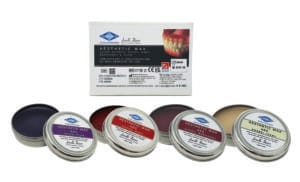
The Aesthetic Wax Kit from Kemdent, designed in collaboration with award-winning dental technician Jenelle Rocco, helps dental technicians create leading wax try-in dentures. With four colours – Ivory, Ruby, Burgundy, and Plum – technicians can replicate life-life gums with care and improve the patient experience. For high-quality materials that help professionals devise the ultimate restoration, contact the Kemdent team today.
As the treatment plan approaches its close, the wax try-in appointment is a key step to finalising an outstanding denture restoration. The dental technician plays an important role, even if they are not in the room for the appointment, and can put the finishing touches on a successful result.
For more information about the leading solutions available from Kemdent, please visit www.kemdent.co.uk or call 01793 770 256
 Author: Alistair Mayoh Marketing Director Kemdent
[i] Chan, M. Y. S., Mehta, S. B., & Banerji, S. (2017). An evaluation of the influence of teeth and the labial soft tissues on the perceived aesthetics of a smile. British dental journal, 223(4), 272-278.
[ii] Parrini, S., Rossini, G., Castroflorio, T., Fortini, A., Deregibus, A., & Debernardi, C. (2016). Laypeople’s perceptions of frontal smile esthetics: a systematic review. American Journal of Orthodontics and Dentofacial Orthopedics, 150(5), 740-750.
[iii] Afroz, S., Rathi, S., Rajput, G., & Rahman, S. A. (2013). Dental esthetics and its impact on psycho-social well-being and dental self confidence: a campus based survey of north Indian university students. The Journal of Indian Prosthodontic Society, 13(4), 455-460.
[iv] Di Murro, B., Gallusi, G., Nardi, R., Libonati, A., Angotti, V., & Campanella, V. (2020). The relationship of tooth shade and skin tone and its influence on the smile attractiveness. Journal of Esthetic and Restorative Dentistry, 32(1), 57-63.
[v] Besford, J. N., & Sutton, A. F. (2018). Aesthetic possibilities in removable prosthodontics. Part 2: start with the face not the teeth when rehearsing lip support and tooth positions. British dental journal, 224(3), 141-148.