

 Dr Aisha Ahmed presents a case of alignment, teeth whitening and composite bonding.
A female patient in her 30s presented at the practice as she wanted to enhance her smile. She specifically enquired about composite bonding – the idea being that she did not want all her teeth substantially prepared for veneers. Her preference for a more conservative, approach made her an ideal patient for highly ethical and minimally invasive cosmetic dentistry.
As the patient was new to the practice, a thorough consultation was enacted. The chief complaints from the patient were the uneven and rounded shape of her teeth and their discolouration. She had an anterior crossbite on the left side and an anterior crossbite tendency on the right. A deep bite on the central incisors was noted. Tooth size discrepancy was evident, with small upper laterals and retained lower second primary molars. A thin gingiva biotype and gingival recession in the upper premolars were also observed. Records were saved, including a digital iTero scan and photographs that were taken by my treatment coordinator.
Planning the treatment phases
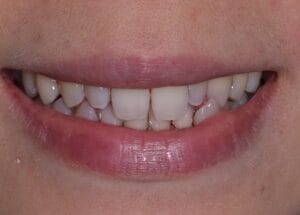
Due to the findings from the initial consultation, the possibility of providing only composite bonding was negated. A comprehensive treatment plan was discussed with the patient. This entailed alignment first, then teeth whitening and finally the composite bonding. A full composite veneer was to be provided on the upper left lateral and edge composite bonding on the upper right 3,2,1 and upper left 1 and 3. The patient was very receptive towards this treatment plan and accepted it for its long-term stability. Doing nothing about her smile was not an option for her; working in a public facing role meant a nice smile was important for her confidence.
The alignment phase of treatment began with thorough planning using the Invisalign system. This would create space to place the direct composite veneer on the upper left lateral. Expansion of the arches was carefully mapped out to avoid worsening the gingival recession. IPR was planned in the lower arch to help manage this. Class 3 elastics were used for anchorage and the lower, well-retained Es were left in place to simplify the treatment.
The total number of aligners was 22 plus eight additional aligners. This was achieved through meticulous planning and excellent patient compliance. Close observation was paid to the gingival recession and it was notable that the recession on UR5 improved following the alignment treatment.
Brighten things up
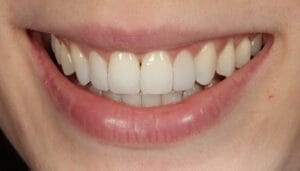
Following the completion of phase one, home whitening was prescribed using 6% hydrogen peroxide and 16% carbamide peroxide. Very little sensitivity was reported by the patient, and she kept it under control by using a desensitising toothpaste. Compliance was continually excellent.
A two-week post-whitening period was given before booking her appointment. Once the desired shade was achieved, she was ready to have her teeth reshaped.. When ready, free hand composite restorations were provided using layers of Empress B1 Dentin, BLL enamel, and Trans Opal shades.
For the retention phase, fixed retainers followed by Vivera retainers was the protocol of choice. The patient has been back for a review of the bonding and retainers, and everything was stable. She was immensely satisfied with the final outcome – since the treatment, she has become a regular patient of ours and brings her family for general dental care too.
The importance of care and communication
Through considerate care in the treatment planning and taking high quality records, the desired outcome was achieved. This approach forms the foundation of a successful consultation and consent process and subsequently improves patient acceptance and compliance with the treatment for a great outcome. Good quality dentistry is important and should run parallel with excellent patient communication and collaboration, both verbal and written, with the help of your team members. With clear and effective communication, dentists can cultivate a positive patient journey, one which will lead to word-of-mouth referrals and practice growth.
For further information and enquiries about the British Academy of Cosmetic Dentistry visit www.bacd.com
Bio: Dr Aisha Ahmed has worked in dentistry for 25 years, operating as a platinum Invisalign provider and holding a Master’s degree in Restorative Cosmetic Dentistry. An active member of the BACD, she runs a boutique cosmetic and facial aesthetics practice in Sale, Chesire, where she mentors young associates. Dr Ahmed can be found on Instagram at smiles.by.dr.aisha.